- Premium Content It takes our newsroom weeks - if not months - to investigate and produce stories for our premium content. You can’t find them anywhere else.
 Vincent Fernando, CFA · · 6 min read
With regulations sharply rising, Ant Group’s Asia investees are more important than ever
Eric Sy co-wrote this article.
Ant Group and China tech as a whole have had a rough two weeks. After regulators halted its US$35 billion initial public offering on November 3, the company now faces an uphill battle as the country’s financial watchdog plans to increase oversight on monopolistic practices in the financial technology space.
This makes it significantly harder for Ant to scale quickly, given that minimum capital requirements may see the company operating more like a traditional bank and less like an asset-light tech player.
Should the proposed regulations pass, Ant may be required to provide at least 30% of funding for loans – a huge jump from its current situation, where only 2% of loans sit on its own balance sheet. Already, analysts are forecasting that additional capital and license requirements may slash Ant’s valuation in half.
These developments highlight the increasing challenges China’s tech giants are facing domestically and underscore the long-term importance of finding growth opportunities overseas.
Critical for growth
Since 2014, Ant has made dozens of international investments, with at least 13 aimed at taking a stake in the region’s e-wallet players. This includes investments in Korea, the Philippines, Vietnam, Thailand, Myanmar, Malaysia, Singapore, India, Pakistan, and Bangladesh, as shown in the graphic below.
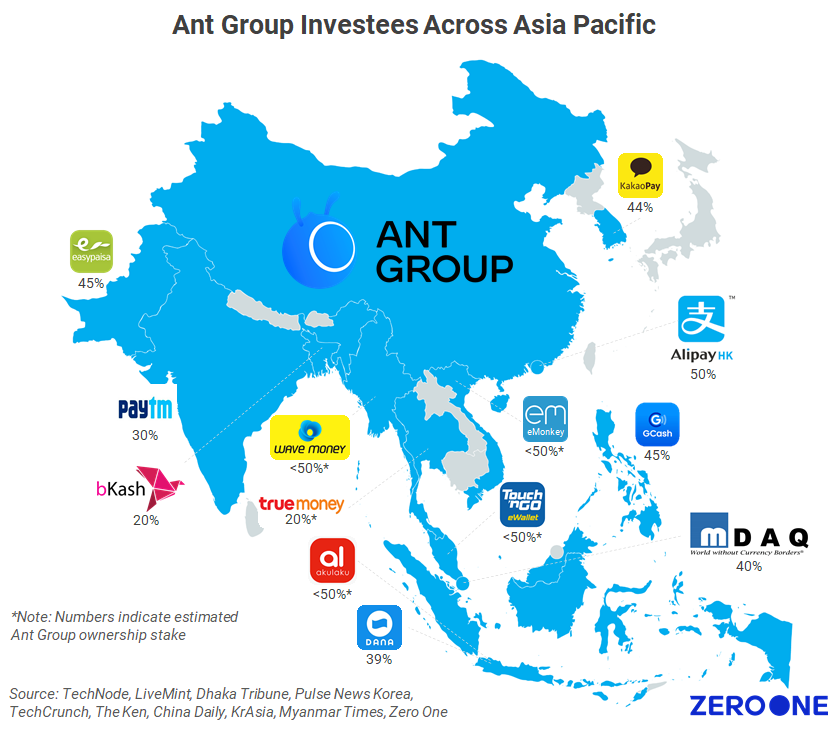
By making these investments, Ant has laid the groundwork to expand its regional presence in markets that are still in the early stages of their fintech development and remain friendly to Chinese business guidance.
More importantly, Ant could provide local e-wallet companies with a playbook, leveraging its own experiences in evolving from a mobile payments app (Alipay) into a full digital bank. That said, Ant seems to have realized that applying its strategies in markets beyond China has been trickier than it expected.
From payments app to digital bank
Ant’s extraordinary business expansion progressed in four distinct phases:
Phase 1: Online escrow solution for ecommerce
Ant Group started as an online escrow solution to solve trust issues for ecommerce transactions. By serving as a payment middleman between buyers and sellers, it facilitated ecommerce adoption and allowed for more seamless transactions.
Phase 2: Mobile payments provider
The solution later evolved into a mobile payment service known as Alipay to enable merchant payments and make peer-to-peer transfers easier. QR codes made this process smoother and more efficient.
At the cusp of evolution
The path ahead
Stay ahead in Asia’s tech landscape
This is premium content. Subscribe to read the full story.
While the fintech firm appears to have reduced its commitment to dominating payments globally, a long-term retreat seems unlikely.
We know this is not ideal. ⌛ Sign up in 20 seconds. Cancel anytime.
Our subscriber community includes professionals from these companies:





Stay updated on the go with our mobile app.
Get latest insights with smoother, more personalized experience through TIA mobile app.












📅 Upcoming Events
22 October 2026
Payoneer x CSPN Summit 2026