 Nadine Freischlad · · 3 min read
Redmart’s big game plan to be the ‘everything store’ in Southeast Asia
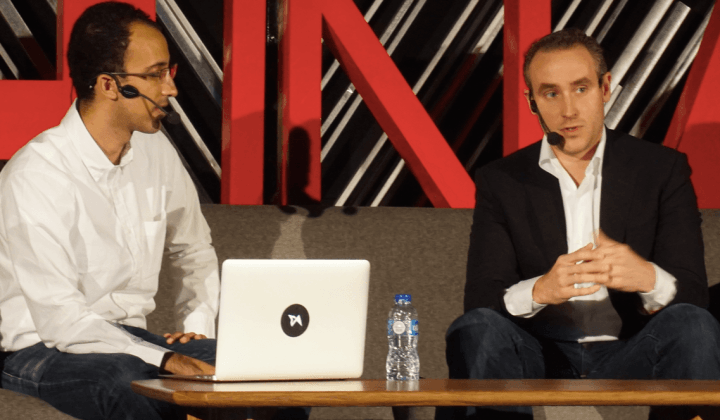
Roger Egan of RedMart on stage with Tech in Asia’s David Corbin at Tech in Asia Jakarta 2015
RedMart, Singapore’s onine groceries delivery service, seems unstoppable. Since it launched in 2012, it’s built up a star-studded line-up of investors, including Facebook co-founder Eduardo Saverin, Skype co-founder Toivo Annus, Softbank Capital, and many others.
The ecommerce company now has close to US$60 million in its coffers, and is set for regional expansion. It employs about 650 people in Singapore.
Tech in Asia has covered RedMart’s development extensively, but couldn’t resist inviting co-founder and CEO Roger Egan to the stage at Tech in Asia Jakarta 2015 to pry more information out of him.
What’s so convincing about RedMart’s model? And what’s next on the company’s plate?
Warehouse and marketplace
Roger likes to explain how RedMart differs from other grocery deliverers. Take Happyfresh for example. RedMart delivers groceries from out of its own warehouses, while Happyfresh partners with existing supermarkets and has shoppers handpick items from the shelves.
The distributed model that strictly partners with supermarkets may be asset lighter in the beginning, Roger says, but on the long run, ownership of the entire customer experience will pay off. “A store can never be as efficient as a fulfillment center,” he explains.
RedMart, in fact, now has a hybrid model. While the bulk of its products are stored and handled in its own warehouses, in July, it expanded to include specialty stores, adding the products of 400 Singapore-based small businesses to its offering.
With this, RedMart was able to increase the number of available products to 30,000. “A regular supermarket has about 10,000 to 12,000 items,” Roger says.
How to work on a rocketship
Roger says that RedMart’s development in the past years has been like being “on board of a rocket ship.”
He says it was extremely important for him to create a good work culture and retain talent. One of his techniques is to give a welcome speech to every incoming cohort of new employees. “Only one engineer left us during this whole time,” he claims. “And he even came back.”
Companies need to be willing to spend on talent, Roger emphasizes. One of the biggest talent catches for RedMart was the hiring of a COO with 12 years of experience of working at Amazon. “I’ve been learning an amazing amount from him,” Roger says. “We’ve grown enough to attract talent like that.”
Expansion plan
RedMart has signalled a while ago that it’s ready for expansion. Roger confirms that the company’s next target is Hong Kong. He wouldn’t mention an exact date for the Hong Kong launch, but said that it could be expected in 2016.
It seems RedMart is in no rush, focusing on owning grocery delivery in Singapore, which in itself is a huge opportunity. “It’s a US$16 billion market. You can build a multi billion dollar company, just for groceries, just in Singapore,” he says.
Nevertheless Hong Kong is on the horizon – “A US$23 billion market for groceries,” according to Roger – and Indonesia might be next. “Indonesia is possible, I think the ten-year story here is bigger than any market in Southeast Asia, but more immediately, Hong Kong is top of the line,” Roger says.
On several occasions during the talk, Roger pointed out that RedMart sees itself as an ecommerce and technology company, bigger than groceries. “We want to be the everything store, the opportunity is much larger,” he said.
And what’s the other everything store? That’s right, Amazon. We wouldn’t be surprised if RedMart moves in the direction of a wider range of ecommerce offerings soon.
When it comes to online grocery delivery startups, do you believe in the strictly distributed model a la Happyfresh or a hybrid model like RedMart’s?
Stay updated on the go with our mobile app.
Get latest insights with smoother, more personalized experience through TIA mobile app.
Recommended reads
 Indonesian AI startup goes global
 Forrest Li on scaling Sea, building smarter bots, and founder grit
 An AI assistant that joins sales calls and scores team skills
 Beyond the check: Why VCs need more than capital
 SGX’s CEO says it doesn’t need a unicorn to win
 SMEs want AI too, but not the kind Big Tech is selling
 Oatside’s alt-milk rise hits a profitable gear
 Alibaba’s financial health in 12 charts
 Asia’s telcos bundle AI into mobile plans. Will it pay off?
 M-Daq chases bigger clients as revenue falls, losses grow





Editing by Malvika Velayanikal and Steven Millward
(And yes, we’re serious about ethics and transparency. More information here.)




