 Annie Teh · · 4 min read
Fintech is struggling in Indonesia, but startups are doing something about it
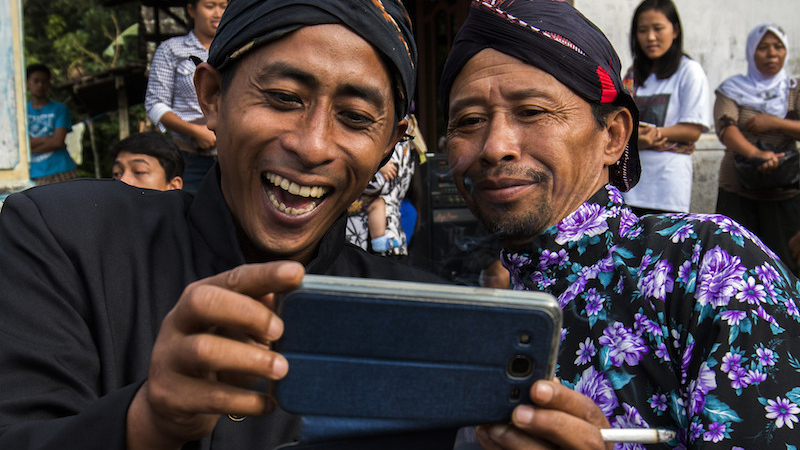
Photo credit: Eko Susanto
Fintech in Indonesia has great potential. With a population of around 255 million and the low cost of smartphones, it has the third largest smartphone market in the region.
Fintech is seen as a tool for financial inclusion, leapfrogging people from credit cards and bank branches of the last decades to smartphone-enabled finance. Banks and telcos in the country have also released their own ewallet options.
But Indonesians are still not adopting fintech. With 50 percent of the population unbanked, 85 percent of the country’s transactions are still cash-based. According to the Wall Street Journal, only 3 percent of Indonesians are aware of the concept of mobile money.
“Right now, [people are] servicing their needs without mobile money,” Financial Inclusion Insights (FII) Asia lead Nathaniel Kretchun told the Wall Street Journal. “You’ll have to show them the way in which their lives will be improved if they have access to these services.”
The slow adoption of fintech in Indonesia stems from one main issue — the benefits of mobile money, and ultimately fintech, aren’t translating to Indonesian citizens. According to a study by Bank Indonesia, 10 to 15 percent of Indonesians either don’t understand banks or don’t see the advantage of saving. Surprisingly, they come from middle or upper-income brackets.
This means that even if more options are created for Indonesian citizens, they may not gain traction in the market. The products are accessible, with a smartphone in the hands of 40 percent of its large population, but the perceived gap between Indonesians and modern finance remains.
Lowering the barriers to entry

Image Credit: public-domain-image.com
If the older generations skipped decades of modern finance, it is no wonder that they would struggle to process how fintech could benefit them. The further the new technology is from their own reality, the harder it is for them to understand.
For example, the cluttered payments market is becoming more of a deterrent than incentive to cash alternatives. Fintech startups, like Veritrans Indonesia, are consolidating payment options like bank transfers and payment through mini-markets with new alternatives like Clickpay Mandiri and Indosat Dompetku. If you bridge that gap between what citizens already understand and newer solutions, like creating digital versions of common moneylending or payment options, you could open the market to a new group of people.
For example, Indonesians are familiar with the arisan, an informal credit society that supports microfinancing within a community. When a community member needs money to finance business ventures or make large purchases, other members pool together a sum as a microloan. Mapan, a service provided by Indonesian startup Ruma, is essentially a digital arisan platform that allows users to purchase big-ticket items and manage groups payments.

A crowdfunding campaign held on Gandeng Tangan
Peer-to-peer (P2P) lending platforms in Indonesia, like Gandeng Tangan and Kita Bisa, also harness the spirit of the arisan, allowing anyone to support community projects from anywhere in the country. As of May 2016, Kita Bisa has facilitated 1,200 campaigns and collected IDR 14 billion (US$1.07 million) in donations.
Evolutionary, not revolutionary
Indonesians may see the value in fintech now, but it will take time not only for the market to grow but regulators to adapt as well. To open discussions between innovators and regulators, the Indonesian Financial Services Authority (OJK) will be hosting the Indonesia Fintech Festival and Conference 2016 (IFFC) with the Indonesia Chamber of Commerce and Industry (KADIN) at the end of August.
The event will have a diverse range of speakers from startup unicorns Tokopedia, and Go-Jek, to financial institutions DBS and Mandiri. Indonesian officials, including Rudiantara, Minister of Communication and Informatics and Muliaman Hadad, Chairman, Board of Commissioners at OJK, will speak on how the government plans to regulate fintech in the country.

The Jakarta Skyline. Photo Credit: Wikimedia
The IFFC will also feature training sessions and speed dating for entrepreneurs, giving Indonesia-based fintech startups the support they need.
According to Dealstreet Asia, OJK is preparing to the new rules by the end of the year.
Indonesia has its work cut out for it. Statista projected that there will be 1.4 million mobile payment users by 2020, which sounds like a lot until you compare it against its 253.6 million citizens.
Yet it has a young population and a large middle class on its side, along with keen businesses looking to make a small dent in the large country.
Indonesia Fintech Festival and Conference 2016
The Indonesia Fintech Festival and Conference 2016 is a joint event between the Financial Services Authority (OJK) and the Indonesian Chamber of Commerce (Kadin). The event will bring together stakeholders of the fintech industry, ranging from regulators, financial institutions, investors, startups, incubators, industry associations as well as academia.
The agenda will consist of events such as: Startup Competition, Startup Coaching, Startup Speed Dating, and a conference that will be attended by various ministers, decision makers of the financial sector, and innovators in the fintech industry.

Stay updated on the go with our mobile app.
Get latest insights with smoother, more personalized experience through TIA mobile app.
Recommended reads
 Life’s a game, and AI agents are Animoca’s new play
 Indonesian AI startup goes global
 Forrest Li on scaling Sea, building smarter bots, and founder grit
 An AI assistant that joins sales calls and scores team skills
 Beyond the check: Why VCs need more than capital
 SGX’s CEO says it doesn’t need a unicorn to win
 SMEs want AI too, but not the kind Big Tech is selling
 Oatside’s alt-milk rise hits a profitable gear
 Alibaba’s financial health in 12 charts
 Asia’s telcos bundle AI into mobile plans. Will it pay off?





Editing by Terence Lee and Malavika Velayanikal
(And yes, we’re serious about ethics and transparency. More information here.)






