- Insights This article was written by a TIA community member. Insights pieces undergo the same rigorous editorial process that newsroom-produced articles have.
 Jacob Chee · · 5 min read
He’s building a free, open-source solution to make blockchain scalable
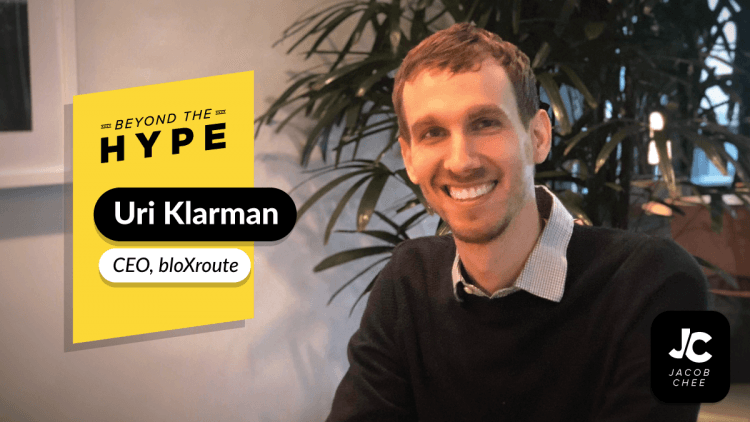
Beyond the Hype is a series by Jacob Chee, Tech in Asia’s head of blockchain initiatives. He interviews influential personalities who are changing the landscape of their respective fields, with a focus on companies that have the qualities to last through the hype.
This week, we speak with Uri Klarman, CEO of bloXroute. Founded by a team of researchers and systems designers from Northwestern and Cornell universities, including the crypto expert Emin Gun Sirer, bloXroute allows practically every blockchain network to “scale today.”
Can you introduce what problem bloXroute is trying to solve?
Our goal is to solve blockchain’s number one problem: scalability. Bitcoin’s average is 3.3 transactions per second, while Visa, MasterCard, and PayPal combined does about 5,000 transactions per second. The heaviest lift is social media—putting Twitter or Facebook on the blockchain requires 200,000-300,000 transactions per second.
One solution is to increase the size of a block. However, doing so also increases the time it takes for a newly mined block to propagate throughout the entire peer-to-peer system. This is critical because this time window leads to forks: the scenario when two blocks are mined by two different miners at the same time, causing them to compete with each other to become the “true” block.
If you increase the block size by 100x, the time it takes to propagate throughout the entire network actually exceeds the interval time, and the blockhain breaks. So, what you are going to have is a blockchain that has a fork, which then leads to forks of forks, and so on—the blockchain then unravels like a rope and doesn’t convert back to a single blockchain. Eventually the blockchain breaks, as nobody knows which fork to follow. This is the scalability problem.
So bloXroute is a blockchain distribution network (BDN), like an Akamai for blockchain. It is a network of well-optimized servers which have one feature: they receive blocks and broadcast them to the world 1,000x faster.
You can send 1GB block through bloXroute at the same speed it would take 1MB without bloXroute. We allow blockchains to scale by more than a factor of 1,000 out of the gate without them having to change anything.
It seems like a innovative way to solve the scalability problem. What are your team’s credentials?
There are four co-founders, including myself. Professor Emin Gun Sirer is a leading crypto expert who had pivotal roles in characterizing the Nakamoto consensus, the DAO detection, and the aftermath. Professor Aleksandar Kuzmanovic is a net neutrality expert. Our CTO Soumya Basu is most well known for creating the Falcon Network, which has been operational in the Bitcoin network since 2016. I myself am in the final stage of my PhD in computer networks from Northwestern University.
It quickly became apparent to us that scalability is a networking problem that cannot be solved at layer one (with a new blockchain) or at layer two (on top of the blockchain), but at layer zero, underneath the blockchain.
The crypto space is currently filled with great cryptographers and systems designers but very few network-level experts. I think no other team is trying to solve the scalability problem on the network level.
Are blockchains the most important stakeholders for bloXroute?
Yes, and we’re not here to compete with any blockchain—we are enablers. We open source bloXroute.
From our perspective, we see the blockchains developing into a “colosseum of crypto” where they compete with each other to provide real value for real people in the real world. Those that do a good job will prevail, while those who won’t will vanish over time.
For us to gain traction with the blockchains, there are two aspects. First of all, miners already want to use bloXroute, because they know that if they mine a block faster, they can make more money.
If you are open sourced, are you worried about competition?
What is your monetization plan?
Do you foresee any issues with SEC regarding BLXR?
What do you foresee happening in this industry in the next 10 years?





Stay updated on the go with our mobile app.
Get latest insights with smoother, more personalized experience through TIA mobile app.