- Insights This article was written by a TIA community member. Insights pieces undergo the same rigorous editorial process that newsroom-produced articles have.
 Christopher Quek · · 8 min read
Opinion: Why Singaporean entrepreneurs don’t fully benefit from their own ecosystem
Singapore was ranked 10th globally in the 2015 Compass Report, the only Asian city that made it. But while Singapore is proud of its startup achievements, foreign entrepreneurs are obtaining the largest returns from its ecosystem.
Top fundraising and acquisitions in Singapore
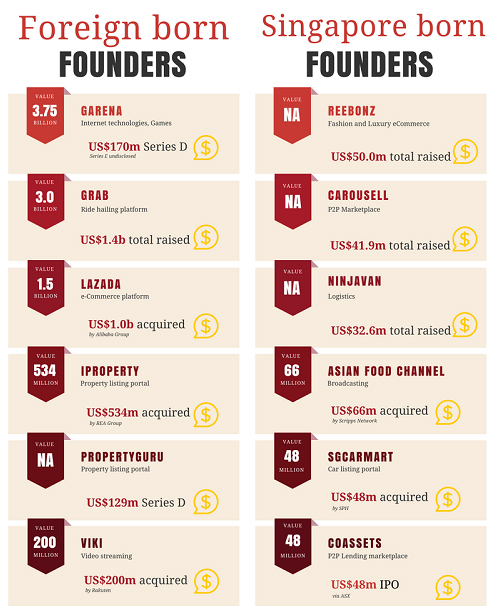
Source: Tech in Asia database and news articles.
Headlines for larger fundraising and exits have been dominated by startups with foreign-born founders like Viki, Lazada, Propertyguru, Garena, Grab, and iProperty.
Of course, there are successes from Singaporean founders as well. Carousell, Reebonz, Ninjavan, AFC, SgCarMart, and CoAssets are the more prominent ones, but they have less than US$100 million in current valuations and exits.
If all conditions were the same, shouldn’t Singapore-born entrepreneurs have similar successes like their foreign counterparts, even more so when two-thirds of companies formed are locally owned? In fact, what you are noticing now is a growing gap of success between the two groups. What are the factors causing this disparity?
Causes of the gap
Open economy and meritocratic government policies
As a small nation with limited size and resources, Singapore will always be an open economy, as it depends greatly on trade with others.
Government officials tell me that meritocracy is a pillar to ensure successful individuals and companies are rewarded for their successes, regardless of background. Protectionist policies to defend local entrepreneurs from foreign-born ones are viewed as unsuitable and contradictory in an open economy.
So when economic policies are created, it is open to anyone who can boost Singapore’s status and GDP.
Optics between a foreign entrepreneur and a local one
Once a foreigner arrives in Singapore, it is a new beginning. He leaves everything behind and tries to achieve his dream in a new land. (This is much the same as the migrants of Silicon Valley who seek the American dream.) This migrant is focused on growing his startup and thinks he must prove his worth, as he is new to the country. He can work seven days a week without any major distractions; he has the spirit to succeed.
But for the local born, he struggles to become an entrepreneur.
But for the local born, he struggles to become an entrepreneur. Upon graduation, he is saddled with student loans, and his parents will pressure him to focus on working first to repay the debt.
Along with this, there is a cultural resistance preventing him from creating a startup. Instead of pursuing entrepreneurship, Singaporeans enter a nine to five work week while the passion for starting something wanes.
Upping the game for Singaporean entrepreneurs
Conclusion





Stay updated on the go with our mobile app.
Get latest insights with smoother, more personalized experience through TIA mobile app.