Apoorva Dutt · · 5 min read
The ‘two-pizza rule’ productivity hack by Jeff Bezos was actually a failure. Here’s why.
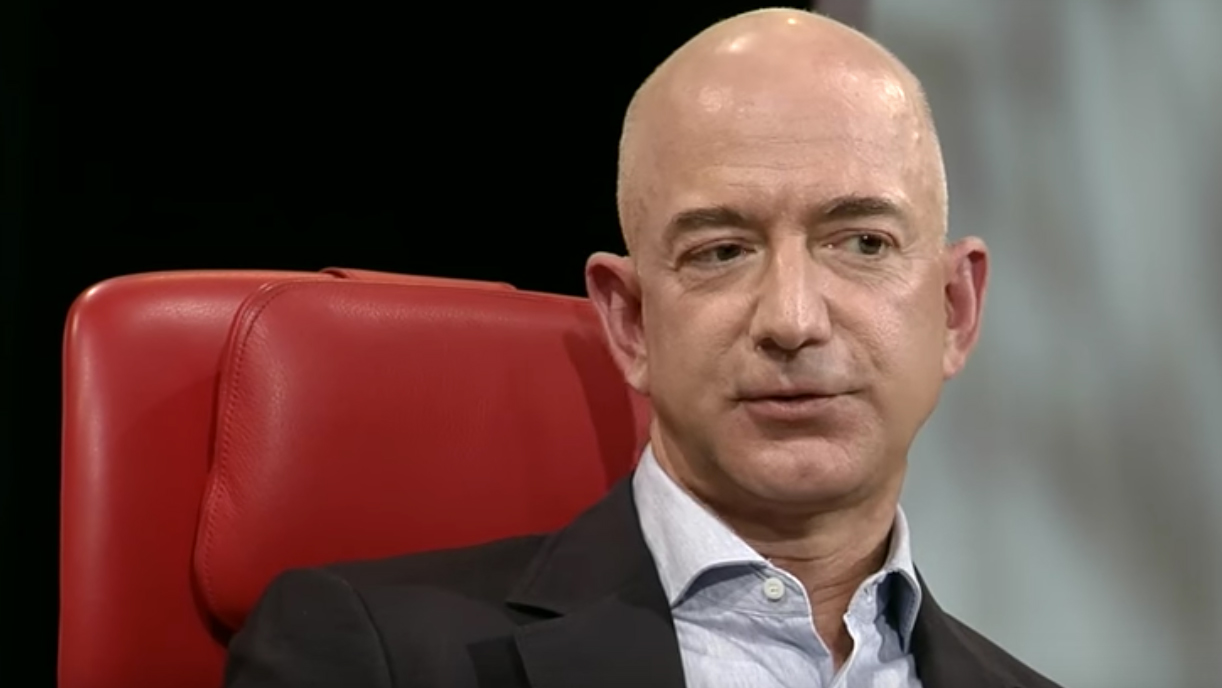
Amazon’s Jeff Bezos is making major plans for India. Screengrab from Code Conference video.
The following is an excerpt taken from “The Everything Store: Jeff Bezos And The Age Of Amazon,” by Brad Stone. The excerpt is provided by Little, Brown and Company. You can buy the book here.
At a management offsite (for Amazon) in the late 1990s, a team of well-intentioned junior executives stood up before the company’s top brass and gave a presentation on a problem indigenous to all large organizations: the difficulty of coordinating far-flung divisions.
The junior executives recommended a variety of different techniques to foster cross-group dialogue and afterward seemed proud of their own ingenuity. Then Jeff Bezos, his face red and the blood vessel in his forehead pulsing, spoke up. “I understand what you’re saying, but you are completely wrong, ” he said.
“Communication is a sign of dysfunction. It means people aren’t working together in a close, organic way. We should be trying to figure out a way for teams to communicate less with each other, not more.”
That confrontation was widely remembered. “Jeff has these aha moments, ” says David Risher. “All the blood in his entire body goes to his face. He’s incredibly passionate. If he was a table pounder, he would be pounding the table.” At that meeting and in public speeches afterward, Bezos vowed to run Amazon with an emphasis on decentralization and independent decision-making.
“A hierarchy isn’t responsive enough to change, ” he said. “I’m still trying to get people to do occasionally what I ask. And if I was successful, maybe we wouldn’t have the right kind of company.”
Bezos’s counterintuitive point was that coordination among employees wasted time, and that the people closest to problems were usually in the best position to solve them. That would come to represent something akin to the conventional wisdom in the high-tech industry over the next decade.
The companies that embraced this philosophy, like Google, Amazon, and, later, Facebook, were in part drawing lessons from theories about lean and agile software development. In the seminal high-tech book The Mythical Man-Month, IBM veteran and computer science professor Frederick Brooks argued that adding manpower to complex software projects actually delayed progress.
One reason was that the time and money spent on communication increased in proportion to the number of people on a project. Bezos and other startup founders were reacting to lessons from previous technology giants.
Microsoft took a top-down management approach with layers of middle managers, a system that ended up slowing decisions and stifling innovation. Looking at the muffled and unhappy hierarchy of the software giant across Lake Washington, Amazon executives saw a neon sign warning them exactly what to avoid.
The drive to cut costs also forced Bezos to eliminate any emerging layers of middle management from his company. After the stock market crash in 2000, Amazon went through two rounds of layoffs. But Bezos didn’t want to stop recruiting altogether; he just wanted to be more efficient. So he framed the kind of employees he wanted in simple terms.
All new hires had to directly improve the outcome of the company. He wanted doers—engineers, developers, perhaps merchandise buyers, but not managers. “We didn’t want to be a monolithic army of program managers, à la Microsoft. We wanted independent teams to be entrepreneurial, ” says Neil Roseman. Or, as Roseman also put it: “Autonomous working units are good. Things to manage working units are bad.”
But as was often the case, no one could anticipate just how far Bezos would venture into these organizational theories in his quest to distill them down to their core ideas. In early 2002, as part of a new personal ritual, he took time after the holidays to think and read. (In this respect, Microsoft’s Bill Gates, who also took such annual think weeks, served as a positive example.)





Stay updated on the go with our mobile app.
Get latest insights with smoother, more personalized experience through TIA mobile app.