
Here’s a simple fact: Most restaurants, no matter how popular, will be largely empty for a bulk of their opening hours. That’s because a lot of people prefer to eat during conventional mealtimes.
This reality is what inspired the launch of restaurant booking and discount platform Eatigo.
“It got us thinking: How can we help these guys improve their capacity utilization?” recalls Siddantha Kothari, the firm’s co-founder and chief financial officer. “That’s when we thought about demand-based pricing.”

Eatigo co-founders (L-R) Pumin Yuvacharuskul, Judy Tan, Michael Cluzel, and Siddhanta Kothari / Photo credit: Eatigo
The Bangkok-headquartered startup created a platform that allows users to get discounts of up to 50% off their meals if they make a booking outside of a restaurant’s peak periods. The further their reservation is from an establishment’s busy hours, the higher the discount they can redeem.
The service went live in Thailand in June 2014, with Singapore operations following eight months later. Now available to users in seven countries, Eatigo claims to have served over 5 million diners at more than 4,000 venues across the region.
But scaling a business is not an easy task, and Eatigo’s expansion journey wasn’t all smooth sailing. Kothari shares the challenges he and his fellow co-founders faced and the biggest lessons they learned along the way.
Set the foundation, then build in stages
In its early days, Eatigo’s founders decided that their platform didn’t have to be perfect or technologically revolutionary – they just needed a working minimum viable product.
“While we had laid down our pipeline for the entire product, we decided on the critical things to begin with so that we didn’t go overboard,” shares Kothari.
As the business grew, so did the product and its features, which were improved based on users’ needs. While this is a standard practice for product development, Eatigo also adopted this step-by-step approach into its other processes.
For example, when the startup began using customer relationship management company Salesforce’s Sales Cloud in 2017, the team was careful not to implement the entirety of the platform’s suite of services immediately. Eatigo started by using Salesforce tools that enabled it to keep better track of its business development team’s performance and manage its sales pipeline. The centralized sales process also allowed the company to increase its lead fulfilment efficiently.
“The first thing we did was decide that we wouldn’t customize too much. We realized that Salesforce knows these processes better than we do, so we changed our business processes to align with Salesforce’s as much as possible,” Kothari shares. Only after Eatigo was comfortable with the system did the team customize and introduce new features.
This allowed Eatigo’s business development staff to take their time to find the processes that worked for them, while leaving room for adjustments if they were necessary. This is critical for companies that are scaling, as the business is prone to rapid structural changes.
Once Eatigo’s business began to scale, the firm began using Salesforce’s Service Cloud and Marketing Cloud solutions to enhance its service support and reveal new customer insights. Since then, the company saw a 150% boost in its closure rate of service cases.
“You should always know what the endgame is so you can set the foundations right, but you don’t need to structure the whole building right from day one,” says the CFO.
Do your homework before entering a market
One of the reasons why Eatigo launched its Thailand and Singapore operations so close to each other was because it recognized that Southeast Asia – a region that its founders aims to conquer – was largely made up of economies that were similar to either one of the two markets.
“You had countries where ecommerce was really prevalent and people were comfortable with transacting on the internet, and countries where hardly anyone was doing restaurant reservations online,” explains Kothari. “We wanted to understand both types of markets well, which is why we went into both Thailand and Singapore.”
With the lessons it learned from operating in the two markets, Eatigo was able to launch in countries like Malaysia and Hong Kong in the first half of 2017. However, Kothari says the startup encountered hurdles in its attempt to replicate these successes in India later that year.
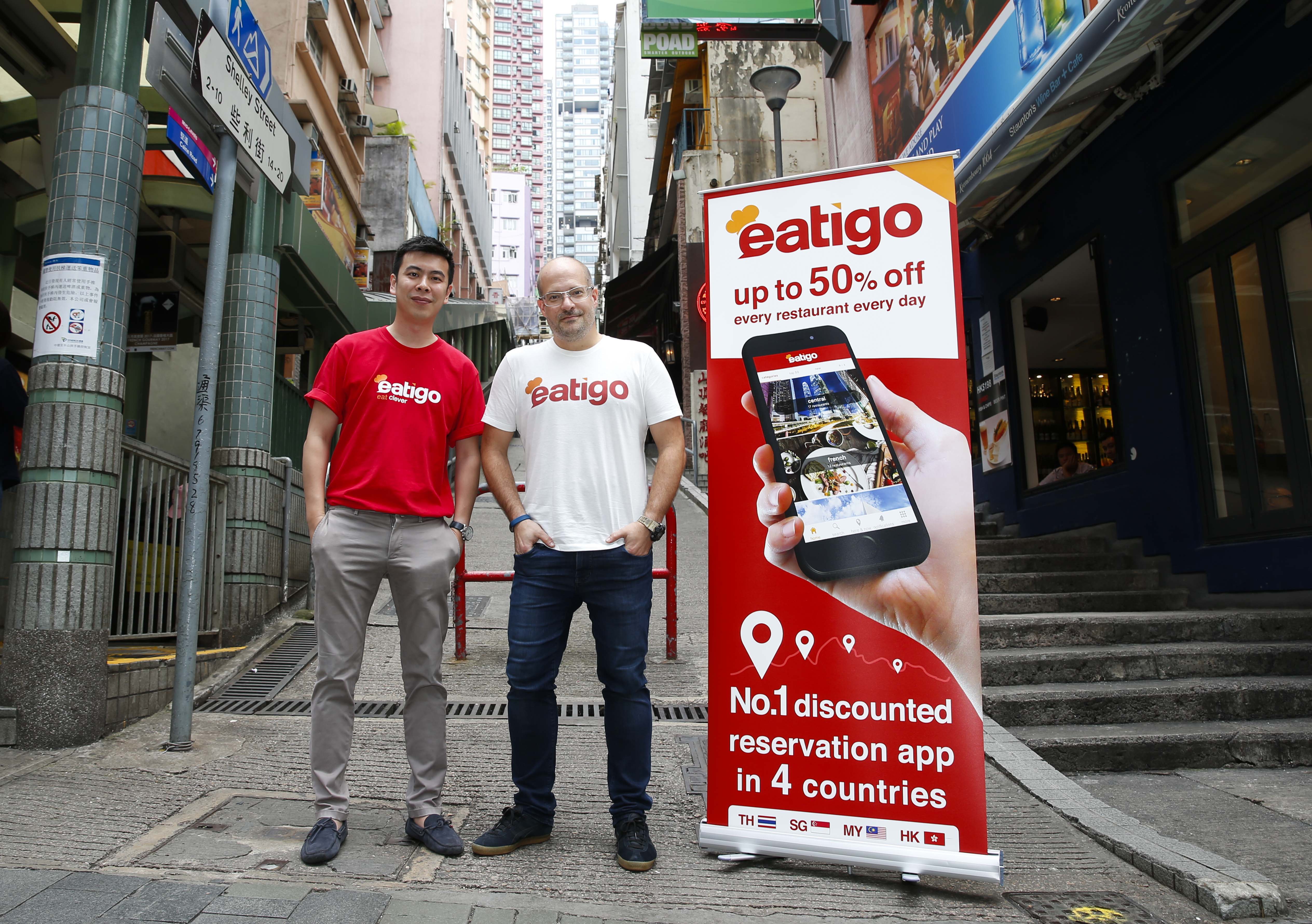
Eatigo co-founders Pumin Yuvacharuskul (L) and Michael Cluzel at the company’s launch in Hong Kong / Photo credit: Eatigo
“The Indian market is very different from Southeast Asian markets when it comes to user preferences, user behaviors, and even simple things like the peak times of restaurants,” he says.
In the country, the company’s customer acquisition strategy relied on attracting iPhone users. But this approach “absolutely failed in India,” as Apple only took up 2.2% of the country’s smartphone market share at the time, notes Kothari.
Recognizing its mistake, the team evaluated all of the new countries it was considering on all fronts – from legal and regulatory aspects to customer behavior and internet penetration. This helped inform the founders’ decisions on the strategies to employ when entering new geographies.
Kothari’s advice: Do a bit of homework to understand each country’s nuances. “While they might look quite similar, there are small differences in each and every market which you need to cater to.”
Start looking for specialists over generalists
When the company was starting out, it was important to hire generalists who could wear multiple hats in the business to keep overhead expenses low. This is true for many startups, but the dynamic changes once a firm starts to scale and reach new heights. This was one of Kothari’s key takeaways from his experience in growing Eatigo.
“If you’re playing in a school-level football match, you don’t hire a Ronaldo in your team,” he says, citing the Portugese professional athlete. “But if you’re going in the Champion’s League, you need to know that the team built for you in the school league will not work for you there: you need to hire different people.”
As a business grows, so does its impact. When that happens, the stakes and risks associated with making mistakes rise exponentially as well. That’s when it’s vital to have a specialist on the team who can deal with specific situations with expertise.
“Only bite as much as you can chew, but never go hungry,” Kothari advises. “There’s no point in being conservative once you’re big enough and can afford more. Then, you should go for the best resources available to you.”
Salesforce brings companies and customers together. It’s the global leader in integrated customer relationship management, which gives all departments, from marketing and sales to commerce and service, a single, shared view of every customer to deliver personalized experiences customers expect.
Read how Salesforce helps Asian startups and emerging companies like Eatigo grow their business on its website or get in touch to learn more.
Stay updated on the go with our mobile app.
Get latest insights with smoother, more personalized experience through TIA mobile app.
Recommended reads
 Exclusive: RedDoorz breaks even in Indonesia, Philippines
 Sequoia partner reveals 4 types of ‘poor quality’ revenue
 QuickBytes: This cleantech firm is changing mindsets and taking on climate change
 Kata.ai’s revenue leap sets stage for Middle East expansion
 Recession Run: Antler to double funding deals
 Sam Altman: Why Google’s success saved OpenAI
 SaaS is dead, long live SaS
 How AI is making the future clearer for business forecasting
 AI is shrinking SaaS moats, redefining sales
 This startup makes durian season last all year with freeze tech





Editing by Jaclyn Teng and Eileen C. Ang
(And yes, we’re serious about ethics and transparency. More information here.)




📅 Upcoming Events
22 October 2026
Payoneer x CSPN Summit 2026