 Michael Tegos · · 4 min read
Rappler wants to change the world with stories people are passionate about
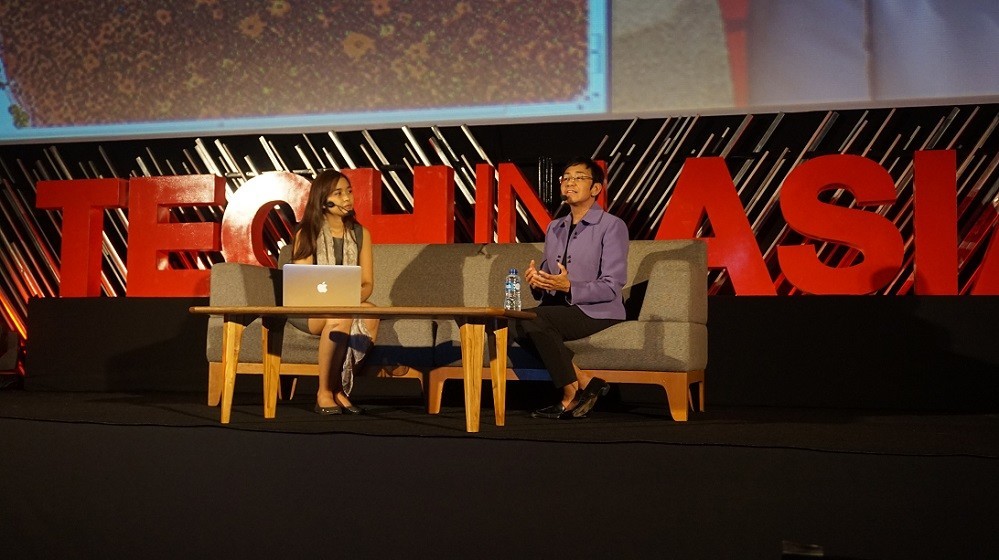
Rappler CEO Maria Ressa says she’s a cynic – her time as an investigative reporter covering terrorist cells in Indonesia for CNN has shown her some of humanity’s worst traits. But that didn’t stop the award-winning journalist from striking out on her own and, with a selection of veteran Filipino journalists, starting a media company aiming to redefine online journalism.
A few years later, Rappler is now one of the most successful new media outlets in the Philippines. And it has just entered Indonesia, the first new territory outside of its home country. It did so by riding a wave of social media and community engagement, made possible by today’s technology.
Speaking at Tech in Asia Jakarta 2015, Maria stresses the opportunity technology presents today to media companies and startups in general. They can “go from linear growth to exponential growth” by taking advantage of the disruption technology makes possible, she says.
Power to the people
In the case of Rappler, Maria explains that the advent of social media, crowdsourcing, and big data was key to the company’s growth. Rappler (a portmanteau of “rap,” which means to talk, and “ripple,” Maria clarifies) combines a core of old-school journalist values with new tech and the power of an engaged audience.
Maria is a proponent of social network theory, where relationships consist of nodes and ties – nodes in a network are individuals, and ties are the relationships between them. A social network, the theory goes, is basically a map of all those nodes and ties.
This, along with the Three Degrees of Influence Rule (the result of a 2007 series of studies by Harvard professors Nicholas Christakis and James Fowler) has helped form Rappler’s strategy when it comes to tugging at its community’s heartstrings using tech. That’s where tools like the mood meter, which tracks the emotions triggered by a story, and Reach, a tool that tracks how stories circulate within various networks, come in.
See: Philippines’ Rappler fuses online journalism with counter-terrorism tactics, social network theoryToday we have social networks online. But in the old days they would be our real-world networks, our family and friends, Maria says. “My definition of social media is your family and friends on steroids,” she quips. It’s the networks we are already used to, but without any “limitations of time and space.”
And what’s fascinating is the ability to move people to action through those networks. An average social media post is just the tip of the iceberg, Maria explains. It is actually carrying an emotion, and that emotion, carried through social networks, influences people’s decisions. “Up to 80 percent of how people make decisions in their lives is based on how they feel, not what they think,” she points out. And, she adds that when Rappler launched in 2012, the Philippines was the most emotional country in the world, according to the Gallup 2012 Global Emotions Report.
Spreading out
The media company’s Indonesia expansion has opened it up to not only a huge new audience, but also a significant presence in the Southeast Asia region. “They say when Indonesia sneezes, all of Southeast Asia gets a cold,” Maria quips.

Rappler is backed by strong investors with a keen interest in media and its mission, like Omidyar Network, and media heavyweights like Marcus Brauchli, Sasa Vucinic, and Stuart Karle. But Maria retains a majority stake in the company and all agreements with investors make sure the team has full creative freedom and editorial discretion.
And investors say it’s working – Maria expects Rappler to break even within the next year, where traditional media companies (like, say, CNN) have been known to take almost a decade.
Unlearn what you have learned
All the while, Rappler is looking how to get to that exponential growth curve. “This is in an interdisciplinary, collaborative work,” Maria says. “We don’t have all the knowledge, nor all the insights.” She stresses that technology needs to be used in such a way as to allow businesses to grow, but also for the betterment of society, which will allow businesses to thrive.
In fact, learning to let go of your power, of what you think you know because of your experience, is one of the toughest challenges, Maria says. But letting experience take a back seat was critical for success, she argues. It could be a guiding hand while the younger generation, the digital natives, brought to bear their energy, enthusiasm, and understanding of the new tech society.
That is the key behind Rappler’s approach to the media business today. “You can change a nation if you know how people feel and move society to action with your stories,” she says. “I want to see the world change in my lifetime. I think we can do it,” she adds.
So much for cynicism, eh?
What do you think of Rappler’s approach to online media? Do you think it has the right idea?
Rappler
Rappler is a social news network where stories inspire community engagement and digitally fuelled actions for social change.
- Location
- Philippines
- Founded
- 2012
- Employees
- 51 – 200
- Website
- www.rappler.com
- Latest Funding
- Early stage
- Hiring
- 0 positions
Stay updated on the go with our mobile app.
Get latest insights with smoother, more personalized experience through TIA mobile app.
Recommended reads
 Life’s a game, and AI agents are Animoca’s new play
 Indonesian AI startup goes global
 Forrest Li on scaling Sea, building smarter bots, and founder grit
 An AI assistant that joins sales calls and scores team skills
 Beyond the check: Why VCs need more than capital
 SGX’s CEO says it doesn’t need a unicorn to win
 SMEs want AI too, but not the kind Big Tech is selling
 Oatside’s alt-milk rise hits a profitable gear
 Alibaba’s financial health in 12 charts
 Asia’s telcos bundle AI into mobile plans. Will it pay off?





Editing by Erik Crouch
(And yes, we’re serious about ethics and transparency. More information here.)






