Stefanie Yeo · · 6 min read
From psych to product: The value of having a non-tech background for this Grab product lead

This article is part of “Women in Focus,” Tech in Asia’s campaign for International Women’s Day 2021. Through this initiative, we’re shining the spotlight on women making waves in Asia’s tech and startup ecosystem.
When you open up your Grab app to book a ride, order food, make payments, or use one of the many other services available on the platform, it’s a pretty intuitive and straightforward experience.
For Minci Loh, the app is a particular point of pride – because she’s one of the driving forces behind the evolution and transformation of Grab’s platform over the last four years.
Loh is the product lead of consumer experience at the super-app platform, where she and her team work on improving the user experience within Grab’s ecosystem. Key aspects of the platform, such as its improved ride-booking flow and super-app redesign, are some of their major contributions.
Features that are now mainstays on the platform, such as pick-up point selection, location tracking, and price comparisons, are the work of Loh and her team, whose main focus lies on developing and testing out new features to improve the user experience.

Minci Loh, product lead of consumer experience at Grab / Photo credit: Grab
But unlike many other product managers who come with technical backgrounds, Loh’s story is a little different. She graduated from Singapore Management University in 2011 with a double degree in business and psychology, and joined a management associate program at multinational financial services firm Mastercard. Upon joining, she found herself assigned to the products and solutions team, which sparked off her product management journey.
After four years at a multinational firm, Loh was itching for a change.
“I wanted to feel less like a cog in a big machine, and Grab offered a chance to be part of a movement, [with its] social mission to bring change to Southeast Asia,” she says.
A baptism by fire
Loh joined Grab in 2016 as the product manager for maps – a move that landed her in unfamiliar territory, given that she had no technical training,
“In the beginning, when I first started, it was a steep learning curve,” she says. “I never had any experience with coding or user experience design, much less domain experience, and I joined a team [with members who] have something like three PhDs and geospatial expertise.”
It was extremely daunting for Loh, especially given that many of the engineers on the team were initially hesitant about her lack of experience.
“When I came in, I had my first meeting with this engineering leader. I said, ‘I’m new to this, but what can I do, how can I help the team?’” recounts Loh. “His response was lukewarm.”
While her initial start at Grab was rocky, Loh didn’t let it get her down. She made the decision to really hunker down and narrow the knowledge gap, learning from colleagues and forcing herself to study hard in order to pick up the technical know-how that she lacked.
“It propelled me to learn, just so I could speak the same language as my peers and provide value to the team,” she says.
Even though Loh’s technical knowledge improved tremendously, she still struggled with imposter syndrome. However, a breakthrough moment came when one of her mentors at Grab advised her that instead of focusing on what she lacked, she should focus on what she brings to the table as a product manager – her “superpower.” For Loh, that came in the form of her consumer psychology background.
“My ‘superpower’ was user centricity,” she says. “You had all these brilliant people who knew how to write the cleanest code and build the most efficient systems, but someone had to marry that to what the business and the users actually wanted, and that was where I brought value.”
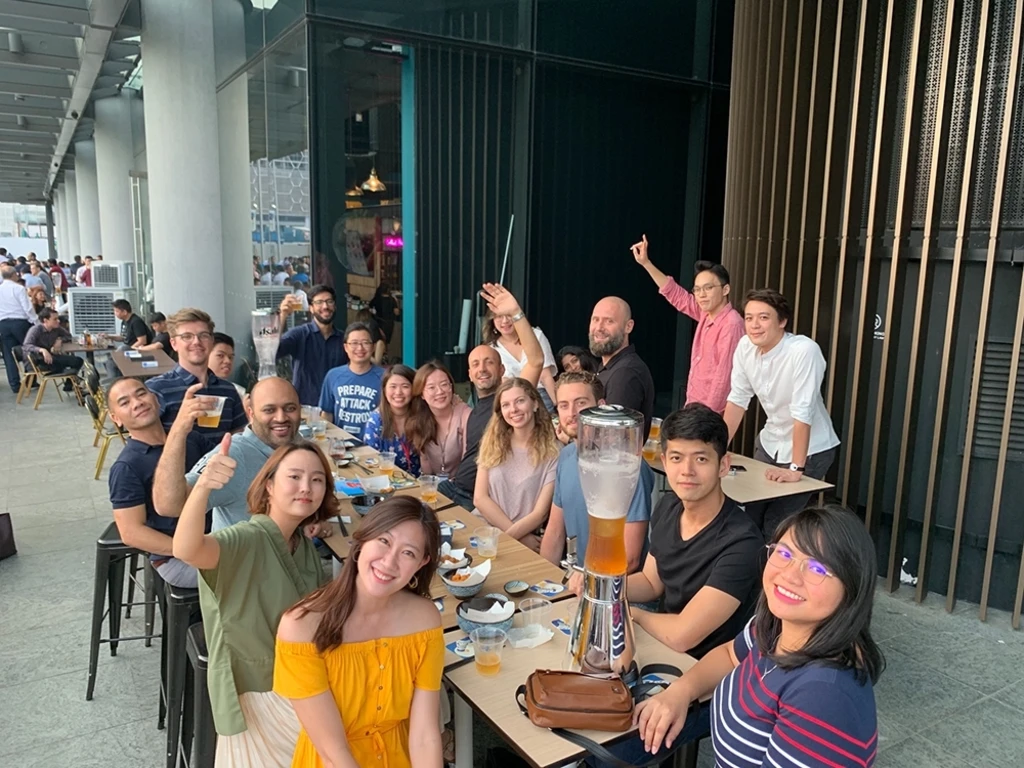
Loh on an outing with her team at Grab, before the pandemic / Photo credit: Grab
Additionally, her psychology degree gave her an edge when it came to the more analytical and statistical aspects of product management, such as product experimentation and hypothesis testing. Plus, her business school experience proved useful in stakeholder management and negotiation – a vital skill given the number of stakeholders involved with Grab’s product.
Eventually, the same engineering team members who were initially wary about her lack of technical experience started coming to her for advice.
“They started opening up to initiate discussions with me and now trust me with the roadmap. That was the moment for me when I thought, oh, I think I’m doing something right,” says Loh.
The power of non-tech in tech
In Loh’s view, there are benefits to being a non-technical person in the product world.
“You can’t out-engineer an engineer or out-design a designer. Trusting the experts in their fields allowed me to focus on the bigger picture of how they come together, and it also went a long way in nurturing stronger working relationships between us,” she shares.
In the broader scheme of things, Loh thinks that the tech world could definitely do with more non-tech people on board.
“The very nature of technology is innovation, and innovation requires a diversity of views, expertise, and perspectives,” she says. “When you’re able to marry and converge all of those into new applications, that’s when innovation occurs.”
Research by the Boston Consulting Group (BCG) found that companies with diverse management teams report 19% more innovation and 9% higher earnings before interest and taxes compared to businesses that don’t. This holds true in Southeast Asia as well, where a BCG study observed a correlation between a diverse workforce and greater innovation, with a higher share of revenue coming from new products.
A case in point would be Internet giant Google, which credits its diverse team as one of the key forces behind some of its innovations and strategies, such as the exterior design of the Google Pixel smartphone and how it’s approaching emerging markets like Africa.
According to Loh, tech companies can achieve diversity by incorporating it into their processes, such as making it an essential requirement in the hiring process to have a diverse pool of candidates from different backgrounds, or putting in guidelines to ensure that teams have a diverse breadth of experience and cultures.
“Diversity breeds diversity,” Loh says. “When people see that a company is welcoming to all geographies, cultures, and genders, and they all thrive equally, that sets an example.”
Getting your foot in the door
Tech companies in the region are realizing the importance of having diverse workforces. In Singapore, for one, tech firms are opening up tech positions to individuals who may not have had technical training, fueled by a need for more talent and diversity.
Additionally, tech giants like IBM and Facebook have a large number of non-tech roles open, at 54% and 47% of available positions respectively, despite being highly tech-driven in nature.
For non-tech folks looking to get into the tech world, Loh’s advice is to start by getting your foot in the door.
“There are many other roles in tech companies that are non-technical in nature but are still part of the industry,” she says, “if you’re from a non-tech background, try getting yourself into a company that is tech in nature and from there, you can get industry knowledge, networks, and exposure to various functions to better understand your options.”
While non-tech individuals will eventually need to pick up the necessary technical skills in order to transition fully into tech-driven roles, Loh feels that it is not an insurmountable barrier. In her perspective, tech is an accessible space, and it’s open to anyone who is willing to roll up their sleeves and learn.
“The capital is flowing in, the opportunities and resources are all there,” she concludes. “This is a great time to come aboard.”
Learn more about Minci Loh’s story on Tech in Asia’s podcast here.
Grab is the leading super-app platform in Southeast Asia, providing everyday services that matter to consumers.
Learn more about careers at Grab on its website.
This content was produced by Tech in Asia Studios, which connects brands with Asia’s tech community. Learn more about partnering with Tech in Asia Studios.
Stay updated on the go with our mobile app.
Get latest insights with smoother, more personalized experience through TIA mobile app.
Recommended reads
 Building a human capital operating system for students
 Mass firing, less hiring: Can Indonesia see hope in a grim job market?
 An AI interviewer being built on interview data, not CVs
 Goldman Sachs CEO says hiring geniuses can be a strategic trap
 Sequoia partner highlights Elon Musk’s hidden genius
 New chapter for Vietnam’s fintech sector
 Firing fast is the secret to building top sales teams
 The founder mistake Airbnb’s CEO thinks kills great companies
 So you think you know startup growth
 Carousell co-founder backs $1m round of SG edtech firm





Editing by Nathaniel Fetalvero and September Grace Mahino
(And yes, we’re serious about ethics and transparency. More information here.)