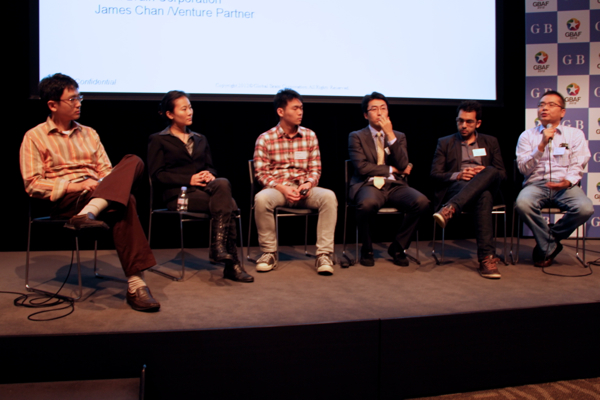
Japanese VC firm Global Brain held its annual startup-focused conference in Tokyo last week, the 6th Global Brain Alliance Forum (GBAF). The firm and its limited-partner investor Nifty unveiled their future investment strategies. In addition, nine tech startups from Japan and the rest of Asia pitched to a Japanese crowd of angel investors, entrepreneurs, and local media.
We’d like to highlight one panel discussion in particular titled “Asian venture companies on track for growth.” Panelists included Gwendolyn Regina Tan (the co-founder of SGE.io, Singapore), Mark Hsu (partner at TMI, Taiwan/台湾創意工場 許安德先生), Mohan Belani (the co-founder of e27, Singapore), James Jung (the co-founder of beSuccess, Korea) and Willis Wee (the founder of Tech in Asia, Singapore/亜洲科技 黄心泉先生). The panel was moderated by Global Brain’s James Chan(陳亮宏先生).
Asian markets are diverse

Mark Hsu(許安德), partner at TMI
The session kicked off by emphasizing the market diversity in the region. “Asia is so huge,” Mark Hsu noted.
Even if we pick one country in South East Asia to talk about, there are many different views [which we cannot apply to] the entire region together. But the ratio of a country’s population to its GDP is a good index to find how much potential a country has. For instance, Myanmar has 55 million people with a GDP of 70 US dollars a month per capita, and Indonesia has 240 million people with its GDP per capita at $300 dollars a month. A country’s population and productivity index lets you easier to understand the state of the country. Thailand’s economic growth is extremely fast now.
e27’s Mohan Belani also pointed out Thailand, calling it “one of the fastest countries in terms of the speed of spreading internet infrastracture in Southeast Asia.
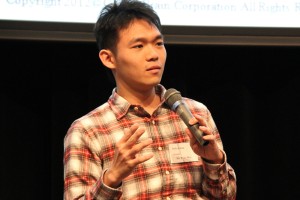
Willis Wee(黄心泉), TechInAsia
James Jung from BeSuccess proudly introduced his country, noting, “Korea’s internet penetration rate is as high as 91 percent, and our mobile penetration rate also high as 70 percent.”
Tech in Asia’s Willis Wee says, “I’m interested in Vietnam. Facebook and Twitter are highly widespread in Indonesia too, and it will be the next big one after mainland China.”





Stay updated on the go with our mobile app.
Get latest insights with smoother, more personalized experience through TIA mobile app.