Sarah Dai · · 2 min read
Pony.ai and Baidu still lag in US self-driving tests, but they are narrowing the gap
Although China has strong hopes for autonomous driving and has beaten Apple in some areas, its leading company still lags behind Google’s self-driving unit Waymo in US engagement tests.
According to data disclosed in an annual report by the California Department of Motor Vehicles on Wednesday, drivers disengaged the autonomous driving mode on Apple’s test cars once almost every mile on average, making it one of the worst performers over a 12-month period through November 2018.
Apple did not immediately respond to an emailed request for comment on its metrics in the self-driving report.
By contrast, Pony.ai – the front-runner among Chinese autonomous driving companies – reported human intervention once every 1,022 miles, according to the report, which was based on self-submissions by companies. Chinese search engine giant and national artificial intelligence champion Baidu was next among Chinese competitors in the tests, reporting human intervention once every 205 miles on average in its self-driving cars.
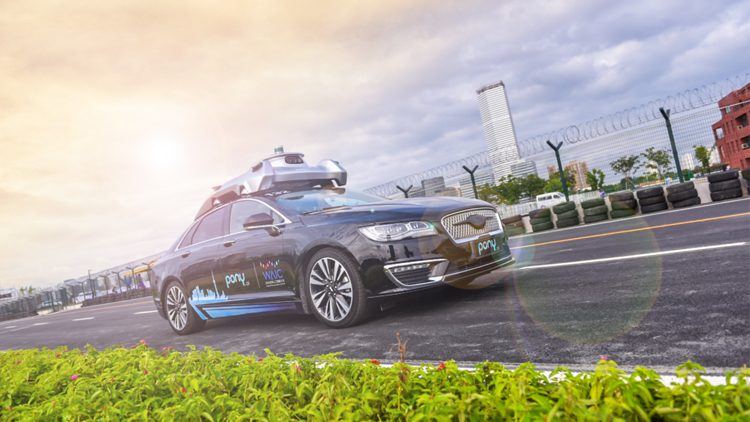
Pony.ai’s self-driving system PonyAlpha / Photo credit: Pony.ai
However, Chinese companies still lag behind leading US companies in the field, with Waymo drivers disengaging the auto-drive function roughly once every 11,000 miles and Cruise drivers once every 5,200 miles on average. The good news for Chinese companies is that they are narrowing the gap, with Pony.ai noting an improvement from its disengagement metric of around once every 100 miles just 18 months earlier, when it first conducted test drives on California’s public roads.
Disengagement covers instances where humans manually disengage the car’s self-driving mode or when the autonomous driving function fails and automatically disengages. The annual disclosures, covering companies with a test permit in California for over a year, offer an insight into how the industry’s leading players are progressing with this new technology and how competition between the US and China is shaping up in this key application of artificial intelligence.
Earlier this week, US President Donald Trump issued an executive order designed to “maintain American leadership in AI” and stave off technological challenges from China. The world’s two biggest economies are currently engaged in talks to negotiate a truce in their trade war, and Chinese telecom giant Huawei Technologies is being pressured by the US in the rollout of global 5G mobile networks.
Of the 48 companies that submitted data on their test drives, about 11 are either headquartered or have their main operations in China. The autonomous driving sector has drawn billions of dollars of investment over the past two years. This week, TuSimple, an Nvidia-backed self-driving truck startup with operations in China and the US, announced it has raised US$95 million in a series D funding round led by Sina Capital.
Pony.ai completed a US$214 million round in July, while its rival Roadstar.ai raised US$128 million just two months earlier.
Visit SCMP.com for the latest China tech news.
Copyright (c) 2019. South China Morning Post Publishers Ltd. All rights reserved.
Editing by Charmaine de Lazo
(And yes, we’re serious about ethics and transparency. More information here.)





Stay updated on the go with our mobile app.
Get latest insights with smoother, more personalized experience through TIA mobile app.