Daniel Tay · · 5 min read
Augmented reality ads platform Playme AR wins Malaysian edition of Tech in Asia Tour
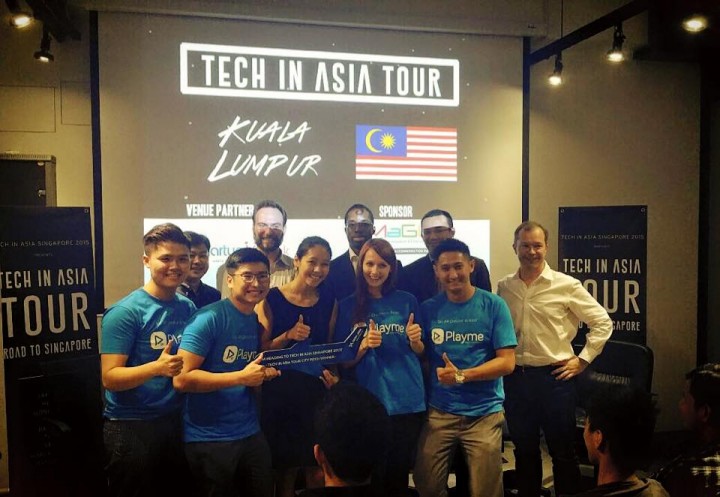
Malaysia has produced some of the greatest startup successes in Southeast Asia to date. On Tuesday, five aspiring startups stepped onstage at our Tech in Asia Tour event in Impact Hub Kuala Lumpur’s brand-new event space to test their mettle.
The panel of judges, which decided who would go to Tech in Asia Singapore for free, consisted of Cradle Fund CEO’s Nazrin Hassan, 50Folds’ founder Alexander Jarvis, venture partner at Golden Gate Ventures Michael Lints, managing director at Monk’s Hill Ventures Kuo-Yi Lim, and Burda International’s senior advisor Friedrich von Scanzoni. Eventually, they went with…
Playme AR

Playme AR connects the traditional print advertising world with its digital counterpart via augmented reality. The co-founders believe that adding a digital layer over existing offline ads will increase engagement with the consumer and – as a result – generate more leads and boost sales.
These advertisements can be created using a drag-and-drop interface in a pay-as-you-go format on Playme AR’s web app. The current conversion rate from free to paid users is 17 percent.
One limitation that it has right now, as co-founder Alvin Ooi admitted, is that the ads can only be viewed using Playme AR’s mobile app, a point that the judges latched on to. Ooi explains that they are currently working on partnerships with agencies. The judges were generally intrigued by its potential, though, and suggested that the team consider plugging it into other apps which have a broader base of users, such as Japan’s Line, to attain critical mass.
Hyve
Misplacing items is a daily reality that people deal with, and certain things have emotional value that cannot be replaced. Hyve is a bluetooth-based loss prevention device which promises that its users will never again leave their stuff behind.
Trackers can be attached to your belongings, and inventorized using a companion app that generates a checklist of items. To find them, all you need to do is click a button on the Hyve, and the tracker will ring. The device works up to a distance of 30 meters.
If your item is beyond the 30 meter mark, you can instead mark your item as lost in the app, and other users who are in the Hyve community will be notified and can help you look for it. Founder Jia Shern calls this the “swarm” function, which is still currently in the development stage.
Jia Shern says that their competitive advantage sits in the fact that Hyve runs on a battery that’s rechargeable via micro-usb, while others tend to use coin-shaped batteries that are expensive and hard to find.
The judges were skeptical as to whether this would be able to set itself apart from the rest in the long run, especially cash-laden competitors who are able to replicate the battery and sell it at an even cheaper price. They also thought it was an item that was “nice to have, but not exactly solving a pain point.”
The Lorry

The Lorry is an on-demand delivery service that uses – surprise – lorries for transportation. Its focus is two-pronged. On one hand, it wants to provide customers with high-quality, transparent delivery service standards. Its quoted prices are fixed from the onset and paid on delivery. All lorry companies are vetted by the team, and only the best ones are selected as partners. Driver details are also sent to the customer for assurance.
On the other, the platform provides lorry companies with a one-stop site to find job assignments. Managers can access a dashboard on the site, which gives them a real-time update on where the drivers are. At the moment, the team is seeing about US$8.70 in gross profit per trip made, and just last month saw a 45 percent growth in the number of trips made.
The judges were curious about some other numbers, including its repeat purchase rate for business-to-business customers, which turned out to be roughly 50 percent. This segment makes up close to 30 percent of The Lorry’s total customer base. The judges thought that the team should focus on either consumers or businesses, but not both.
Oddle
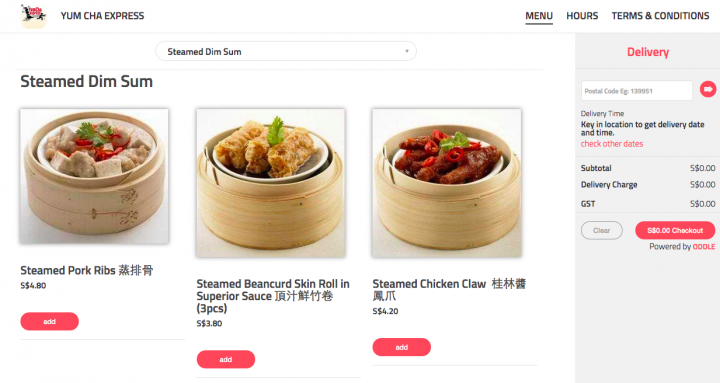
Oddle is a cloud-based order management system for deliveries and takeaway. Its focus is on multiple-store restaurant chains. Orders are routed to the respective outlet as they come in.
Unlike most food ordering apps, Oddle takes a fixed monthly subscription fee of S$120 (US$88) per month, plus another S$60 (US$44) per additional store. Founder Pua Yong Xiang thinks this is what separates them in a relatively crowded space. The judges begged to differ, saying that Oddle’s potential to scale is now limited by the number of restaurants there are.
Offpeak

Offpeak is a dining deals website that offers discounts which are applicable only at designated hours. This model was inspired by the hotel industry, in which extra inventory is resold at a discount.
Over 300 restaurants – some of which are big names in the F&B industry – have used Offpeak so far, with over 10,000 bookings made. A geotagging function allows users to find nearby deals from its companion app wherever they are. Recently, the firm also expanded to Thailand.
The judges seemed impressed with Offpeak, until it was revealed that in the interest of gunning for scale, the team was not taking transaction fees from its clients just yet. They agreed that this puts Offpeak at a great disadvantage, as well as renders its traction unreliable, “because who doesn’t like free?”
Stay updated on the go with our mobile app.
Get latest insights with smoother, more personalized experience through TIA mobile app.
Recommended reads
 Indonesian AI startup goes global
 Forrest Li on scaling Sea, building smarter bots, and founder grit
 An AI assistant that joins sales calls and scores team skills
 Beyond the check: Why VCs need more than capital
 SGX’s CEO says it doesn’t need a unicorn to win
 SMEs want AI too, but not the kind Big Tech is selling
 Oatside’s alt-milk rise hits a profitable gear
 Alibaba’s financial health in 12 charts
 Asia’s telcos bundle AI into mobile plans. Will it pay off?
 M-Daq chases bigger clients as revenue falls, losses grow





Editing by Leighton Cosseboom and Steven Millward
(And yes, we’re serious about ethics and transparency. More information here.)