Jonathan Chew · · 6 min read
One of the world’s biggest manufacturers is pumping $35m into startups

In the tech sector, industry players that have been around for a long time are uncommon, let alone those that have existed even before the electric television was first successfully developed in 1927.
Mitsubishi Electric, which was established as part of the Mitsubishi Group in 1921, is one of the rare few.
Today, the electric hardware company has 10 different business units across a wide range of industries – from home appliances to space technology – making it one of the world’s largest manufacturing companies.
But even with so much under its belt, Mitsubishi Electric wanted to get out of its comfort zone and explore areas outside of manufacturing. In January this year, the company officially launched its 5 billion yen (US$34.9 million) ME Innovation Fund in partnership with Japan-based VC firm Global Brain.
The move is a catalyst for Mitsubishi Electric to begin exploring deep relationships with tech startups.
“Traditionally, we’ve focused on only developing things by ourselves,” says Kenji Minefuji, manager at the business innovation group of Mitsubishi Electric.
“But now, we’d like to open up our innovation circle to work closely with startups.”
Pedal to the metal
Mitsubishi Electric has a long history of hardware manufacturing, but its original business model has begun stagnating in recent years.
In 2019, the company’s top-line revenue plateaued, and amid Covid-19, the firm reached its “ceiling” for growth, says Minefuji. It needed to find a new way to innovate.
It was around this period that Mitsubishi Electric noticed the importance of digital transformation in other industries, which led its leadership team to consider how to implement such a shift within the firm. It decided that open innovation through direct investments in relevant startups would be the way forward.
“That way, we’ll be able to partner with someone outside to incorporate their strengths and adopt things that are not necessarily hardware-focused,” says Tsuyoshi Hidaka, a senior manager at Mitsubishi Electric’s business innovation group.
Some areas that the company took an interest in include AI and deep learning, which could help the firm digitalize analog processes, improve data management, and develop business intelligence solutions.
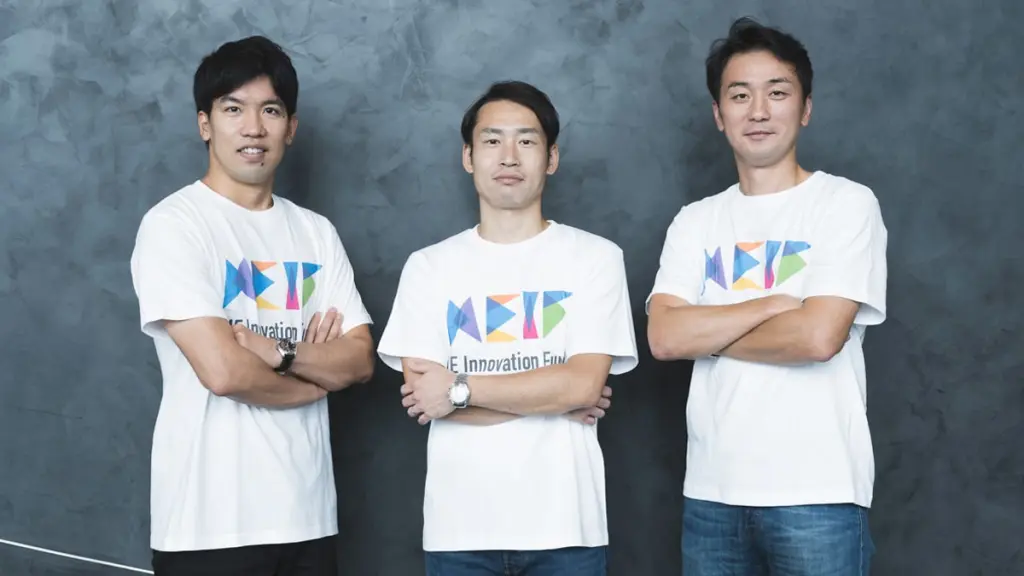
ME Innovation Fund founding members Niwa, Minefuji, and Hidaka. / Photo credit: ME Innovation Fund
In July 2021, Mitsubishi Electric began internal discussions regarding the development of a corporate venture capital fund, which took only around half a year to finalize. The firm’s leadership team was on board with the idea from the beginning, making the approval process much faster, Minefuji explains.
“There was a sentiment that we had to change something internally and start the transformation process as soon as possible, and that mood was already within our company,” he shares.
The development of the fund went even smoother thanks to the expertise of the people involved in the project, who ultimately helped get the investment vehicle on the same page as the startups it’s interested in backing.
Minefuji, for instance, has been involved with startups since 2017 – even before the fund started – providing hands-on support for startups across 10 countries as a mentor and developing novel collaboration schemes and concepts between startups and multinational corporations. With his understanding of both cutting-edge science and technology, as well as his experience with business strategy, Minefuji was also able to advise on areas such as due diligence, deal making, and valuation, and played a key role in running the ME Innovation Fund.
Senior manager Hidaka, on the other hand, had been with Mitsubishi for 20 years and was instrumental in helping Minefuji translate what was needed and escalate this to internal stakeholders.
A region of opportunities
Since its official launch earlier this year, the ME Innovation Fund has placed a strong focus on exploring opportunities within Southeast Asia.
The number of unicorns in the region was a major factor for this goal, according to Minefuji.
As of April this year, Southeast Asia is home to a total of 49 billion-dollar firms. In contrast, Japan has only recorded four of such companies as of 2021.
“Entrepreneurs in Southeast Asia are great at making businesses scale and have the power to execute ideas,” Minefuji says. “There are a lot of great talents, and we also want to learn from them.”

Image credit: Timmy Loen
When considering which startups to invest in, how the company can integrate with Mitsubishi Electric is a critical factor, as it corresponds to how much value the partnership will bring to both parties, says Yuji Niwa, one of the founding members of the ME Innovation Fund.
One example of how this synergy could be realized is the firm’s potential partnership with FTV Labs, a Singapore-based software company that has created a solution for organizing dispatches of employees to external worksites.
The startup has also developed a cloud-based field service management solution that automates the manual workflows often found in the manufacturing sector while providing visibility and insight to empower companies’ decision-making processes.
While negotiations are still ongoing, Minefuji shares that Mitsubishi Electric is looking to adopt FTV Labs’ dispatch solution for its own internal purposes. For example, when Mitsubishi Electric needs to send out teams for elevator and escalator maintenance or technical support for factory automation, the software could prove useful.

Photo credit: kadmy / 123RF
It’s also important for the manufacturing firm that the value created through its investments goes both ways. This follows what Mitsubishi Electric calls the “give-and-give” mentality – both sides must be prepared to accommodate each others’ needs and wants.
“Financial returns are not necessarily everything. We have a lot of assets we can provide to startup companies,” Minefuji says.
Through the fund, startups can receive support in several ways. On one hand, Mitsubishi Electric can provide its internal teams for branding, marketing, and PR assistance. On the other hand, Mitsubishi Electric’s network of business units can also help startups improve their supply chain or technology manufacturing capabilities.
The big ‘C’
As the fund continues to look for more investment opportunities, Niwa says that one of the biggest challenges is making sure it understands the cultures or attitudes of the startups it wants to invest in.
This isn’t surprising, as Japanese companies typically have different decision-making processes compared to overseas firms. Some say the country’s work culture can be non-confrontational and risk-averse.
To overcome this and get a clearer picture of foreign work attitudes, Niwa says that the fund has made communication with potential partners one of its top priorities. By understanding startups better, it can then figure out the best way to motivate them.
We want to make our organization the first choice when startups think about seeking investments.
Minefuji says that while Mitsubishi Electric is still in the process of figuring out how to communicate with startups most effectively, he and the rest of the fund’s team can act as liaisons to facilitate conversations and help meet the needs of both parties.
This means the ME Innovation Fund will act as a communication bridge between startups and Mitsubishi Electric. Not only does this help overcome language barriers, but it also bridges differences in cultures, mentalities, and intentions.
In the long run, Minefuji says the ME Innovation Fund’s goal is to be one of the best supporters for startup companies.
“We want to make our organization the first choice when startups think about seeking investments,” he shares.
Mitsubishi Electric Corporation is one of the world’s leading companies in manufacturing, marketing, and sales of the electrical and electronic equipment used in information processing and communications, space development and satellite communications, consumer electronics, industrial technology, energy, transportation, and building equipment.
To find out more about its ME Innovation Fund, visit this website.
This content was produced by Tech in Asia Studios, which connects brands with Asia’s tech community. Learn more about partnering with Tech in Asia Studios.
Stay updated on the go with our mobile app.
Get latest insights with smoother, more personalized experience through TIA mobile app.
Recommended reads
 This profitable SG firm combines mercenary approach with Amazon-like infrastructure
 Ex-AWS exec launches startup to power enterprise systems with AI
 An AI co-pilot for scientists designing new biomaterials
 East Ventures, Temasek Foundation launch second climate tech competition
 Indian SaaS startup bags $20m to help businesses manage genAI models
 Despite setbacks, this Malaysian healthtech firm eyes EBITDA breakeven by year-end
 EFishery acquihires Indonesian AI-powered IoT startup, to launch AI brand
 SG fintech firm Bambu shut down after missing profit targets, says founder
 Indonesia-based FishLog hooks in major funding, scales up sustainable seafood
 Wavemaker-backed WasteX raises $450k to expand biochar solution across Indonesia





Editing by Winston Zhang and Jaclyn Tiu
(And yes, we’re serious about ethics and transparency. More information here.)