Rick Martin · · 3 min read
Government, Google, and Citizens Come Together for Crisis Response in the Philippines

Google’s Crisis Response map for Typhoon Pablo
Folks in the Philippines have been hit by another typhoon over the past few days, as Typhoon Pablo hit on Monday. More than 40,000 people were reportedly evacuated and dozens killed [1], and just as with the floods that occurred earlier this summer, efforts were being made online to circulate critical information about where to find shelter, which areas were at most at risk, as well as other storm-related alerts.
Amid the crisis, the government stepped up its game this time by providing a mobile-friendly, text-based disaster information page that could be easily read on most mobile devices. It includes important announcements like the location of the storm and which areas were in danger of or experiencing flooding [2].
I can’t help but wonder if there might be a need for a dedicated open source CMS for crisis response, to help countries in getting disaster information out in a hurry. Recovers.org is a promising initiative in the US (see Staten Island Recovers for an example of how it works), but it may take some time before Asia jumps on board with this, or something like it.
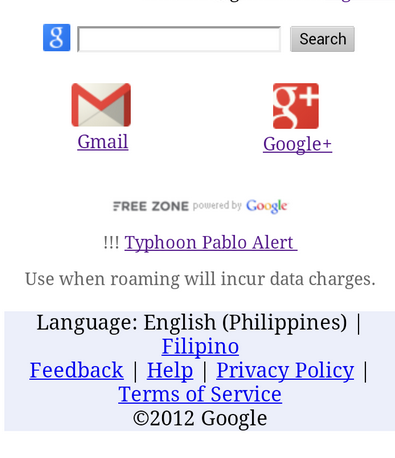
Typhoon Pablo alert, Free Zone
As usual, the folks at Google were quite active as well with a crisis map in place displaying shelter locations, predicted storm surge levels, flood hazard areas, and other information. As usual, the public has chipped in to help with information sharing as well, with another Google Map created to show shelter locations too [3]. And as we saw last summer, conversation on Twitter is extremely active as well around the #PabloPH hashtag.
Google also took advantage of its recent partnership with Globe Telecom to link to the afore-mentioned government site from its Free Zone sign in page. You can see how that looks on mobile in the screenshot to the right. Since the Philippines still has just 30 percent of the population using smartphones, this effort to get information to feature phone users who may not have active data plans is certainly worthwhile. For more information on Google’s role, you can check out the video interview below with Philippines’ ANC News.
Given that Asian regions are generally more prone to natural disasters, hopefully we can see governments, organizations, and citizens come together to create better ways to prepare for them. Sharing critical information is only one aspect of this, but it’s something everyone should keep in mind, especially civic/social entrepreneurs who want to contribute to their communities.
-
Known as Typhoon Bopha outside of the Philippines. There are conflicting reports about the official death toll, so I’ll refrain from citing a specific figure. ↩
-
This is something we also saw Japan’s Local Authorities Systems Development Center encourage after the Japan earthquake as well. In flooding situations where personal computers might be damaged by water, ensuring that information is available via mobile, and not clunky PDF files, is essential. ↩
-
I believe this was created independent of Google, though I could be mistaken. ↩





Stay updated on the go with our mobile app.
Get latest insights with smoother, more personalized experience through TIA mobile app.