- Premium Content It takes our newsroom weeks - if not months - to investigate and produce stories for our premium content. You can’t find them anywhere else.
 Elyssa Lopez · · 5 min read
Philippine giants plug into EV charging space despite profit woes
Conglomerates run almost every major utility in the Philippines, from power generation to telecom networks. The newest entry to that list: electric vehicle charging stations.
The Electric Vehicle Industry Development Act (EVIDA) in 2022 brought conglomerate-owned mall operators, such as Ayala and SM, into the EV infrastructure space.
The law mandated every public and private property to allocate at least 5% of its dedicated parking slots for EV charging. It aims for 60,000 charging stations by 2028.
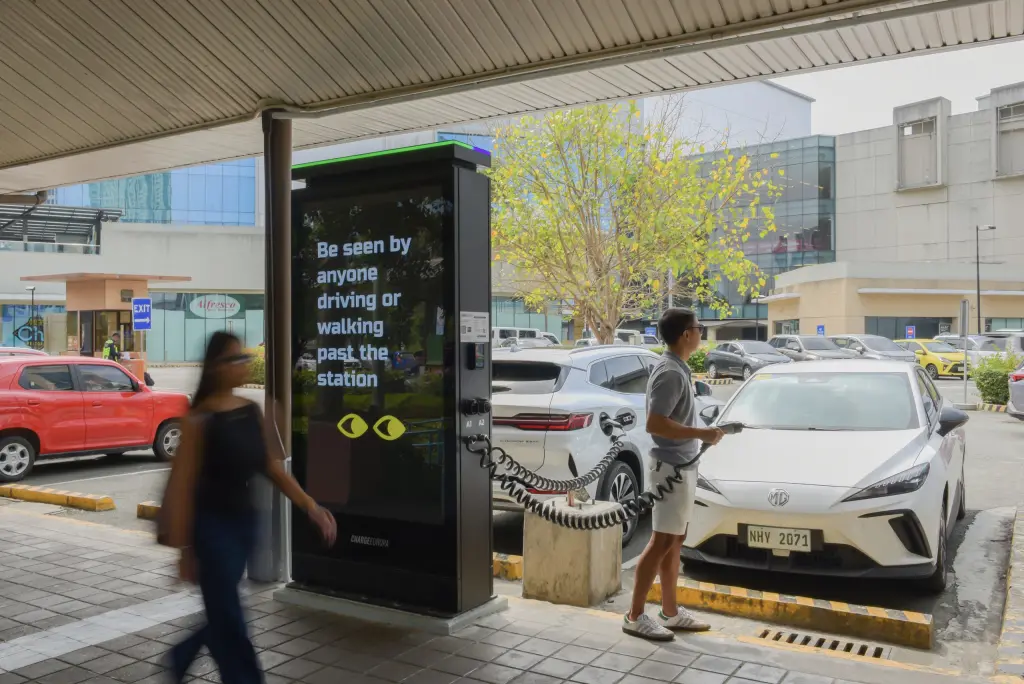
ChargeEuropa’s charging station in the Philippines. / Photo credit: ChargeEuropa
With a surge in EV adoption in the country – in 2024, sales jumped by 21x compared to 2021 – some players learned there was potential money to be earned if they offered charging services. The number of charging points for four-wheeled EVs has jumped from 86 in January 2024 to 413 as of February 2025.
That said, EV charging firms tell Tech in Asia that despite the business’ potential, profits remain elusive, though they stay optimistic. Is it a pipe dream?
Private EV users can’t give full charge
Jose Bienvenido Biona, executive director of the EV Association of the Philippines (EVAP), estimates that eight out of 10 EV owners in the country prefer to charge at home. “It’s still cheaper compared to the charging rate offered in the market,” he says.
For Biona, charger operators would have to adopt a “hybrid” business model, wherein operators onboard a “captive market” for their chargers and offer other services.
For instance, ACMobility – a subsidiary of listed conglomerate Ayala Corp. – has established a charging station that serves both private cars and public buses.
Meanwhile, Polish EV charger operator ChargeEuropa will feature large ad placements to generate additional income. It partnered with Movem, a subsidiary of local utility conglomerate Meralco, to launch public charging stations in the Philippines, the first of which is set to be inaugurated by April.
The ad placements are crucial as they “subsidize” the operations of the charging stations, says ChargeEuropa founder Matt Tymowski. Though he didn’t specify the profit margin the startup earns on ads, he contends that revenue from it is “significantly larger” than revenue earned solely from charging services.
Relying on EV charging alone for revenue will be a “race to the bottom” with competitors to have the most competitive charging rate, says Tymowski.
See also: Battery swapping faces uphill climb in Singapore’s EV market
So far, ChargeEuropa’s business model has worked in its favor. On a “purely net economics basis,” Tymowski says the startup’s operations in Poland are already profitable.
Conglomerates in for the long haul
Riding on incentives
Stay ahead in Asia’s tech landscape
This is premium content. Subscribe to read the full story.
Local regulation nudged conglomerates to build EV charging stations. Now, they’re aiming to make them profitable businesses.
We know this is not ideal. ⌛ Sign up in 20 seconds. Cancel anytime.
Our subscriber community includes professionals from these companies:





Stay updated on the go with our mobile app.
Get latest insights with smoother, more personalized experience through TIA mobile app.