Michael Tegos · · 5 min read
Fresh from hitting $20m in revenue, Rotimatic maker Zimplistic raises $30m
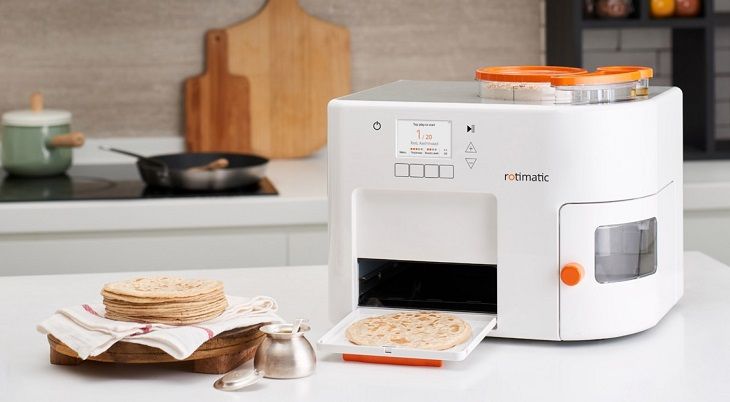
Photo credit: Zimplistic
Singapore-based Zimplistic announced today it has raised US$30 million in a series C round led by private equity firm Credence Partners and EDBI, the investment arm of Singapore’s Economic Development Board. Existing investors also joined the round.
Zimplistic is known for Rotimatic, a household appliance that automates Indian-style flatbread making. The device solves a problem for households that want to have freshly baked flatbread for their meals, but their busy lifestyles turn them toward ready-made, frozen, and generally unhealthy options.
The startup, led by the husband-and-wife team of Rishi Israni and Pranoti Nagarkar, claimed a revenue of US$20 million last year, which was its first year of selling the Rotimatic. Israni says the company now has 30,000 users, up from 20,000 in November 2017.
With the new funding, the startup says it hopes to turn 25 percent of the world’s flatbread-consuming population into Rotimatic users. Israni and Nagarkar tell Tech in Asia that the startup plans to devote the funding to product development and manufacturing, after-sales support improvement, and building up their product brand. “Zimplistic started selling Rotimatic slightly over a year ago. As a young startup, we have a long way to go and many challenges to overcome,” Israni says.
Zimplistic, which started out in 2008 and developed the Rotimatic over the course of eight years, hopes to target the automated kitchen appliance market. The sector is expected to reach US$253.4 billion by 2020, with a compound annual growth rate of 6.4 percent between 2014 and 2020, according to Allied Market Research. The research firm attributes this growth to “increasing disposable incomes, the growing food and services industry, and the increasing health concerns.”
The startup says it has plans for more types of automated devices as part of its vision of a “kitchen of the future,” although it’s not sharing more details for now.
The team is counting on its new and existing investors for active support as they address this new market opportunity. “It’s so rare that you get to work on an invention and creating a new category from scratch. It is very exciting, yet equally hard,” says Nagarkar. Credence’s leadership, consisting of renowned investor Koh Boon Hwee and other veterans from Singapore-based electronics manufacturer Omni, has hardware experience that will be invaluable to the startup. EDBI’s networks and its view on Singapore’s business ecosystem and talent pool is also a big plus. “We didn’t want silent partners,” the co-founders say.
The hardware opportunity
Benjamin Joffe, general partner at hardware startup accelerator Hax, thinks the funding is a positive for the sector, as long as the product makes sense. “Fortunately, this one does,” he tells Tech in Asia.
Joffe thinks Rotimatic’s focus on a specific customer segment shows that a cultural play can be successful. Zimplistic has update the device with settings for pizza and is planning to add features for wraps, tortillas, and more, which would broaden its customer base. Its initial focus on Indian-style flatbread, however, helps it resonate with a specific target audience.
He compares Rotimatic to bread-making machines that proved popular in Western markets, but adapted to Asian cultural staples. “Flatbread might be closer to a rice cooker in its cultural importance and have more stickiness,” he adds.
The Hax team sees potential for Rotimatic in business-to-business (B2B) applications as well. “One trend in appliances – you can call them robots – is to offer close to professional-quality services at home without staff,” Joffe says.
Hax associate Anant Phatak adds that a larger version of Rotimatic could make commercial kitchens more efficient, as they typically need to have two people doing the job of kneading dough and cooking rotis. Joffe points out that Zimplistic could implement a two-pronged strategy, with a more affordable device for households and a larger one for businesses.
Commercial application of a hardware product initially aimed at consumers is certainly one possible route to further growth. Singapore-based startup Souschef, for example, couldn’t quite crack the consumer market with its smart cooking-assistant device, but found new opportunity in refining it as a drinks-mixing device aimed at businesses after a stint with Entrepreneur First.





Stay updated on the go with our mobile app.
Get latest insights with smoother, more personalized experience through TIA mobile app.