Iris Deng · · 4 min read
Outbound travel market may be the best bet for Visa, Mastercard to access China
While “cash or card” is the usual question when standing at a cashier’s till in the west, in China the answer is neither.
Visa and Mastercard, the world’s leading credit card companies accepted in over 200 countries, may eventually enter China after a 20-year wait as part of a potential US-China trade deal.
But China’s transition towards a cashless and cardless society, with nine out of 10 internet users already paying for things with smartphones, means the card giants will likely look to work with the country’s dominant mobile payment providers in key segments, such as outbound tourism.
“Visa and Mastercard won’t be able to change the payment culture that Chinese consumers have formed in the past decade. They have missed the golden era,” said Wang Pengbo, an analyst at Chinese internet consultancy Analysys.
“It will be a rather long process for Visa and Mastercard to establish business partnerships in China and systems capable of handling huge transaction volumes, all in compliance with Chinese regulations.”
For the past two decades, Mastercard and Visa have long sought to enter China’s huge yuan card payment market, but Beijing has been reluctant to let them in. Access to China’s electronic payment market for Visa and Mastercard was one of 10 points agreed to between the US and China after the first Trump-Xi summit in April 2017. And in recent US-China trade talks, it has been reported that China is still open to this idea as part of an overall trade agreement.
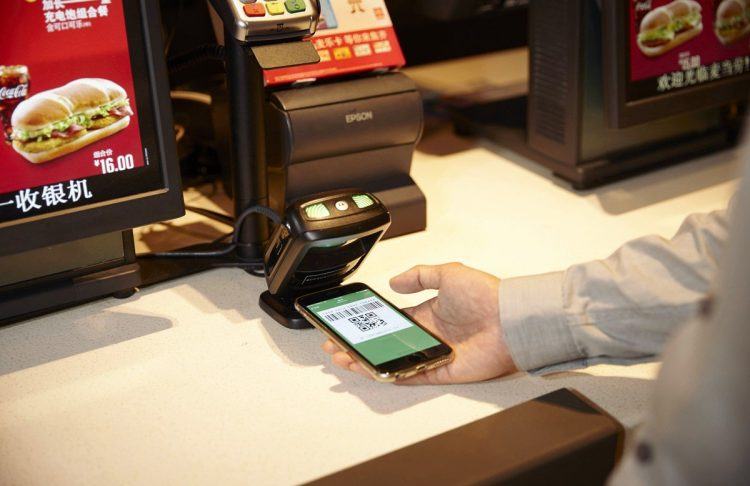
Paying for food with a messaging app / Photo credit: McDonalds
The world’s second largest economy and biggest smartphone market had an estimated 890 million people using mobile payments last year, according to a report on China’s third-party mobile payment market by research firm Ipsos. This vast mobile payment market is dominated by two players: Alibaba-backed Alipay, which has more than 1 billion active users around the globe, and Tencent’s WeChat Pay, which has more than 900 million monthly active users.
Mobile payment transactions reached a record 81 trillion yuan (US$12.8 trillion) from January to October in 2017, according to figures from the Ministry of Industry and Information Technology. Users pay with money deposited in their Alipay and WeChat Pay wallets or through the debit and credit cards they link to these mobile services.
“They [Visa and Mastercard] will be particularly focused on tapping those within China who travel overseas frequently. Despite the expansion of UnionPay, WeChat, and Alipay in overseas markets, using Visa and Mastercard when abroad is still much easier than using Chinese payments systems currently,” said Michael Yeo, research manager for financial and retail insights at IDC.
Mastercard is “in active discussions” with Chinese regulators and making “every effort to secure the requisite license,” according to a Mastercard statement provided last week. It will apply for a bank card clearing license “in the very near future,” the company said.
Visa did not immediately respond to a request for comment.
“The cashless, cardless culture will continue to thrive in China. It’s impossible to return to a less convenient way to pay,” said Lei Ying, assistant professor at Guanghua School of Management of Peking University.
Visa and Mastercard would compete directly with China’s monopoly bank card services provider China UnionPay if they are allowed into China, said Lei, and they would also be up against Alipay and WeChat Pay as platforms that allow users to link multiple cards in one digital wallet.





Stay updated on the go with our mobile app.
Get latest insights with smoother, more personalized experience through TIA mobile app.