Malavika Velayanikal · · 10 min read
An insider’s account of how Go-Jek hit 900x scale in 18 months and is still doubling
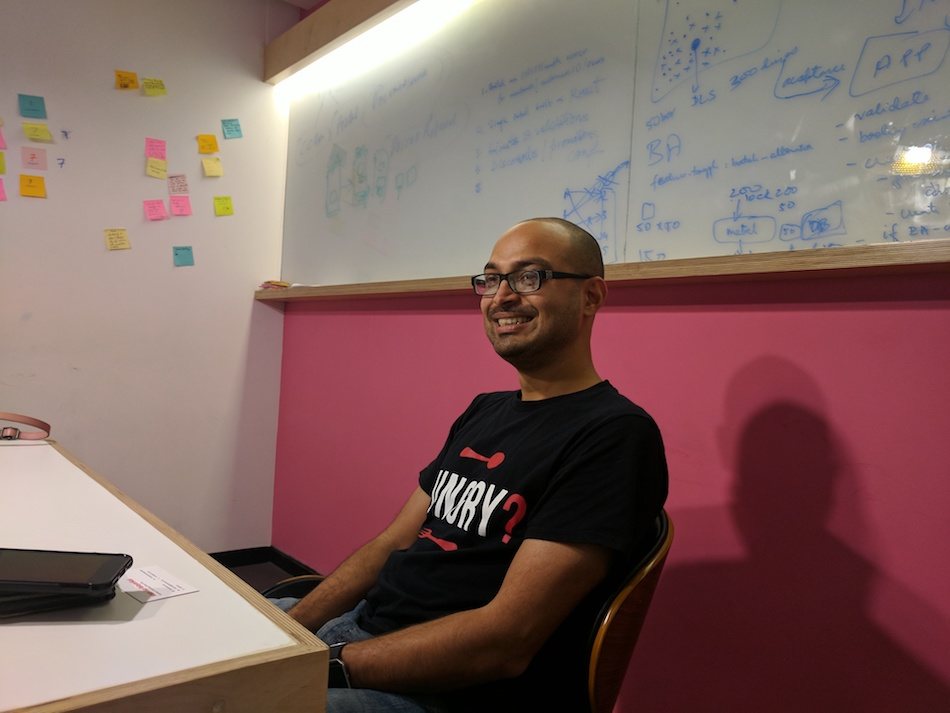
Sidu Ponnappa, Go-Jek’s head of engineering. Photo credit: Tech in Asia.
Go-Jek scaled 900 times in the first 18 months after the launch of its mobile app in January 2015. By June 2016, there were over 20 million bookings on Go-Jek – about 667,000 rides per day. After that, the Indonesian startup turned into a unicorn, raising a funding round of US$550 million. It did all that with a team of less than 80 engineers.
“Even now, across Go-Jek, we may have 200 to 210 engineers, and we’re running [the equivalent of] three unicorns – at least – under one roof,” Sidu Ponnappa, Go-Jek’s head of engineering, tells me.
To give me a sense of proportion, he compares Go-Jek’s volume with other Indian unicorn companies. “We do comparable transport to [Uber’s Indian rival] Ola. We do double the Indian market for food deliveries, as per publicly reported numbers. That means if you take Swiggy and Zomato combined in terms of their published order volumes, we do twice that number. Our payments are of the same order of magnitude as Paytm’s. And we’re supporting all of this with just over 200 engineers across three locations: Jakarta, Singapore, and Bangalore.”
Ponnappa was the founder of Bangalore startup C42 Engineering, which got acquired by Go-Jek. He was meeting me at the Indonesian company’s office in the heart of Bangalore. Most of Go-Jek’s engineers are now based here, even though India is not a market for Go-Jek yet.
The Bangalore tech team powers its ride-hailing product with a string of on-demand services thrown in. “In headcount terms, this is our largest office, but all our teams are distributed. So you’ll find that every single team in Bangalore also has members in Singapore and Jakarta; [and] every single Go-Jek product is executed across these three locations,” Ponnappa explains.
We must be the first company who raised prices so we would have fewer customers [while scaling backend tech].
Go-Jek is Indonesia’s first unicorn. It has raised over US$1.7 billion in total funding so far. The Go-Jek umbrella now covers 18 services – from ride-hailing to massage at home. It lets users find connecting bus rides, book tickets to events, or get their cars serviced and parcels delivered.
But when I asked Ponnappa to pick the Go-Jek product that excites him most, he says Go-Jek is actually just two products: logistics and payments.
“Everything we do is an intersection between the two. If you look at logistics, we have the same fleet delivering multiple services. In fact, that’s the advantage we have,” he says. “The same driver who will deliver your breakfast will also drop you [off at] work and then come back to pick up your keys if you’ve forgotten them.”
Technology is not a means to an end for him; it’s a medium. If you don’t understand the medium, you can’t do good stuff with it. “If you look at it transactionally – like what I care about is this outcome, and I don’t care how you do it – you’re not going to be able to leverage the medium to its fullest and that’s something that Go-Jek just gets right.”
Unforeseen scale
All-nighters
Firefighting mode
Hiring challenge





Stay updated on the go with our mobile app.
Get latest insights with smoother, more personalized experience through TIA mobile app.