 J.T. Quigley · · 5 min read
Todai to Texas: These Japanese hardware startups wowed the crowd at SXSW (part 2)

Japanese hardware startups were out in force at this year’s SXSW Interactive. In fact, the Japan section of the SXSW trade show was the largest display by any foreign country that made the trip to Austin.
The University of Tokyo’s “Todai to Texas” area, which showcased 10 up-and-coming hardware startups, made up the bulk of the Japan section and was one of the event highlights. You can read all about Todai to Texas and their first five startups in yesterday’s post.
Without further ado, here are the remaining five:
AgIC x Mesh Project

Circuit-board printing startup AgIC is, undeniably, one of Japan’s fastest-rising tech stars. Last year, it won pitch contests at both the Btrax-sponsored Japan Night VII and TechCrunch Tokyo. Then in January, it rang in the new year with a US$830,000 angel investment round. The startup even recorded US$125,000 in annual sales for 2014.
At SXSW, AgIC was joined by the Sony-backed Mesh Project to show off what appeared to be a futuristic take on the Japanese zen garden. Clear tubes containing AgIC’s printed circuit boards were placed in the garden, each performing sound or light functions based on Mesh’s “Canvas” visual programming software. Mesh, which allows users to harness the power of “internet of things” with a simple drag-and-drop interface, was successfully funded on Indiegogo earlier this month.
“We wanted to make a creation tool for creative people,” explained Mesh Project head Takehiro Hagiwara. “[This collaboration] isn’t just for engineers, but for designers and regular people without knowledge of circuit boards or programming. We hope they can create smart inventions easily.”
SenSprout
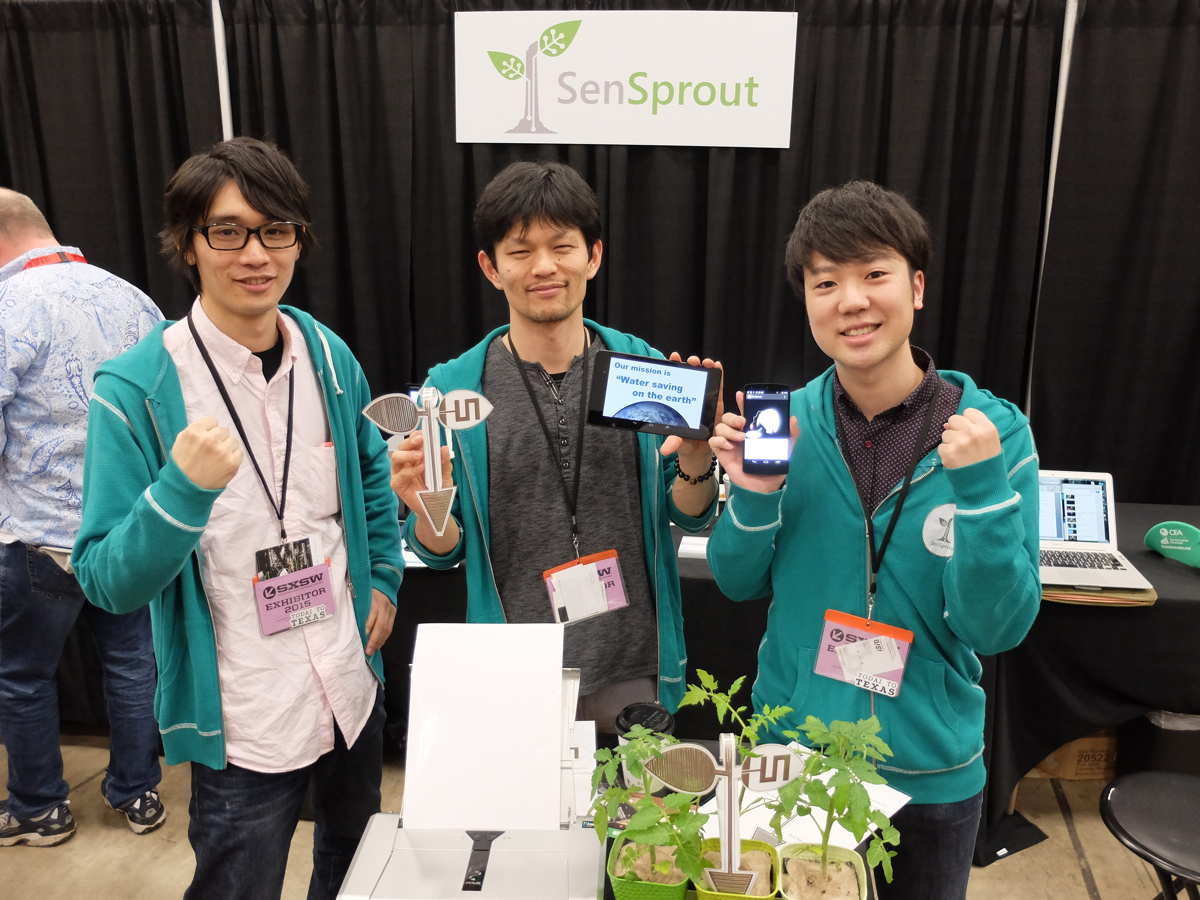
In the future, clean water could become a commodity more valuable than gold and platinum. Less than 1 percent of the Earth’s water is drinkable, and more than 80 percent percent of it is used for agriculture. With an ever-increasing human population, it’s clear we must find a way to divert some of that agricultural water to thirsty people.
Enter SenSprout, a leaf-shaped sensor that allows farmers to remotely measure rainfall and soil moisture levels. Of course, such sensors already exist – but deploying them across an entire farm can cost tens of thousands of dollars. SenSprout, on the other hand, uses printed circuit boards (courtesy of AgIC’s conductive ink) to cut the cost exponentially.
“Traditional water sensor probes costs over US$100 without monitors or data loggers,” explained SenSprout co-founder Kazuhiro Nishioka. “Our sensor costs less than US$50 with a monitor and data logging system included thanks to accessing the cloud via a user’s smartphone.”
Nishioka said that a future version will also include a sensor that checks the nutrient content of the soil. He hopes to market the sensor to the California wine industry and will also attend SXSW Eco in October. SenSprout was the winner of the Todai to Texas pitch contest.
Exiii
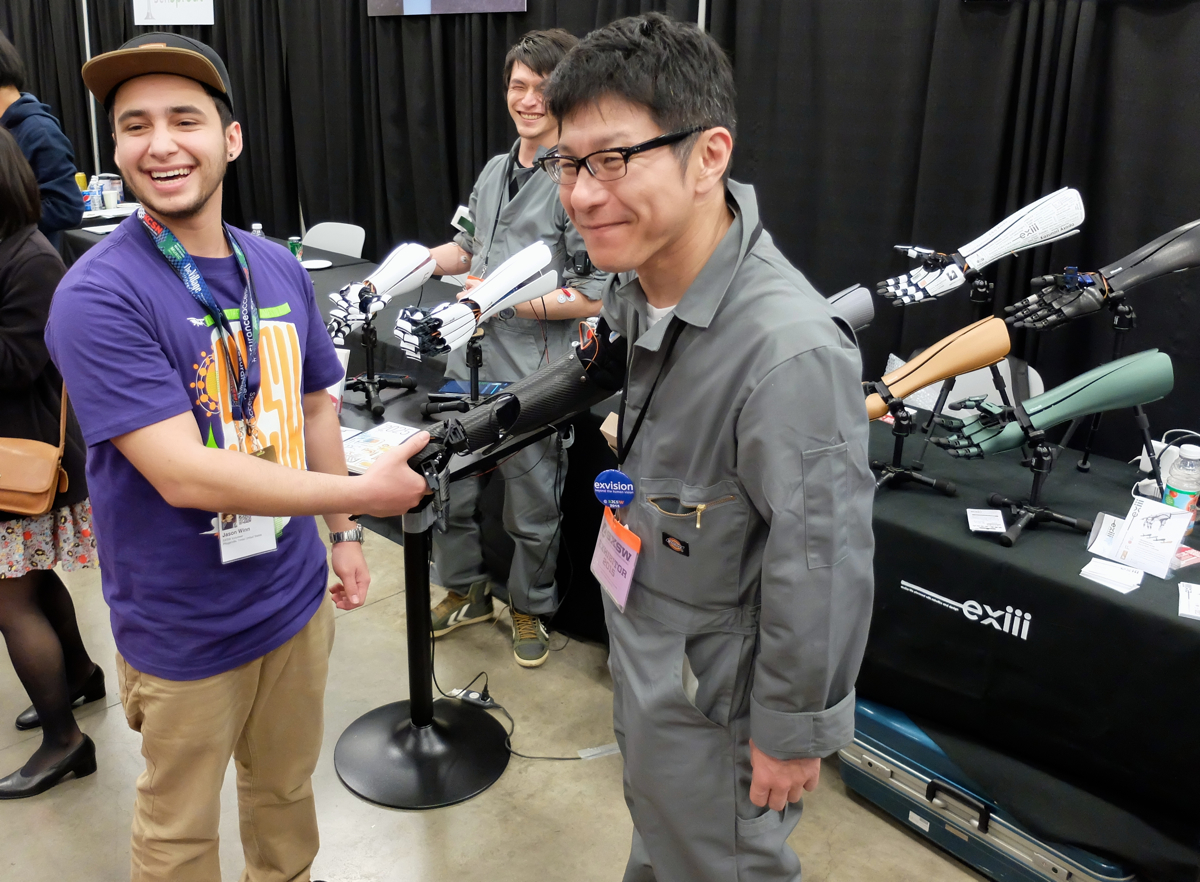
After two full days of wandering around the SXSW trade show, I can write with confidence that Exiii drew more attention from attendees than any other booth in the convention center. It’s no surprise why: the startup has created an affordable 3D-printed robotic arm for amputees and those born with missing or partial limbs. By combining the kind of futuristic tech that westerners expect from Japan with a mission to actually help others, Exiii’s “Handiii” solidified itself as the feel-good hit of the show.
Handiii features a custom linkage mechanism that allows its three-joint fingers to grip objects using a single motor. To further decrease costs, a user’s smartphone replaces the arm’s purpose-built computer for signal processing.
“We traveled to SXSW to simply see the reaction from the audience,” Exiii CEO Genta Kondo told Tech in Asia. “We’re open to opportunities, of course, but we really just want to see how the world reacts to [Handiii].”
Kondo said that the device has been in development for a year and a half. The CEO studied cybernetics at the University of Tokyo and previously worked for Sony and Panasonic.
“To make this kind of prosthetic practical, price and design is so important,” Kondo added. “Now that we have 3D printers and smartphones, I realized that I could make something better than what I had seen before, even with just three members on our team.”
Akira Morikawa (pictured above) is Exiii’s evangelist and first test user. SXSW attendees were queuing up to shake his bionic hand.
Phenox2
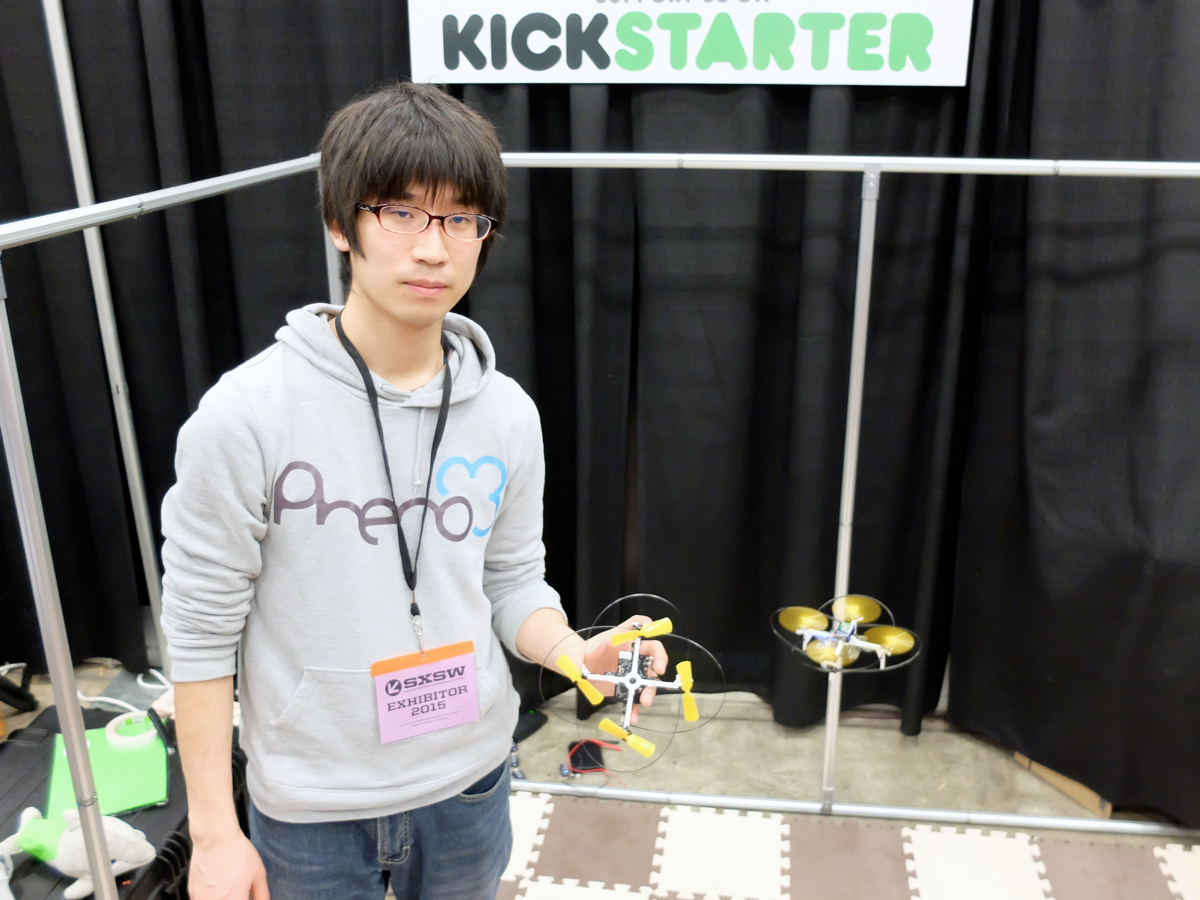
Love ‘em or hate ‘em, drones are one of the biggest gadget booms of late. Phenox2 is the latest iteration of the autonomous mini-drone after a successful Kickstarter for version 1.0 last year.
Phenox2 features a custom intelligent self-control system (ISCS) that allows it to maneuver based on visual feature points like specific colors and patterns (i.e. hovering over a black square on a white floor). Using dual cameras and a microphone, it can follow a user based on vocal cues and land in the palm of your hand – no remote control required. It’s also Linux-based, allowing users to write custom flying programs and install them directly on Phenox2’s on-board computer.
The drone’s creator, Ryo Konomura, said that he came to SXSW to announce a fresh Kickstarter for the latest version. The original Phenox was limited to 30 units because it was made by hand, but the current Kickstarter (with an ambitious US$100,000 goal) hopes to raise enough money for mass production in Japan.
Re: Sound Bottle
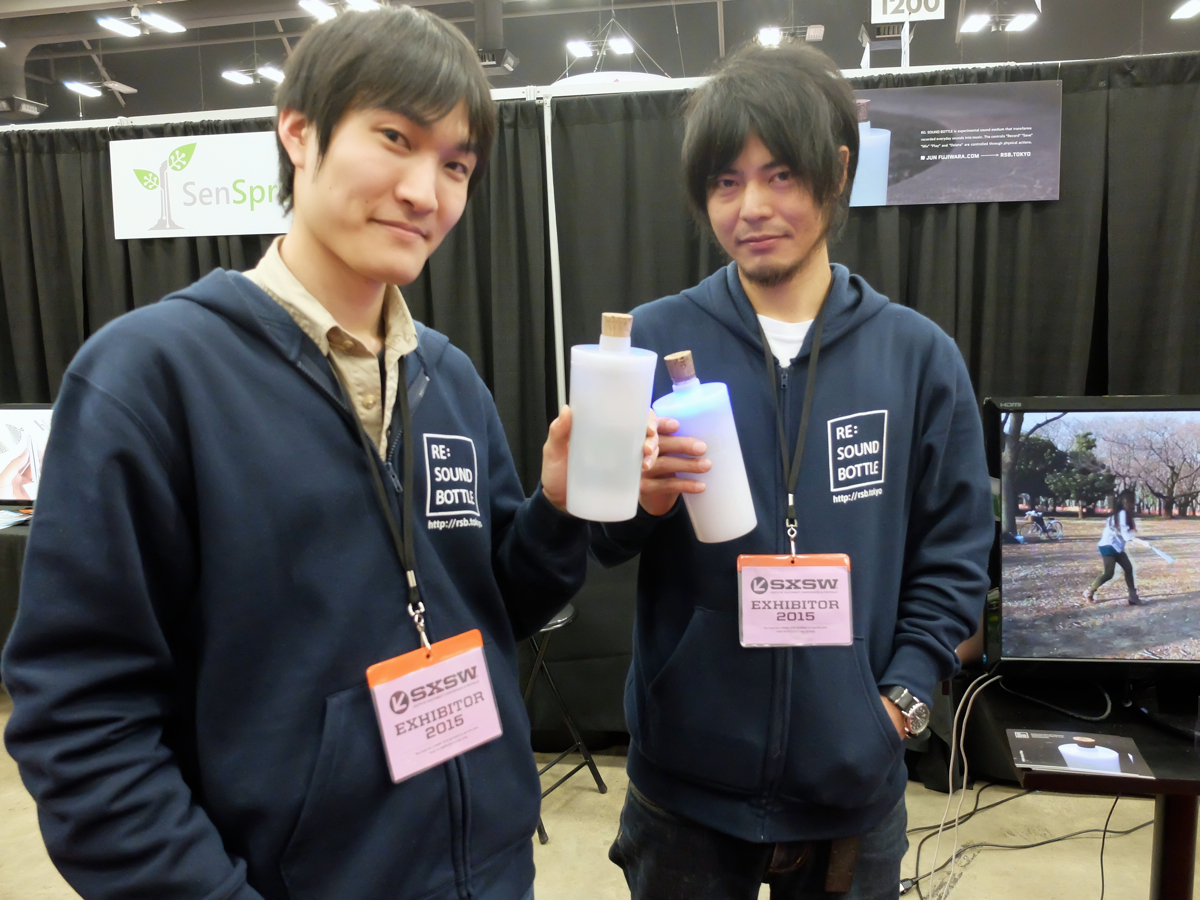
Re: Sound Bottle is an experimental music creation device that automatically mixes whatever sounds a user captures. Simply uncorking the bottle initiates the recording process, and returning the cap stores it. Up to six sounds can be captured and simultaneously mixed by the on-board software at a time. It’s like having your own personal DJ in a bottle.
A simple LED interface allows users to control the volume and BPM, and an SD slot can be used to save music or add pre-recorded sounds. A spokesperson told Tech in Asia that Re: Sound Bottle will hit Kickstarter by the summer.
Stay updated on the go with our mobile app.
Get latest insights with smoother, more personalized experience through TIA mobile app.
Recommended reads
 Indonesian AI startup goes global
 Forrest Li on scaling Sea, building smarter bots, and founder grit
 An AI assistant that joins sales calls and scores team skills
 Beyond the check: Why VCs need more than capital
 SGX’s CEO says it doesn’t need a unicorn to win
 SMEs want AI too, but not the kind Big Tech is selling
 Oatside’s alt-milk rise hits a profitable gear
 Alibaba’s financial health in 12 charts
 Asia’s telcos bundle AI into mobile plans. Will it pay off?
 M-Daq chases bigger clients as revenue falls, losses grow





Editing by Steven Millward
(And yes, we’re serious about ethics and transparency. More information here.)



