 Daniel Tay · · 8 min read
In the startup world, personality types can become a prison
If you’ve been keeping your finger on the pulse of the startup world, you’ll have noticed that the topic of introverts in the workplace has come up a lot. In particular, many have been doggedly extolling the upside of being an introvert – headlines such as The Secret Power of Introverts and Why Introverts Make Great Leaders have been popping up across the web recently.
And then there’s also the bestseller Quiet: The Power of Introverts by Susan Cain that got the ball rolling.
Many of these articles have excellent arguments on why introversion has its benefits. The first article mentioned above, for example, has a section named “The hidden value of introverts” that reads like an advertisement for introverts (on behalf of all introverts, I thank you). Of course, the writer balances it out nicely by concluding that, well, it’s all “about balance”.
But let’s not gloss over the prevailing opinion, which continues to be that entrepreneurs need to be hand-shaking, party-loving extroverts in order to succeed. Many less outgoing people still believe that they can’t be ‘good entrepreneurs’, or even play a big role in a successful startup because they feel that they won’t be able to wheel-and-deal like the best of them.
The pressure to be more extroverted, as it is, doesn’t seem to be abating at all – this despite an increasing literature fighting against the status quo.
Is this debate ‘useless talk’?
The thing is, labeling oneself as purely an introvert or extrovert is fundamentally incorrect – unless you have a personality disorder, that is. The psychologist Carl Jung, who coined the terms ‘extrovert’ and ‘introvert’, reportedly said that there is no such thing as either, and added that such a person “would be in the lunatic asylum.” It is instead useful to think of human personality as a gradient:
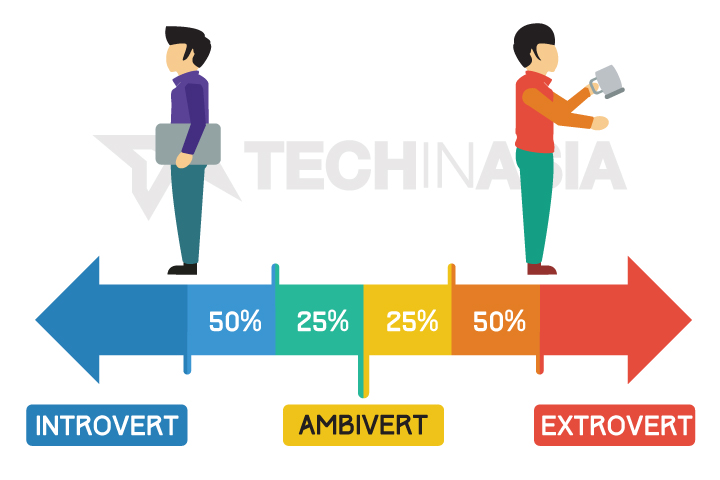
Simply put, humans are complex creatures, as are our personalities. It is all too easy to get trapped in a box of your own making by convincing yourself that you are one or the other in definite terms – and no, a personality test doesn’t prove anything definitively.
Experienced entrepreneurs know better than to pigeonhole themselves based on their personalities. Darius Cheung, a seasoned Singaporean entrepreneur, scoffs at the excuse that being introverted somehow diminishes your chances of becoming a ‘good entrepreneur’:
Startup people do what it takes to get things done, including switching personalities when the situation calls for it. If an entrepreneur says that [being an introvert works against them], he or she shouldn’t be an entrepreneur.
He has good reason for feeling bemused by this notion. In his previous startup, Homie, he was the team lead for marketing, sales, and fundraising. As such, he had to train himself to be more extroverted, which he claims was a step away from his natural personality.
“Entrepreneurs should figure out how to leverage on their strengths to overcome the weaknesses,” Cheung says. “There are advantages and disadvantages of being anything – Asian or American, rich or poor – but getting caught up with such talk is simply useless.”
Cheung considers himself to have a foot in both worlds today, depending on the situation.
Harder for some than others
Making the necessary adjustments
Introverts are great workers, too
Seeing success in a startup





Stay updated on the go with our mobile app.
Get latest insights with smoother, more personalized experience through TIA mobile app.












📅 Upcoming Events
22 October 2026
Payoneer x CSPN Summit 2026