- Premium Content It takes our newsroom weeks - if not months - to investigate and produce stories for our premium content. You can’t find them anywhere else.
 Putra Muskita · · 10 min read
Can online food delivery ever be profitable?
For many of the world’s biggest online food delivery platforms, being profitable in a thin-margin space remains elusive. But China’s Meituan-Dianping seems to prove that it’s entirely possible.
After weathering some rough waters after its initial public offering, Meituan-Dianping recorded close to US$400 million in net profits for 2019, with more than half of the company’s revenue coming from food delivery. Meanwhile, its US counterparts Uber and GrubHub are still striving for profitability.
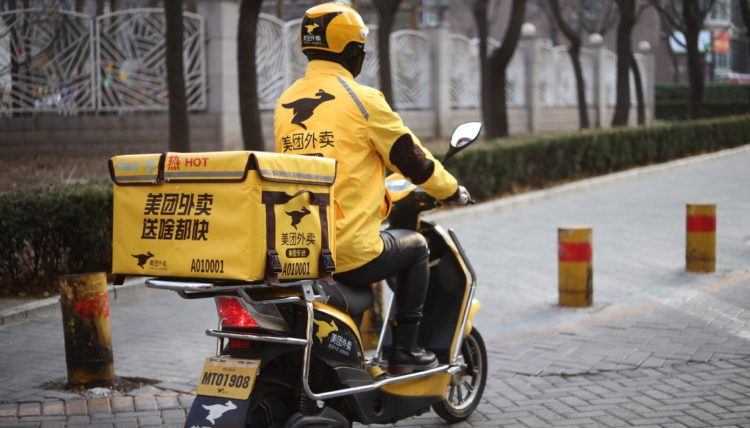
Photo credit: Meituan-Dianping
But the Chinese company’s success raises this question: Can others replicate its success in markets other than China? Meituan-Dianping benefits from some advantages, such as the country’s densely packed megacities, highly developed infrastructure, and even relatively lax parking regulations.
These same factors can also be found in Southeast Asia. That said, the region’s food delivery space is in its early stages and remains unprofitable – a new Reuters report says that GrabFood’s Thailand business is still making a loss.
Densely populated megacities
On the whole, food delivery is typically an efficiency game. Margins are thin, and the traditional path to profitability lies in attaining high volumes while keeping costs down.
Therefore, the denser and more populous a city is, the more efficient it is for food delivery platforms. A delivery rider can fulfill more orders in a shorter span of time if they’re covering a smaller area.
“The market size at a country level is not important; the market size across top cities is what matters,” says Sangeet Paul Choudary, founder of Platformation Labs and author of the book Platform Revolution. “Delivery economics are impacted by route optimization. Density and parking [regulations] are the biggest factors there.”
Chinese cities are generally much more densely populated than American ones. As Bloomberg points out, China’s urban areas have 2,426 people per square kilometer, almost eight times the comparable density. The US has 10 cities with a population of over 1 million, but China has over 100. For example, Liuzhou, China’s 50th largest city, has 2.1 million people.

Cities in India and Southeast Asia also tend to be densely populated megacities, which should give them a similar demographic advantage. Metro Manila in the Philippines has a population density of 21,000 people per square kilometer, while Indonesia’s Jakarta has 14,464 people per square kilometer. The latter does not even include the surrounding areas that make up Jakarta’s metropolis, which is home to an additional 20 million people who mostly spend their days within the city limits.
Of course, some of the biggest American cities like New York City or Chicago have comparable population densities. But ultimately, the US doesn’t have as many as China or Southeast Asia do.
Efficiency can go beyond demographics, however. It matters where a city’s restaurants are located, according to Jianggan Li, founder of venture builder Momentum Works and a former managing director of Foodpanda in Singapore. Delivery is always more efficient with streetside establishments because couriers can leave their bikes directly out front. In comparison, restaurants inside shopping malls require couriers to park in a designated area first before they can make their way into the building.
Low “multihoming” costs
A good omen for the super-app model
Stay ahead in Asia’s tech landscape
This is premium content. Subscribe to read the full story.
Meituan-Dianping’s success is partly due to China’s demographic advantages, but there are other factors that Southeast Asian players can emulate.
We know this is not ideal. ⌛ Sign up in 20 seconds. Cancel anytime.
Our subscriber community includes professionals from these companies:





Stay updated on the go with our mobile app.
Get latest insights with smoother, more personalized experience through TIA mobile app.






📅 Upcoming Events
22 October 2026
Payoneer x CSPN Summit 2026