- Insights This article was written by a TIA community member. Insights pieces undergo the same rigorous editorial process that newsroom-produced articles have.
 Benjamin Joffe · · 6 min read
How hardware startups succeed or fail

Photo credit: Goran Bogicevic / 123RF
Benjamin is a TIA Star Contributor and publishes high-value content that serves the Asian tech community. Read more from TIA Star Contributors here.
The folks at CB Insights dug into their data to identify the causes of hardware startup failures. Their short list included:
- Lack of consumer demand
- High burn rate
- Lack of interest after initial crowdfunding
- Product strategy mistakes
Yes, make something people want and don’t run out of money. But how should you do that?
We looked into what happened to our pool of 200+ hardware companies and came up with some insights. We tried to find the root causes of failure using Toyota’s Five Whys, a method to prevent repeating mistakes. We mind mapped the various parameters and it led to some interesting (yet somewhat confusing) results.
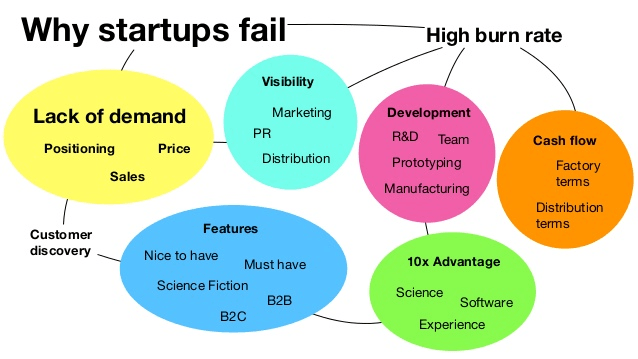
We can’t quite find the root yet.
How do you avoid lack of demand?
- Do proper customer discovery research.
- Clarify your positioning and message.
- Determine must-have features, and don’t get carried away by the appeal of spectacular-yet-useless features (“dogs vs demons” problem).
- Make sure your price is OK (too expensive = no sales).
- Don’t forget PR, marketing, and distribution (the best tech won’t win without visibility and a clear message).
How do you avoid high burn rate?
- Move to where you have low expenses and where you can build fast and cheap. Time is money! The most suitable location might change depending on the focus (R&D, prototyping, production, sales, etc.).
- Your factory should give you not just a good price but also good terms. They can act almost like a bank and save your cash flow. Same deal for distributors.
In fact, startups die because they don’t reach milestones that unlock new resources. In some cases, a milestone is not really “verified” demand (look at Magic Leap, which raised billions without a product in the market). In hardware, those milestones are generally lab prototype -> Works Like, Looks Like -> design for manufacturing (DFM) -> product -> US$1 million sales, then US$3 million, US$5 million, and so on until profitability. (However, it doesn’t seem to be necessary. Razer, for example, did an IPO with a loss, but still resulted in a valuation close to US$5 billion).
How do you reach milestones?
By understanding that it’s all about learning. Beyond tech, founders need to learn about positioning, prototyping, manufacturing, PR, marketing, sales, distribution, logistics, financing, customer service, product management, team management, and self-management. Learn fast, then execute.
Startups that failed
Based on our experience, there are four main reasons why startups fail:
- Too niche: Sometimes they can expand, but sometimes they couldn’t. This was more common in the early Hax programs around five years ago.
- Founders don’t get along: While this doesn’t happen frequently, it probably carries the highest risk before shipping.
- Giving up: If founders give up after trying hard for two years, we would probably understand (and help). Earlier than that, it might feel that you just didn’t try hard enough, and that our money and efforts would have been better spent on someone else.
- Too slow: You’re running against the clock. Execute slowly and you’ll surely run out of money before your next milestone. In some cases, this happens when founders go back to R&D— a risky move—instead of delivering an initial less-than-ideal-but-still-acceptable product.
Startups that did well
Startups that recovered
Conclusion





Stay updated on the go with our mobile app.
Get latest insights with smoother, more personalized experience through TIA mobile app.