Terence Lee · · 4 min read
On JFDI-Innov8 Bootcamp Demo Day, startups pitch and score homeruns
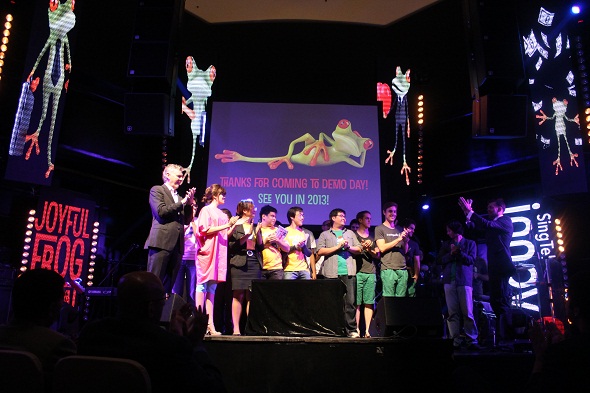
Watching each startup deliver their pitch at the JFDI-Innov8 2012 Bootcamp Demo Day, I get the sense of witnessing a child taking her first tentative steps or going to school for the very first time.
At the accelerator program, the first of its kind in Singapore, promising entrepreneurs, who had nothing but ideas, had to undergo an intense regimen of mentoring, training, and product development.
Mentors in the bootcamp came from all around the world as well as from Singapore, consisting of entrepreneurs who have gone through the whole agonizing process of creating a product people actually want.
Glancing across the room, amidst the glaring stage lights and about a hundred curious investors, those very same mentors are egging the startups on stage to succeed. The incubatees took turns to demostrate their products: Refined, refreshed, and in some cases, completely rehashed after the 100-day bootcamp.
And they rocked. The consensus among the attendees was that the pitches were polished and well-delivered. There wasn’t a single bad pitch.
Business ideas were solid and addressed valid pain points, although some were concerned about how easy it is to copy some of those products.
But the fact that the presentations were nice and shiny isn’t an accident. The pitches were appalling at first, Edgar Hardless, CEO of Singtel Innov8, and vastly improved only with much coaching. Many of the startups pivoted after much critical feedback as well.
An extreme example is Gradeful, a mobile app for dads, which pivoted on Day 80 to become Remember, a mobile photo scrapbook for families. HobbyMash, too, pivoted in Day 50 to become FamilyKo, after realizing that it would be hard to monetize their original idea.
At the end of the pitches, the startups went to their corners and waited as investors flocked to find out more about the teams and their products.
While there was quite a lot of variety in the 11 teams, SoLoMo, a term which I use grudgingly, is still very much alive and well. Most of the startups have some element of each, and it looks set to be the wave of the future.
Analytical tools featured big as well in startups like TradeGecko, Stubb (formerly Qryo), and FetchFans, indicating how businesses are increasingly embracing data-driven decision-making.
What is surprising to me are the amount of family and child-oriented startups around. FamilyKo and Remember deal with the themes of using mobile devices to bridge the divide between children and their busy or geographically distant parents. Kark and Wildby revolve around educating children in interactive and age-appropriate ways.
From what I have seen and heard, many of the teams have generated great interest and buzz from investors, and some were oversubscribed.





Stay updated on the go with our mobile app.
Get latest insights with smoother, more personalized experience through TIA mobile app.