 Terence Lee · · 5 min read
Om Malik doesn’t give a shit if people don’t invite him to parties

Om Malik is an institution in the tech journalism world. At 48, he’s seen many booms and busts in his stints at Forbes, Red Herring, and Business 2.0. He then started respected tech blog GigaOm in 2006. The industry was shocked when it shuttered its doors more than a year after he left his day-to-day role to become a venture capitalist.
But as he spoke during a fireside chat at the Tech in Asia Tokyo 2015 conference, it was clear that the journalism spark has not left him. “I always had one master to serve. And that was the reader. I didn’t give a shit if the people didn’t invite me to their parties.”
All he cared about was for readers to accept GigaOm into their lives. “A sign of a good reporter is when the CEO hates you.”
Yet this fundamental aspect of tech journalism is often forgotten as the hype cycle reaches its zenith, as valuations soar, and as more investors join the fray to cash out. People caught up in the hype tend to write what Om calls the “spectacle of tech.” They only touch the surface and don’t go deep into the dynamics of the story.
Om sought to avoid that at GigaOm, which diversified away from an advertising and eyeballs driven model by adding events and subscription fee revenues. But that didn’t pan out as the company took on massive debt and had a research product that didn’t work out as expected. He was not involved in the company’s daily affairs by then.
He did not dwell too long on GigaOm’s abrupt shutdown during the chat, but he did elaborate on the challenges he faced running the site. Scaling the site was a problem, since it existed before the social web grew in popularity. So while they had an idea of how they’d do it, it was the younger generation at Mashable, Huffington Post, and Buzzfeed that mastered virality.
Further, their content strategy wasn’t in sync with social media. They focused on adding value to readers, and as a result took a longer time to craft each article. Timely and snackable content, on the other hand, was often what got the widest reach on social networks.
“Let’s just say we tried to do some damage control, and it was really, really hard, and a little late. We had gone down a certain path and that path was very expensive and it caused more problems than we realize.”
Om laments how GigaOm’s demise meant that a lot of companies who do real tech are getting less attention. It takes a lot of care to explain the ideas behind these companies, and they may not necessarily have mass appeal.
Avoiding “bubbletalk”
Om sees Buzzfeed and Vice as the torchbearers of the hyperscale online media – getting massive audiences and earning from advertising. However, these opportunities require special people who can raise tons of money and scale up the operation rapidly.
Yet he also sees opportunities in niche media, bringing up examples like Skift and the Business of Fashion. “Big is not better. Unfortunately, the culture, wherever you go, focuses on the success of the big. So everybody wants you to become big, not better,” he tells me on the sidelines of the conference.
Niche media does not require as much fundraising, yet it’s possible to build a profitable business. He adds that if he were to start something new, it would be a niche media site because it’s easier to build, focus, and find the market. He brought up an example: a community of smartphone photography enthusiasts. Ultimately, community is what niche media thrives on. It’s not about content, but bringing people together to talk about issues of the day.
With so much untapped potential in online media, does Om feel compelled to leave behind his venture capitalist job and go back into media?
“No,” he says, interrupting the interviewer mid-sentence. “I am done dealing with the advertising-based media models. I’ll let other people grow old doing that.”
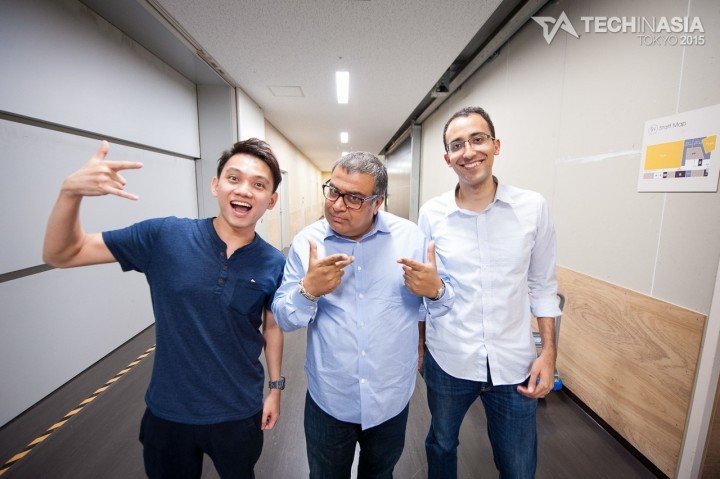
Om Malik. Like a boss.
Om still writes these days. He freelances with the New Yorker and other publications, and he pens down whatever he fancies on his personal blog. “Probably tonight I’ll write about a bar I went to last night.”
Nonetheless, as a partner at True Ventures, he’s applying the same principles he learned as a media person to investing. Instead of worrying about bubbles and valuation fluctuations, he’s focused on the long-term, noting how technology goes through a long period of incubation before breaking out.
He gave two examples. First, the steam engine. After it was invented, it went static for 40 to 50 years, relegated to niche functions like pumping water out of mines.
“Then, somebody had a bright idea: what if we put a steam engine on wheels and see what happens? Well, massive-scale industrialization happened,” he says.
Om also mentions the microprocessor. Once confined to the four walls of homes and offices, it’s now mobile, thanks to Moore’s Law and wireless technology. Now computers sit in our car, on our wrist, and will soon get into everything.
“This is going to be a long shift. It’s not going to be two years and three years. Valuations may go up or down, but if you’re building things of value, they will exist for a long time. I think that’s what people need to focus on.”
He sees no upside in talking about bubbles, and he poured scorn on the term “unicorn” – which refers to tech firms above US$1 billion in valuation.
“A unicorn is a mythical thing which doesn’t exist. It’s a big fat lie. If you’re calling yourself a unicorn as a company, you’re a big fat lie. Why don’t you just say what you are, that you’re a startup with some valuation? I get really teed off on that.”
Getting angry over overused words? Picking out the real story behind the news? Speaking with brutal honesty?
Sounds like the journalist in him is very much alive.
This is part of the ongoing coverage of Tech in Asia Tokyo 2015, our annual conference taking place on September 8 and 9.
Stay updated on the go with our mobile app.
Get latest insights with smoother, more personalized experience through TIA mobile app.
Recommended reads
 50 rising startups and tech companies in India
 Hooq offers stark lessons for remaining video-streaming players
 Letter to readers: Temasek’s stunning move; Hmlet’s layoffs
 20 fresh tech and startup jobs in Asia this week
 How much is your startup worth? We heard the perspective of a VC.
 The Singles Day black hole
 A VC’s advice for startups looking to take the next step in their growth journeys
 What it takes to scale an engineering team, from 2 CTOs
 The six crucial components of a pitch deck





Editing by J.T Quigley
(And yes, we’re serious about ethics and transparency. More information here.)



📅 Upcoming Events
22 October 2026
Payoneer x CSPN Summit 2026