- Insights This article was written by a TIA community member. Insights pieces undergo the same rigorous editorial process that newsroom-produced articles have.
 Jeffrey Towson · · 4 min read
4 things people are getting wrong about Meituan-Dianping
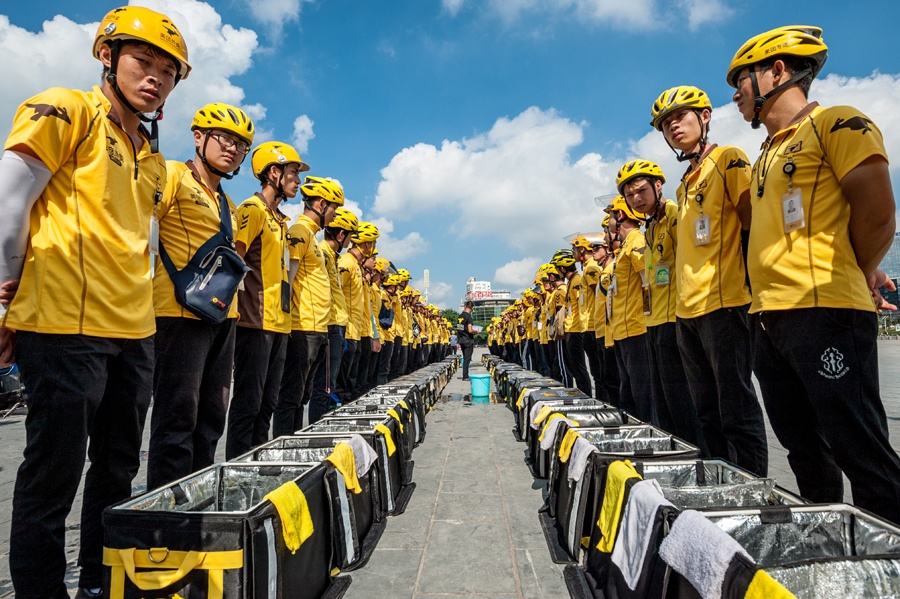
Meituan-Dianping’s delivery staff / Photo credit: Meituan Dianping
Jeffrey is a TIA Star Contributor and publishes high-value content that serves the Asian tech community. Read more from TIA Star Contributors here.
I recently visited the Meituan-Dianping headquarters in Beijing, and I summarized my three takeaways in a previous article.
In this part, I’m going to argue against some of the common statements I hear about Meituan. This is what I think (in my humble opinion) a lot of people are getting wrong.
Myth 1: Meituan is only food delivery
From their now public financials, we can see that more than 70 percent of their daily orders are in food and delivery (about 20 million orders daily). So, the company remains concentrated in food (dine-in and delivery). This is a pretty good place to be in, given the high frequency of these particular services.
But expansion into other consumer services is critical, and the company is doing that quite aggressively. The main verticals they mention are hotels, lifestyle (entertainment, ticketing, wedding, beauty), and transportation (bike-sharing via Mobike and maybe ride-sharing).
While these services are a small percentage of their daily orders today, they are still in the millions of orders daily. The operating margins on these other services also tend to be much higher than in food delivery.
Hospitality is the Meituan service I am watching most. The company is number two or three in hotel bookings in China, a space they could win big in. Ctrip is number one by a long way, but they have stayed within travel and hospitality. So, it is unclear to me whether such an approach can win against broader services platforms like Meituan and against “product plus services” platforms like Alibaba.
Myth 2: Food delivery and O2O are unprofitable
Local services and O2O are not as immediately profitable as things like hotel bookings and dining reservations; you have additional costs, like putting bicycles on the streets and paying delivery.
But according to Meituan’s financials, they have a gross margin of 36 percent overall (with food delivery being lower at 8 to 10 percent). This should increase as they move into other services. They also have around 290 million monthly average users, with an average customer using their service once a month. So basically, you have a big volume of activity with a healthy gross margin overall.
Despite big marketing expenses, the company is operating close to breakeven. They should start making operating profits soon, depending on growth and competitor behavior.
The losses that O2O leaders incur have mostly been on early-stage competition (fairly common in China). This phase is pretty much over in much of O2O, and only Ele.me and Meituan are left (although others could enter).
Myth 3: Meituan is going into too many things
A part of me agrees with this. Meituan is jumping into tons of services (bike-sharing, ride-sharing, ticketing, etc.), and they are taking on everyone from Alibaba, Ctrip, to Didi.
But strategy doesn’t really help in the front lines of digital China, where it’s usually just a frantic sprint. Companies don’t have time for strategy; they roll out products and services as fast as they can and respond to what their competitors are doing in almost real time. Strategy is just not as important as innovation, culture, and speed.
Myth 4: Meituan can’t go international





Stay updated on the go with our mobile app.
Get latest insights with smoother, more personalized experience through TIA mobile app.