Samantha Cheh · · 5 min read
From offline to online: Tokopedia is bringing Indonesia’s mom and pop shops into the future

You could argue that the humble warungs – small family-owned kiosks peppered throughout Indonesia – are the tiny but powerful engines of the archipelago’s economy.
They account for almost 60% of the country’s gross domestic product and 97% of its domestic employment while also collectively serving as an important social institution that helps Indonesians easily access basic essentials.
We are now seeing many of these small to medium-sized enterprises making the move to online, which could have an outsized influence on Indonesia’s road to recovery post-Covid-19 and beyond.
The pandemic resets the conversation
Digital platforms have proven to be a lifeline for many businesses as consumers move to online shopping en masse. According to research conducted by the University of Indonesia with Indonesian technology company Tokopedia, online selling not only revived pandemic-affected businesses but has also helped many sellers who used to operate exclusively offline. As many as seven out of 10 sellers on Tokopedia’s merchant platform managed to increase their sales volume by an average of 133%.
That said, many of the estimated 3.5 million warungs scattered across Indonesia remain offline entities that rely on manual operations. They lack access to a robust internet connection, sophisticated technology, and basic financing, says Karina Susilo, head of Mitra Tokopedia, the online marketplace’s seller-centric platform designed to help warungs get easy access to wholesale and digital products while also providing payment and delivery services.
The pandemic has pushed many mom and pop stores to overcome their hesitance. Since they bear the brunt of Covid-19’s economic devastation, they have come around to seeing digitization as a necessity, says Doni Nathaniel Pranama, who co-leads Mitra Tokopedia with Susilo.
Making the leap to an expanded universe of goods
The Mitra Tokopedia team understands that acknowledging the necessity of going online and actually making the transition are two different things. It set out to make the process as easy and non-intimidating as possible, even going as far as doing homestays with the owners of these mom and pop stores to get an in-depth understanding of their pain points.

(From L to R) Doni Nathaniel Pranama and Karina Susilo, co-heads of Mitra Tokopedia / Photo credit: Tokopedia
“Ultimately, we created an app that could load all of Mitra Tokopedia’s services on even the most basic phones and a support program to help them make the transition,” Pranama says, referring to the “sobat” system. Sobats – slang for “best friend” – are the sales officers who act as key account managers, guiding their charges through the onboarding and inventory purchase processes, what the popular products in the market are, and how to handle any other issues.
The Mitra Tokopedia platform serves as one part of the Tokopedia group’s wider mission to democratize commerce through technology, creating solutions to help merchants easily run and scale their businesses, says Pranama.
“These mom and pop stores are like the economic spurs of Indonesia, and we’re here as an online-to-offline platform that bridges the gap between the two,” he notes.
The main way it does this is by expanding merchants’ revenue streams by giving them access to more products or stock-keeping units (SKUs). Traditionally, most warungs rely on offline agents for this, but this process creates an inefficient supply chain, says Pranama, as it essentially limits the warungs to agents’ specific lists of products and delivery capabilities. Finding other agents to restock high-demand products is a costly and time-consuming endeavor.
The Mitra Tokopedia platform streamlines things by giving merchants access to hundreds of SKUs, which can be easily ordered online and delivered affordably by one of the company’s distribution partners.
“They don’t have to go from one agent to another,” Pranama says. “That helps during this pandemic because they don’t need to have face-to-face interactions to stock up.”
Merchants are also being supported with a new bookkeeping integration on the app, which helps them optimize inventory purchases by providing insights into customers’ demands.
“This helps them see other potential products they can sell, based on their historical transactions,” Susilo says, describing it as a way for warungs to grow their business.
Keys to the digital kingdom
The Mitra Tokopedia platform also enables warungs to expand their revenue stream to include sales of digital goods such as phone credits, data packages, and bill payment services. These digital goods were previously difficult to access as many neighborhoods are far from commercial or administrative centers where these services are provided.
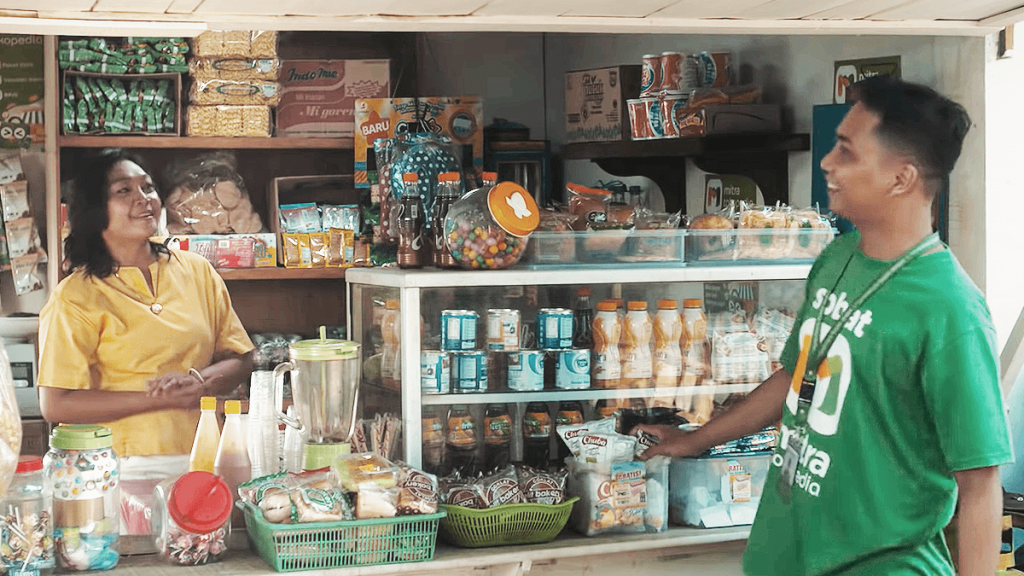
Photo credit: Tokopedia
Micro-entrepreneurs can also take advantage of this to quickly set up shop, such as the case with Ni Luh Gebi Sasmitawati, a 19-year-old entrepreneur in Bali who saw the platform as a means to help her family. As a tourism center, Bali was hard-hit by the pandemic, which had decimated many local breadwinners’ sources of income. With the help of Mitra Tokopedia, Gebi was able to launch her own business and build a new income stream to make up for what was lost.
“What [Gebi] shared with us is that due to the pandemic, many people now work and study from home so they have to buy phone credits and data packages,” says Susilo, adding that Gebi’s sales doubled amid Covid-19 lockdown measures.
The human impact
According to Pranama, owners of warungs are usually the main breadwinners of their families – and so their success has a direct impact on everyone else’s well-being.
Based on a survey Tokopedia conducted among its merchants, more than 25% of respondents who use the Mitra Tokopedia platform said they have more time now to spend with their family, thanks to reduced travel and meeting time with agents. They also reported higher rates of savings due to lower inventory costs.
Additionally, the platform offers some the opportunity to gain financial independence. Daniel Djap Nen Kiong, a disabled merchant from Singkawang, West Kalimantan, says the platform greatly eased things for him as he’d previously struggled with the necessary back-and-forth trips to restock his goods.
“For someone with disabilities like [Daniel], the platform makes the process a whole lot easier,” says Susilo. “In Indonesia, this group of people is underserved: A lot of them don’t have jobs and mostly rely on their families. With our app, they are able to have their own source of income.”
While there is hesitation among some mom and pop shops that think moving online will negatively impact the agents they’ve built relationships with, Susilo says that Mitra Tokopedia doesn’t intend to replace these agents. Rather, it wants to enable them to achieve their highest potential.
“Our mission is to become a solution for these traditional retail players to be able to participate in the technological development trend and promote digital economy equity in Indonesia,” she says. “Our goal is to see micro-businesses become small businesses, for small businesses to become medium-sized enterprises, and so on. By doing so, we hope to see a future where empowering the sector will further accelerate Indonesia’s economy.”
Find out more about how Tokopedia’s marketplace and digital product solutions are driving the Indonesian digital economy on its website.
This content was produced by Tech in Asia Studios, which connects brands with Asia’s tech community. Learn more about partnering with Tech in Asia Studios.
Stay updated on the go with our mobile app.
Get latest insights with smoother, more personalized experience through TIA mobile app.
Recommended reads
 Indonesian AI startup goes global
 Forrest Li on scaling Sea, building smarter bots, and founder grit
 An AI assistant that joins sales calls and scores team skills
 Beyond the check: Why VCs need more than capital
 SGX’s CEO says it doesn’t need a unicorn to win
 SMEs want AI too, but not the kind Big Tech is selling
 Oatside’s alt-milk rise hits a profitable gear
 Alibaba’s financial health in 12 charts
 Asia’s telcos bundle AI into mobile plans. Will it pay off?
 M-Daq chases bigger clients as revenue falls, losses grow





Editing by Winston Zhang, Nathaniel Fetalvero, and September Grace Mahino
(And yes, we’re serious about ethics and transparency. More information here.)