 Daniel Tay · · 8 min read
Airbnb for parking spaces Parking Duck wins the Bangkok edition of Tech in Asia Tour
Compared to many other countries in Southeast Asia, Thailand is a different animal simply because of its size. With a population of close to 70 million people, many startups can get away with focusing on ideas that look inward only.
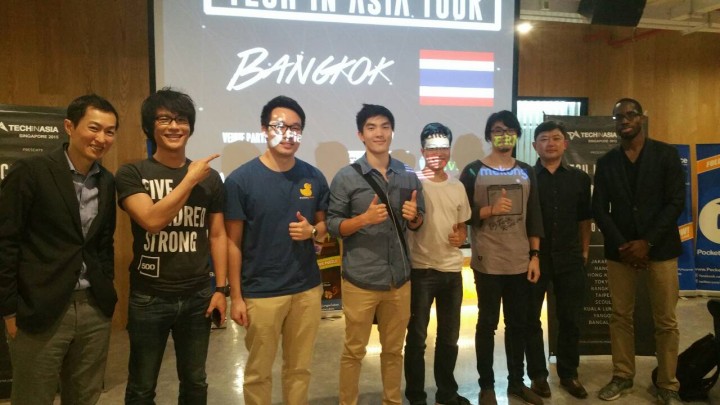
It comes as no surprise, therefore, that the judges of Tech in Asia Tour Bangkok decided to go with a business that looks to solve a major pain point in the bustling city. When it came down to just two choices for the winner, the panel of judges chose Parking Duck as the stand-out startup in the competition. That gets the Parking Duck team a free trip to Tech in Asia Singapore 2015 on May 6 and 7 where they’ll get an exhibition booth.
Our panel of judges in Bangkok were Moo Natavudh, founder and CEO of Ookbee; Tom Kim, founding partner and CEO of Inspire Ventures; Michael Lints, venture partner at Golden Gate Ventures; and Kuo-Yi Lim, managing director of Monk’s Hill Ventures.
All in all, the judges were happy to announce that the overall quality of the challengers was really high across the board. Read on for a brief description of each startup, and the judges’ comments on them.
Parking Duck
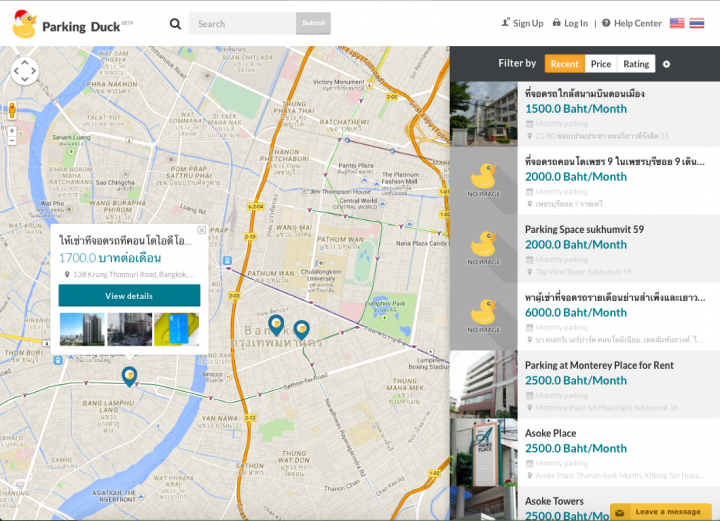
Densely populated Bangkok has around 7 million registered cars, but only 400,000 parking spaces, many of which are owned by homeowners at their condominiums, apartments, and homes. This is a problem that Parking Duck, an Airbnb for parking spaces, is trying to solve by getting anyone with available parking space to put it up for rent.
Since its launch in December last year, 26 bookings for a total rental period of 103 months have been made on Parking Duck. In the past three months, 330 drivers have registered, but with only 134 hosts onboard, founder Paruey Anadirekkul says that it is facing a classic case of supply being unable to meet demand.
During the Q&A with the team, the judges wondered what the difference was between Parking Duck and other listing sites. Anadirekkul replied that most of the listing sites are currently unable to process transactions directly, making them unsafe to use. They were also curious to know which countries Anadirekkul was planning to expand to next. Kuala Lumpur, Jakarta, and Hong Kong are currently on his list to be considered.
SmipterCommerce

SmipterCommerce is a cash-on-delivery service focusing on social commerce. It tackles two unique features of Thailand’s buy-and-sell landscape: many online shops tend to be on social media platforms such as Facebook and Instagram – around 60,000 of them, according to Founder Koben Lee – and Thai customers still prefer to pay for the items that they purchase online with cash in hand.
Since launching in December last year, SmipterCommerce has completed 1,031 shipments for 94 customers to date. Lee says that the company has a fleet of 314 drivers on its platform.
The judges pointed out that, based on their experience with cash-on-delivery services, problems such as fraud and theft are extremely common. Lee was confident, however, that its vetting process for drivers would weed out the bad ones. For drivers to sign up and receive tasks, they will need to put down a THB 20,000 (US$610) deposit first, a significant amount that acts as a safety mechanism. Thereafter, the SmipterCommerce team will individually vet each of them to ensure that they have no criminal record.
Rangy
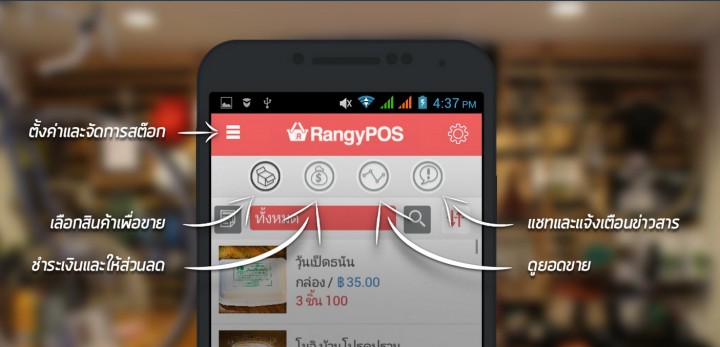
The idea of Rangy, which consists of a mobile point-of-sales system and wallet, is to generate repeat customers for its merchants. Reason: the cost of bringing a customer back is potentially a lot less than bringing a new one onboard, according to founder Tinnakorn L. Merchants can access and manage their inventory and transactions via the app.
In return for using the app to shop, merchants can choose to reward consumers with offers that are personalized based on their buying patterns, thereby encouraging them to return. So far, shop owners who are users of Rangy have generated around US$500,000 in revenue, selling over 4,000 products.
When questioned about who its main competitor is, Tinnakorn points to ecommerce monolith Shopify. The judges responded by saying that it will be a tough battle, especially given the latter’s resources and the slate of free services it offers as part of its subscription model.
12go

12go (which sounds like “want-to-go”) is an eticketing system for all forms of public transport across Southeast Asian countries. Apart from airlines, most modes of transport throughout the region require physical transactions to be made, which is cumbersome and inefficient. For example, to take a train to anywhere in Thailand, you will need to make a booking via email first, and then meet the person-in-charge at the train station on the day itself to swap money for tickets.
What is interesting about 12go is that it aspires to be the one-stop platform for all transport needs in the region. It has its own rechargeable mobile account for transactions to be made from, and caters to multiple languages and forms of transportation. To date, 12go has a presence in Singapore, Thailand, Malaysia, Cambodia, Indonesia, and Brunei, and is looking to go to Laos, Myanmar, Japan, and South Korea in the near future.
In 2014, the platform saw roughly US$85,000 in revenue. Demand is scaling quickly, though – last month alone it brought in US$70,000, with a month-on-month growth rate of 100 percent.
Founder Alexsey Abolmasov reveals that he has already raised US$350,000 from an angel investor called FBC Logistics, and is looking to bump that up to US$1 million to bring more travel operators and agencies onboard. The judges generally thought it was an idea with great potential.
Cryptosigma

Cryptosigma is a peer-to-peer money transfer and mobile wallet app. It aims to tackle four problems: the slow speed at which remittances take to reach the receiving end, high transaction fees of three to 11 percent incurred when sending money across borders, poor customer service standards, and a lack of transparency in terms of pricing.
Making use of a recent technology called Blockchain, money transfers can be done almost instantaneously with Cryptosigma. It also has an “Auto Exchange” function that allows the user to send and receive funds in the desired currency. Transaction fees are kept below 0.5 percent, and the app has 20,000 or so users right now.
Interestingly, Cryptosigma also offers the option to draw physical cash out, or spend at offline shops, with its Visa debit card. Over US$300,000 worth of transactions have been processed via this option since January this year.
Aaron Siwoku hopes to bring the six billion-large underbanked population around the world into the future with this service, bypassing traditional institutions. Siwoku certainly seems confident that it can – according to him, the short-term goal is to float on the Hong Kong Stock Exchange in five years.
The judges were concerned about the viability of such an app in Southeast Asian countries like Thailand, where the rate of credit and debit card adoption is still rather low.
T-Advert
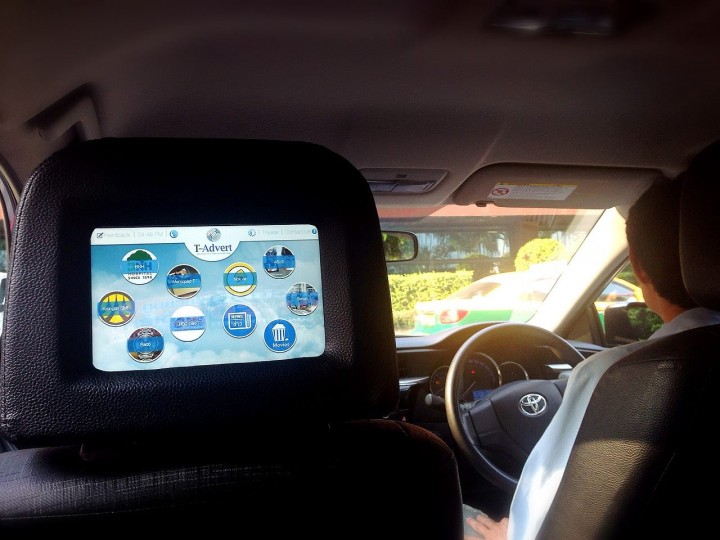
Advertisements are everywhere, and they’re by no means well-loved by consumers. This didn’t stop T-Advert founder Gregory Benjamins from starting a business that puts ad displays into taxis, which makes sense given that a passenger is pretty much a captive audience, especially in Thailand’s torrid traffic. He says that roughly 40 percent of passengers end up touching the screen, hypothesizing that it is probably out of pure boredom.
Each touchscreen will have a maximum of 10 advertisements, with the option to pay directly and purchase whatever wares or services they are hawking. But T-Advert isn’t forcing passengers to watch the ads – there is an option to switch off the screen if not interested. An ad slot would set a brand back about THB 20,000 (US$610) per month, and Benjamins claims that it is currently bringing in THB 600,000 (US$18,300) in revenue each month.
The judges wondered what would motivate drivers to put these ads in their taxis. Benjamins says that T-Advert pays for the installation of the screens, and runs a regular “lottery” for drivers that matches the taxi’s number plate to the nationwide lottery.
Roomfilla

Roomfilla is a vacation rental aggregator that helps home owners list their properties on websites such as Airbnb and Travelmob. According to founder Stuart, Airbnb has only captured 40 percent of the market so far. Roomfilla’s differentiating factor, according to the founder, lies in its end-to-end service – from enquiries to welcome documents, everything is handled by the team.
It seems to be working out well so far. With just 100 local properties on its platform, Roomfilla has earned over US$150,000 for its property owners to date. The judges, however, weren’t convinced that Roomfilla could sway and retain the loyalty of property owners, especially with so many competitors in the same space.
#Links

#Links is a Tinder-like job matching service – what they call the “Linkedin for the Mobile Y Generation.” By focusing on mobile-only, it wants to make the process easier and faster for both the job seeker and the hirer.
When creating their profiles, users are asked to list all the skills that they have, which are then used to generate a list of jobs that matches them. The job hunter can then swipe left or right through the list of jobs to indicate if they are interested or not. Two months since its beta launch, #Links has about 2,000 users, and 76 percent of them are active.
In addition to job postings made by companies for anywhere between THB 3,000 to 20,000 (US$90 to US$610) per month, #Links earns money through affiliate partnerships with traditional job search platforms, and other value-added services such as company branding.
Parking Duck
Parking Duck is a peer to peer online marketplace for sharing your parking spaces.
- Location
- Thailand
- Founded
- 2014
- Employees
- 2 – 10
- Website
- parkingduck.com
- Latest Funding
- No data
- Hiring
- 0 positions
Stay updated on the go with our mobile app.
Get latest insights with smoother, more personalized experience through TIA mobile app.
Recommended reads
 Daily news roundup – February 8
 Indonesia’s FDA to Halodoc: Take down listings of prohibited drugs
 Revolut to invest $45m in India, hire 300 employees
 Gojek appoints new head in Vietnam
 Shopee emerges as no. 1 liveselling platform in SEA survey
 Zoomcar names ex-Grab head as chief tech and product officer
 Sociolla CEO to step down
 Grab aims to break even in group adjusted EBITDA by H2 2024
 MAS awards major payment institution license to PayerMax unit
 Ex-Zalora, Grab execs’ logistics firm bags $11m in series A money




Editing by Steven Millward
(And yes, we’re serious about ethics and transparency. More information here.)





