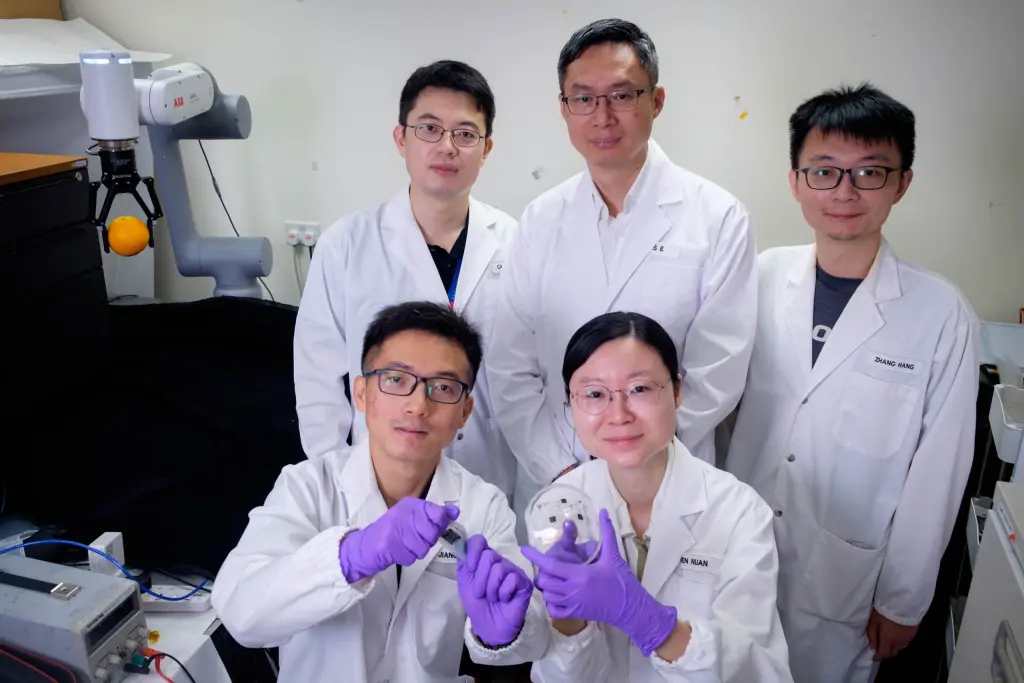
Photo credit: NTU Singapore
Like what its name implies, soft electronics are made from materials resembling soft tissue, instead of the traditional rigid components like silicon chips and circuit boards.
They are poised to transform several fields. For instance, electronic patches can conform to one’s skin and integrate with an individual’s nervous system, restoring lost functions or introducing new sensory experiences.
Singapore’s Nanyang Technological University has developed a number of ultra-thin and stretchable electronics. While patent pending, the university is establishing a pilot laboratory for the prototyping of the tech.
The lab also plans to work with industry partners, including SMEs, to co-develop soft electronics.
Developed by a team of scientists led by Professor Chen Xiaodong, these soft electronics – whose size can be thinner than human hair – can be integrated into wearable devices. It can then enable real-time monitoring of vital signs such as heart rate, blood pressure, and oxygen levels.
Soft electronics also has applications in agriculture. By attaching soft sensors to plants, users can monitor the plants’ health and control their actions, which can help mitigate crop diseases.
“We aim to address some of humanity’s most pressing challenges, from climate change to healthcare advancements,” said Professor Chen in a statement. “My goal is to establish a new center of excellence for soft electronics, building a team of industry experts and commercial partners to swiftly bring these technologies to market.”
See also: Shaking up alternative proteins: Can this SG startup turn red ink into green?
Editing by Putra Muskita and Lorenzo Kyle Subido
(And yes, we’re serious about ethics and transparency. More information here.)





Stay updated on the go with our mobile app.
Get latest insights with smoother, more personalized experience through TIA mobile app.











📅 Upcoming Events
22 October 2026
Payoneer x CSPN Summit 2026