
Shenzhen. Photo credit: yuliufu / 123RF Stock Photo.
In the last couple of years, innovation has been a buzzword for China’s government. In fact, while examining the country’s latest five-year plan, analysts at Barclays discovered that the word “innovation” appears more than 70 times throughout the text.
If you’re talking about China and innovation, it’s hard not to mention Shenzhen. The city is home to quite a few tech industry giants and countless other companies that specialize in the production of components such as smartphones, 3D printers, and robotics.
However, unlike China’s other mega-cities, Shenzhen has a short history.
Shenzhen’s origins
Just three decades ago, the city was a small fishing town, home to only 20,000 people. It was promoted to a city in the late seventies; in 1980, it was designated one of the country’s first Special Economic Zones (SEZ). Because of its SEZ status, investors flooded the city in the following years. Shenzhen has now developed into an extensive electronic manufacturing hub; according to UN data, its population is now over 7 million.
Today, Shenzhen is also home to global tech giants like ZTE, Tencent, and Huawei. As of 2015, the city’s GDP reached US$270 billion. What’s more: according to Bloomberg, Shenzhen’s Nanshan district is now officially the richest district in the country. Two years ago, the district had a per-capita GDP of US$49,000 GDP, noticeably more than its neighbor Hong Kong. Shenzhen also houses one of China’s three stock exchanges, the eight-largest stock exchange in the world.
Attracting top talent
The city is also spending a lot of money in an effort to attract innovators from China and around the world. Forbes reports that professionals and scholars who base themselves in Shenzhen can now apply for a one-off payment of ¥6 million, which amounts to more than US$920,000. In order to boost Shenzhen’s standing as the country’s number one city for innovation, this year, the city’s officials spent around US$680 million to attract the finest workers and academics.
Shenzhen’s officials spent around US$680 million in 2016 to attract the finest workers and academics.
But the officials aren’t only looking to attract veterans: they’re also targeting inexperienced graduates. Shenzhen is offering young people with bachelor’s degrees more than US$2,300 in housing subsidies. If a person has a master’s degree or even a Ph.D., that figure can be anywhere from US$3,800 to US$5,400. The only thing you have to do is to move to the city and find a job in order to apply for the one-off payment. The officials also announced that they plan to make over 10,000 apartments available during the next five years for use by visiting professionals.
The ecommerce sector
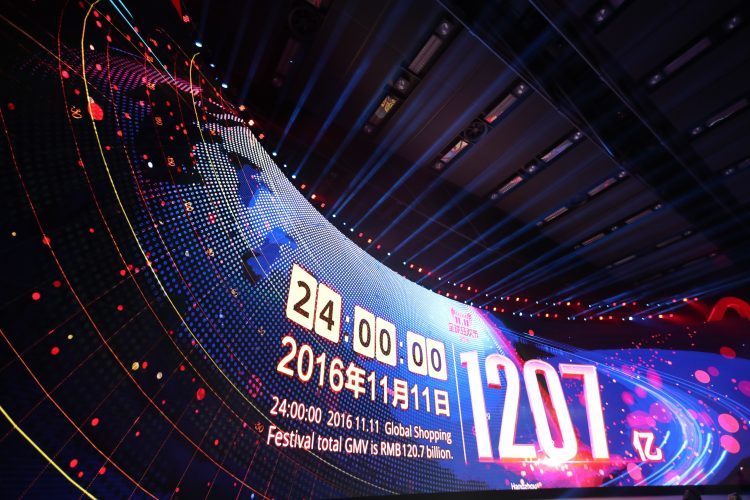
From this year’s Singles Day. Photo credit: Alibaba Group.
China is now officially the biggest ecommerce market in the world. With more than US$911 million in sales expected this year, the country will be responsible for almost the half of the world’s digital commerce sales, according to eMarketer. Seeing how Chinese consumers are now quickly shifting from traditional brick-and-mortar to online shopping, ecommerce represents a high-growth sector. In order to keep up with this increasing demand, startups are now seeking new ecommerce solutions to improve their services.
Furthermore, Cainiao (Alibaba’s logistics arm) currently owns more than 180,000 delivery stations for the shipment of products. Recently, the company has also expanded its fresh food distribution centers across the country. A couple of months ago, Cainiao completed their first external funding round and over the next five years, it’s expected to spend an additional US$16 billion to expand the firm’s network. The recent growth in the underdeveloped logistics sector can surely be expected to accompany China’s expansion of ecommerce.
The “Made in China” stigma





Stay updated on the go with our mobile app.
Get latest insights with smoother, more personalized experience through TIA mobile app.











📅 Upcoming Events
22 October 2026
Payoneer x CSPN Summit 2026