- Premium Content It takes our newsroom weeks - if not months - to investigate and produce stories for our premium content. You can’t find them anywhere else.
 Apoorva Dutt · · 8 min read
From $2 to a personal worth of $1.9 billion: How Infosys’ Nandan Nilekani did it
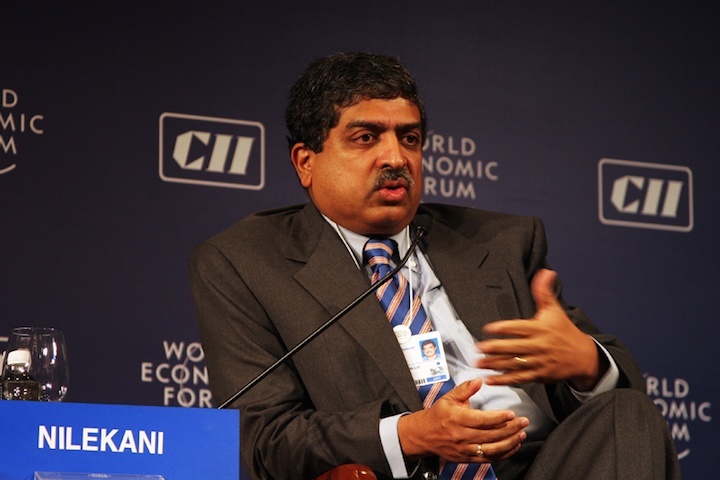
“I started out with Rs 200 (US$2) in my pocket when I graduated from ITT. We founded Infosys with Rs 10,000 (US$300),” Nandan Nilekani said in a TV interview in 2017.
The following is an edited excerpt from Men Of Steel by Vir Sanghvi. The excerpt was provided by Roli Books. You can buy a copy here.
“I started out with Rs 200 (US$2) in my pocket when I graduated from IIT. We founded Infosys with Rs 10,000 (US$300),” Nandan Nilekani said in a TV interview in 2017.
I’ve known Nandan Nilekani for over 25 years now. Or, to put it differently, for half of his life. When we first met in Mumbai in 1980, he was two years out of the Indian Institute of Technology Bombay (IITB) and worked for a computer firm called Patni Associates in Nariman Point. None of us, Nandan included, had the slightest idea that he would become a household name by the end of the century.
In that more modest era, Nandan’s salary was a princely Rs 1,200 (US $16) a month. And he thought he was making good money. After all, when his father retired, the old man’s salary was Rs 1,200 (US $16). As Nandan now recalls, “It seemed like a very good deal to start your career with a salary that was the same as your father’s at the end of his career.”
The figures should tell you something about Nandan’s background: solid, well-educated, South Indian middle class. They also reveal that he came from a family that never had much money, but never minded that it wasn’t rich. By most standards, Nandan’s climb to wealth and fame is an astonishing success story.
My first impression of Nandan – and one that has endured for nearly two decades – was there’s more to this man than meets the eye. He did not say much, never spoke about himself and deflected all serious questions with an easy laugh. But even when he was not participating in a conversation, you always had a sense that he was watching closely. Even when everybody else had drunk themselves silly and Nandan appeared to be asleep and totally out of it, I always knew that he was fully alert. This was a man who was never off.
A meeting that changed his life
Nandan Nilekani is clear that he does not owe his current position or prominence to his brains. Yes, of course, he was bright. He came first in school when he was at Bishop Cotton in Bangalore. At the age of 12, he went to live with an uncle in Dharwad and spent four years at Karnataka College in that town before finally getting into IIT Bombay.
“I had always been in the top three in my class at school. But getting into IIT was a revelation. I studied electrical engineering, which was then the most popular course, so we had some of the brightest minds in IIT. And compared to those guys, I was not outstanding. I was never at the top of my class. There were people who were just so much brighter than me.”
By the end of 1978, when his engineering term was coming to an end, Nandan rejected the standard find-a-job-abroad option because of what he now describes as “inertia and laziness.” He considered applying for an MBA course, but even that fell through when he was taken ill before the IIM entrance exam. So he looked for a job in Mumbai, joined Patni Systems, and met N.R. Narayan Murthy. And his life changed forever.
A walk-out called Infosys
The history of global business is replete with stories of guru-chela relationships (what they describe as “mentoring” in the textbooks) but I know of no other Indian company where a relationship between a genius and his protégé has led to such happy consequences. In the late 1970s, Narayan Murthy headed a division for the Patnis, evolved a relationship with one of the Patni brothers and was left pretty much on his own. Murthy had his own approach to hiring. He preferred young people straight out of college to engineers with experience. But he didn’t trust exam results alone.
So when Nandan went for his interview, he was startled to find that Murthy expected him to solve puzzles and behaved like a schoolmaster conducting an IQ test. Obviously, Nandan was good at puzzles because Murthy hired him on the spot and the two men quickly became close. But, insists Nandan, he was not the only young man whom Murthy mentored: “He has extraordinary leadership qualities and the entire division hero-worshipped him.”
In 1981, the Patni brother who normally interacted with Murthy was out of town and another brother treated him roughly. Nandan refuses to divulge details of the disagreement but from what I remember of that era, it went like this: Murthy was asked to do something he disagreed with; he asked Mr. Patni for an explanation and was told “Just do what you’re told to do.” Anyone who has met Murthy will recognize that he places self-respect above everything else. So naturally, he walked out. And naturally, his entire division walked out with him. They were fed up of working for traditional bosses, they said. They would launch their own company. That company was, of course, Infosys.
The Punjabi who missed it
Infosys goes public… and it’s the FIIs
Money matters
Stay ahead in Asia’s tech landscape
This is premium content. Subscribe to read the full story.
“I started out with Rs 200 in my pocket, when I graduated from IIT; we founded Infosys with Rs 10,000,” Nandan Nilekani said in a TV interview in 2017.
We know this is not ideal. ⌛ Sign up in 20 seconds. Cancel anytime.
Our subscriber community includes professionals from these companies:





Stay updated on the go with our mobile app.
Get latest insights with smoother, more personalized experience through TIA mobile app.








📅 Upcoming Events
22 October 2026
Payoneer x CSPN Summit 2026