- Premium Content It takes our newsroom weeks - if not months - to investigate and produce stories for our premium content. You can’t find them anywhere else.
 Melissa Goh · · 7 min read
How banks look to take over fintech with embedded finance
In September 2022, Bukalapak partnered with Standard Chartered to launch BukaTabungan, a digital bank service within the ecommerce platform.
Over a hundred million Bukalapak customers and merchants in Indonesia can open an account digitally in under two minutes, pay for purchases within the platform, or get a digital or physical debit card. Some can also obtain credit.

Image credit: Bukalapak
Like Bukalapak, ecommerce firms, online travel agencies, and fintech firms and many other companies are looking to embed financial services into their platforms to scale and acquire more users – all without a banking license.
While the trend of embedded finance isn’t new, increasing pressure from shareholders on banks to lower operational costs and raise profits are driving more banks – which already own these licenses – to enter the fray. They’re enabling such firms to offer financial services themselves instead of relying on intermediaries to do so.
By lending their core banking infrastructure, balance sheets, and licenses to entities like ecommerce platforms, banks gain new revenue streams and tap new customer segments. The use of digital channels also reduces user acquisition cost as well as the need for physical branches and large sales teams.
In the case of BukaTabungan, not only did Standard Chartered gain new customers, but 98% of them have never banked with the UK-headquartered institution.
How does a bank or a financial institution offer such services, especially if it’s bogged down by legacy infrastructure? That’s where tech providers come in.
Banks enter the fray
Rising shareholder pressure on banks have driven the conversation around “how best to generate returns on the existing cost base,” says Kelvin Tan, CEO of tech provider Audax. The firm powers Nexus, Standard Chartered’s banking-as-a-service (BaaS) offering.
“That, combined with the fact that [existing banking] technology is not quite up to scratch for serving scale … that’s where it becomes an interesting sweet spot for players like us,” Tan tells Tech in Asia.
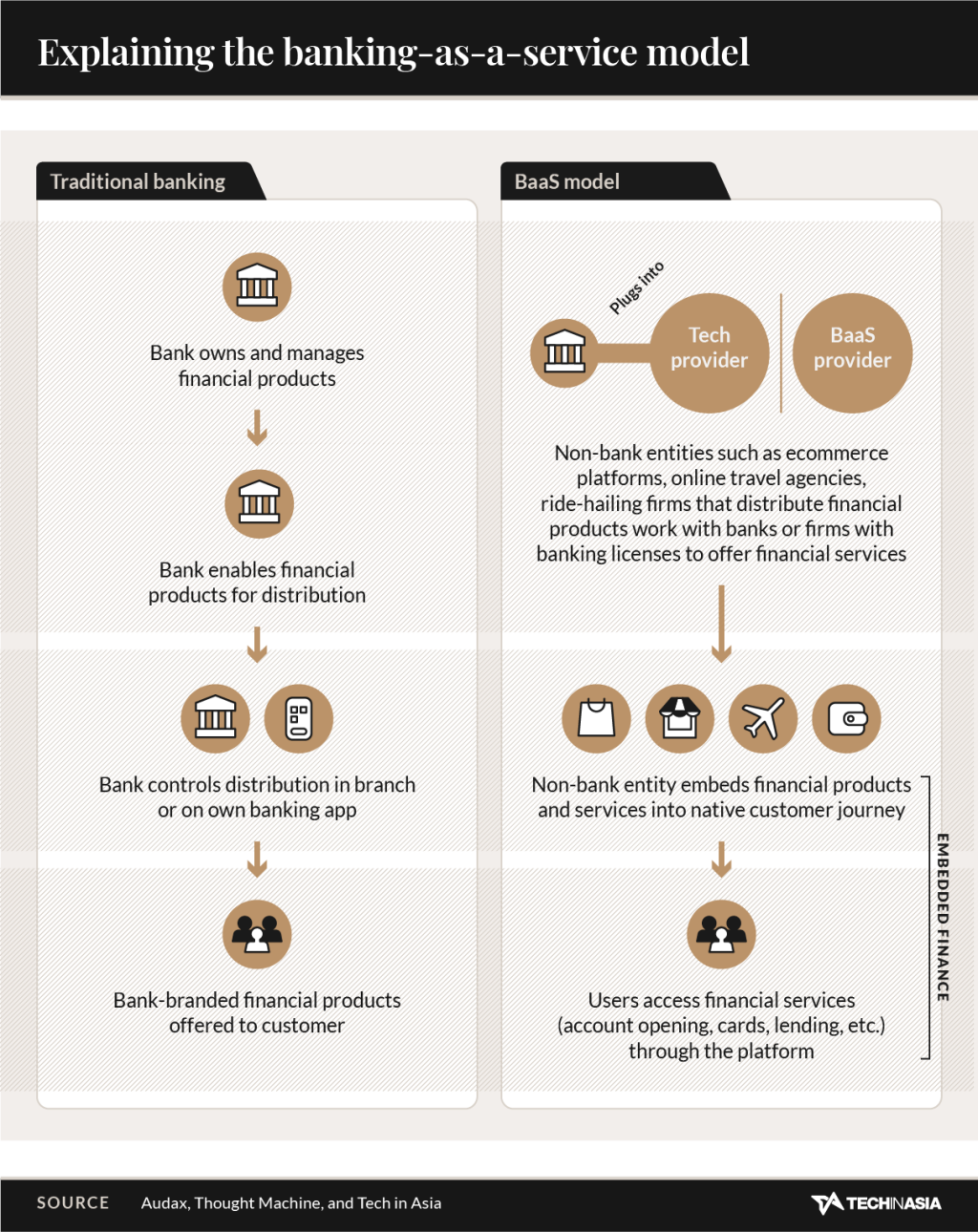
Tan, who built and launched Nexus in 2018, says the conversation began around how Standared Chartered could drive a higher return on equity through a scalable business.
“The idea here was to become a platform for multiple front-end partners to plug in and turn themselves into digital banks,” he adds.
Launching faster and cheaper
Embedded finance 2.0
Profitability game
Stay ahead in Asia’s tech landscape
This is premium content. Subscribe to read the full story.
Using banking as a service, digital banks can lower the cost of acquiring a new customer from US$100 to US$20, tech provider Audax claims.
We know this is not ideal. ⌛ Sign up in 20 seconds. Cancel anytime.
Our subscriber community includes professionals from these companies:





Stay updated on the go with our mobile app.
Get latest insights with smoother, more personalized experience through TIA mobile app.










📅 Upcoming Events
22 October 2026
Payoneer x CSPN Summit 2026