Jeff Quigley · · 4 min read
Startup World Cup: UniFa wins Japan heat on road to $1m grand prize
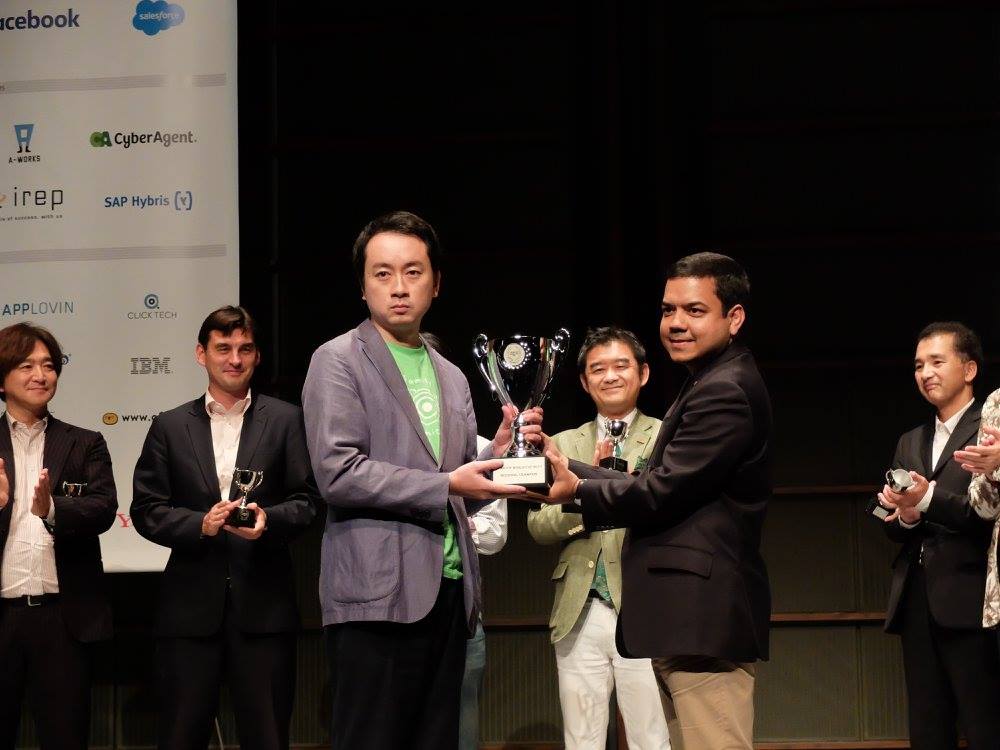
Fenox Venture Capital general partner and CEO Anis Uzzaman presents the regional world cup trophy to UniFa.
Startup World Cup, a series of global pitch contests culminating with a conference and grand finale in Silicon Valley early next year, made its way through Japan last week. The event, organized by Silicon Valley-based Fenox Venture Capital, saw 10 Japanese startups go head-to-head for a chance to represent their country as the regional winner.
In the end, UniFa – an IoT solution for tracking kindergarteners’ physical and mental growth – was crowned the winner by a panel of well-known judges from the domestic tech and startup ecosystem, including SNS founder Takafumi Horie (who also delivered a fireside chat), Gumi CEO Hironao Kunimitsu, and ABBA Lab CEO Osamu Ogasahara.
 Last month, Indonesian on-demand laundry provider Ahlijasa was awarded the first regional cup. The top 16 startups from 14 countries will go head-to-head on March 24, 2017 in San Francisco for a shot at a US$1 million investment.
Read more about each of the 10 Startup World Cup Japan regional finalists below:
UniFa (Japan regional champion)
UniFa wants to lessen the communication gap between children and their parents with the Internet of Things (IoT).
It offers a small robot called Meebo, a smart thermometer, and a smart bed that collect data from children at kindergarten to give parents a better idea of their child’s feeling and experience.
It also cuts down on unnecessary paperwork for kindergarten teachers, allowing them to focus solely on education.
Alpaca
Alpaca, dually-based in Japan and the US, is a fintech startup that leverages artificial intelligence.
It offers a deep-learning platform for forex traders that automates trades based on successful past trades. Traders can generate a custom trading algorithm in as little as 15 seconds.
The company’s founder cut his teeth at Lehman Brothers during the subprime mortgage crisis of 2008.
See: He quit banking, lost his savings, and then found his startup passion
Fuller
Fuller is a mobile app analytics startup known for its App Ape product, which focuses on Japan and South Korea. It can measure concurrent app usage, provide app-on-app usage comparisons, and track hourly active users per app.
The startup also offers a website-to-native-app conversion service called Joren.
See: App Annie rival raises $4.2m to expand beyond Japan
Terra Drone
Terra Drone is the drone arm of Terra Motors, an EV startup that provides high-quality electric scooters and three-wheelers to developing markets. The startup’s expertise in EV batteries paved the way for it to enter the autonomous drone market, with a focus on agriculture and construction site surveying.
See: Japanese electric scooter startup is now making drones
MoneyForward
Fintech startup MoneyForward offers online tools that help individuals and SMEs manage finances and expenses. Users can link their various banking, credit, and securities accounts to get an instant snapshot of their current wealth, while big data aggregation hints at where their financial future is headed.
The MoneyForward app can connect to more than 2,500 financial institutions at present.
See: Japan’s MoneyForward gets series C funding amid fintech boom
AsMama
Despite a population that’s aging and shrinking at an unprecedented rate and fewer and fewer Japanese couples having children, finding daycare and reputable babysitters in Japan is incredibly difficult.
AsMama connects parents on both its online platform at at events, who can then share babysitting and carpooling duties. The startup hopes to branch out to offer a range of childcare – and eventually eldercare – services for both individuals and companies.
Mitsucari
Mitsucari combines personality quizzes and artificial intelligence to help users find an ideal company to work for, based on similarities with existing “superstar” employees.
While existing job-matching services can find candidates with a skill fit, Mitsucari claims to match users by both skill and culture fit – the latter being especially important in the world of startups.
FiNC
FiNC gathers data about a user’s wellbeing from tissue samples, blood tests, wearables, and more then leverages its artificial intelligence engine to provide physical and mental healthcare solutions.
Liquid
Liquid is a biometric security and payments startup that wants you to leave your credit cards, loyalty cards, and more at home. Using next-generation biometric authentication, the startup promises a faster and safer way to prove that you’re who you claim to be.
D Free (Triple W)
D Free is a medical wearable that detects activity in a user’s intestinal tract and sends an alert to their smartphone letting them know when they will have to use the restroom. Losing control of one’s bowels is a daily concern for senior citizens, the disabled, and those suffering from bowel dysfunction.
In pilots at nursing homes, D Free was able to reduce diaper and caregiver costs by more than 30 percent.
See: Don’t laugh – this wearable device alerts you before you have to poop
Stay updated on the go with our mobile app.
Get latest insights with smoother, more personalized experience through TIA mobile app.
Recommended reads
 Life’s a game, and AI agents are Animoca’s new play
 Indonesian AI startup goes global
 Forrest Li on scaling Sea, building smarter bots, and founder grit
 An AI assistant that joins sales calls and scores team skills
 Beyond the check: Why VCs need more than capital
 SGX’s CEO says it doesn’t need a unicorn to win
 SMEs want AI too, but not the kind Big Tech is selling
 Oatside’s alt-milk rise hits a profitable gear
 Alibaba’s financial health in 12 charts
 Asia’s telcos bundle AI into mobile plans. Will it pay off?





Editing by Sim Yanting
(And yes, we’re serious about ethics and transparency. More information here.)