- Premium Content It takes our newsroom weeks - if not months - to investigate and produce stories for our premium content. You can’t find them anywhere else.
 Putra Muskita · · 4 min read
Co-working spaces see a surge in demand – but it may not last
As Covid-19 continues to spread unabated, companies across Southeast Asia are looking to minimize the impact on their teams, partly by spreading their workforce across multiple locations.
That presents a big opportunity for co-working space operators. Several have reported a recent increase in demand and interest, though it’s not clear yet if it will translate into long-term opportunities.
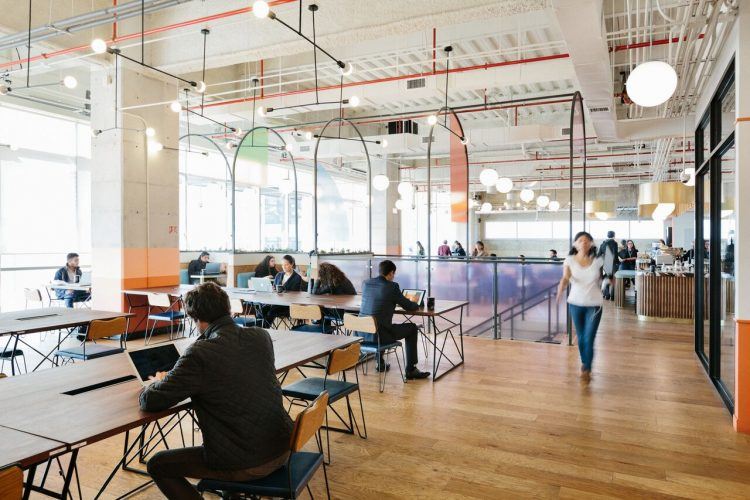
A WeWork in Jakarta, before Covid-19 / Photo credit: WeWork
“We are seeing an increase in proactive conversations from our members and non-members,” says Turochas Fuad, WeWork’s managing director for Southeast Asia, noting that space has become a “crucial need” to ensure business continuity.
CoHive, which manages 37 co-working locations across Indonesia, has also been approached by multiple companies looking for temporary workspaces, says co-founder and CEO Jason Lee. Doing so allows businesses to station employees in several locations or reduce the need for commuting, he adds.
Another example is FlySpaces, an “Airbnb for workspaces” platform that lists down co-working spaces run by other companies across five markets in Southeast Asia. Based in the Philippines, FlySpaces is also seeing a surge in demand for temporary office spaces, says Peter Northcott, the startup’s vice president of marketing and business development.
“Whether it’s a need to evacuate buildings for sanitization or to ensure that larger teams are working in separate locations, we are seeing big jumps in these types of requests,” he observes.
Short-term play
That said, these are primarily short-term arrangements. FlySpaces’ partners are mostly operating with skeleton crews due to the Covid-19 pandemic, affecting the company’s ability to offer clients in-person viewings and site visits.
“This has led to a delay in larger decisions regarding office space for most businesses in the region – a natural response to this unpredictable environment,” says Northcott.
The situation is also evolving quickly and differently across countries, which adds another layer of difficulty for those that operate in multiple markets.
“While Hong Kong was impacted first in early February, it is more fully operational – for now – compared to Malaysia, Indonesia, and the Philippines,” says Northcott. He adds that Singapore – the most readily prepared to handle such a crisis – has had strong business activity throughout, though its government is now putting tougher measures in place.
Of course, co-working spaces have to comply with measures aimed at communal or public places. JustCo, which operates 26 properties across Singapore, Jakarta, and Bangkok, is implementing stricter screening protocols including regular temperature checks and requesting guests to submit travel declaration forms.
All this may lead to at least a short-term increase in operational expenses. JustCo, for one, says that costs have gone up but declined to provide details. WeWork has also been making additional investments to implement more stringent screening procedures at its workspaces, adopting best practices from China, which has reported no new locally transmitted Covid-19 cases since the pandemic began.
What happens after
Stay ahead in Asia’s tech landscape
This is premium content. Subscribe to read the full story.
But operators see potential in long-term demand, even after the pandemic is over.
We know this is not ideal. ⌛ Sign up in 20 seconds. Cancel anytime.
Our subscriber community includes professionals from these companies:





Stay updated on the go with our mobile app.
Get latest insights with smoother, more personalized experience through TIA mobile app.








📅 Upcoming Events
22 October 2026
Payoneer x CSPN Summit 2026