- Insights This article was written by a TIA community member. Insights pieces undergo the same rigorous editorial process that newsroom-produced articles have.
 Aaron Painter · · 5 min read
Why China’s Shenzhen isn’t just a manufacturing hub
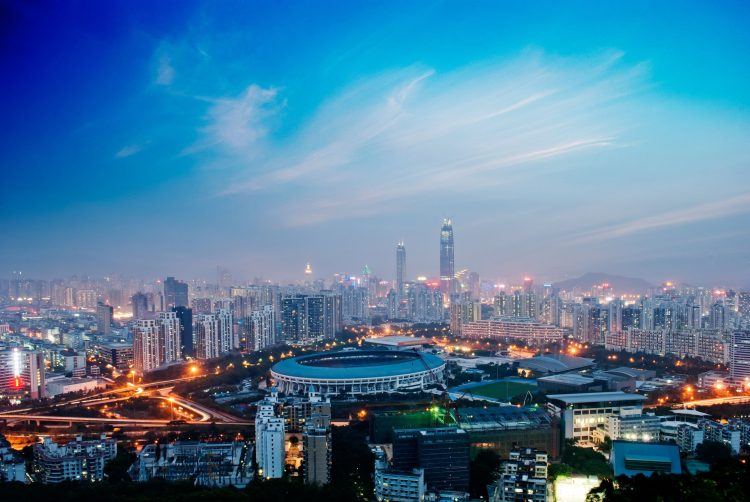
Photo credit: yuliufu / 123RF Stock Photo.
About four years ago, I visited Shenzhen for the first time. It’s just over the border from Hong Kong, where I live, and I expected the trip would be quick and not too impactful. I was wrong.
I was so inspired by what I saw that I’ve visited Shenzhen about once every six weeks since then. Even in that short period of time, the city has continued to grow and evolve. I have watched it change and witnessed the impact those changes are having, both in China and around the world.
Shenzhen is typically perceived as a manufacturing hub. In fact, what’s happening there is far more profound and far more exciting than simply the making of products; the city is producing world-class innovation and modeling approaches that your business can learn from.
A brief history of computing
Early pioneers of computing, such as Bill Gates and Paul Allen, often saw manufacturing as a hobby, assembling components and building machines in their garages. Eventually, this experimentation led to the first personal computers.
When the time came to bring computers to a mass market, these pioneers were in a position to order many interchangeable parts and put them together in a consistent way. This boosted the number they could build and reduced the price.
For decades, making quality products at scale was a solid business model. Dell, HP, Lenovo, Samsung, Apple, and others all followed this blueprint successfully.
Over the past several years, however, cloud computing has shifted the landscape. By bringing many computers together, it’s possible to generate almost unlimited processing power.
As a result, the innovation focus has shifted to software, a shift that has both democratized the process of change and radically shortened feedback cycles. Now, anyone with a computer and coding skills can build and test an app, with very little capital investment.
Shenzhen has taken that cycle to its logical next step, allowing people to build and test hardware at a speed comparable with software.
Fishing village to a technological metropolis
In 1979, Shenzhen was chosen to be China’s very first special economic zone. At the time, it was a fishing village with a population of fewer than 300,000 people. By 2020, it’s anticipated that the city will be home to an excess of 15 million people.
In the space of a few decades, Shenzhen has transformed to a degree that would be unimaginable in most cities.
The city has long had a reputation as the world’s workshop, and there’s a reason for that. A staggering quantity of goods is manufactured there. More recently, however, Shenzhen has evolved into a perfect storm of markets, workshops, and factories. This makes it possible to design, build, and test new hardware at an astonishing pace.

A license to tinker
What does this mean for you?
In hardware innovation, all roads lead to Shenzhen
Every innovator needs to visit





Stay updated on the go with our mobile app.
Get latest insights with smoother, more personalized experience through TIA mobile app.









📅 Upcoming Events
22 October 2026
Payoneer x CSPN Summit 2026