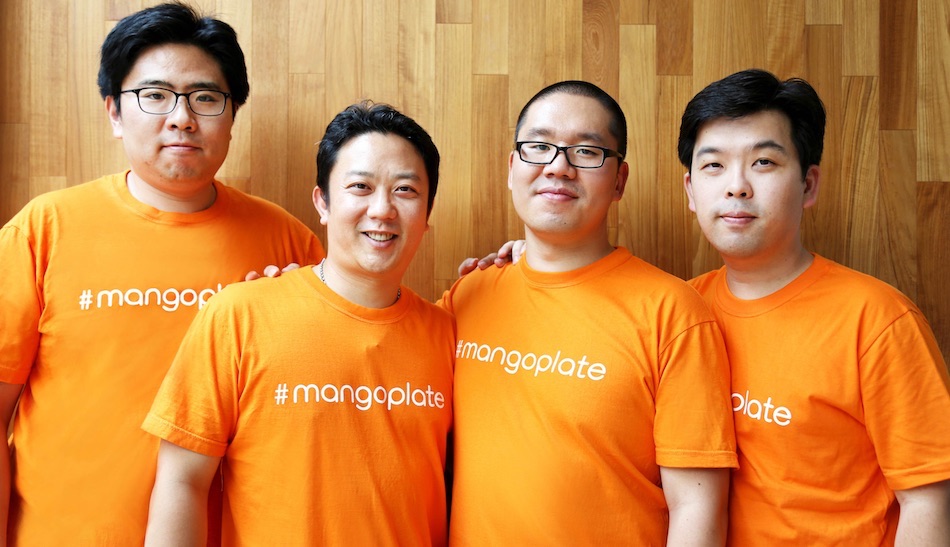
The MangoPlate founding team
The dining and food service industry in South Korea is estimated to be worth a staggering US$70 billion with approximately 500,000 restaurants servicing the country.
But restaurant discovery is a cumbersome process, fraught with problems like fake reviews and unscrupulous blogs. That’s the problem MangoPlate is trying to solve. It’s the Yelp for Korea, blending food reviews, ratings, and content.
The startup, founded by Joon Oh, Bernard Kim, Danny Ryu, and Michael Roh, initially started off just as a crowdsourced spreadsheet of restaurants. After inputting their entries, the founders passed it along to their families and friends. It soon became too big to manage purely on Excel, so Bernard and Danny, who are software engineers, started coding a basic app to put all the information on the cloud.
That’s how MangoPlate came into being.
The startup got a boost after graduating from SparkLabs, an accelerator that bridges the gap between Silicon Valley and the Seoul tech ecosystem. It nabbed two seed rounds worth a cumulative US$1.4 million from SparkLabs and SoftBank Korea, before closing a sizeable series A of US$6.1 million led by Qualcomm Ventures.
MangoPlate boasts 1.5 million monthly active users.
Arguably, however, the most compelling reason for the founders to start MangoPlate was the decision of the South Korean government to shut down restaurant discovery app WingSpoon. The app, owned by internet conglomerate Naver, dominated South Korea’s foodtech scene but closed operations in early 2014 to apparently help other startups flourish (yes you heard that right).

Photo credit: Your Coastal Bend.
Where do I find the best ramen in Seoul?
In the early days restaurant discovery features were incorporated via search and curated lists, recalls Joon, co-CEO. Users were eager to try out MangoPlate’s recommendations but reluctant to post deep reviews.
To inculcate changes in behavior, the team tried different tactics. One was to rename the features of the app for better reviews. Another was to encourage content curation – users loved scrolling through recommendations and lists, so the team created a separate section for it altogether, called “Picks.”
MangoPlate isn’t monetizing its services yet, but boasts 1.5 million monthly active users. Its target is to cover 80 percent of South Korean restaurants by the end of 2016.
An effort to build trust is one of the main reasons the startup hasn’t tried to collect revenue yet. It doesn’t charge users any money nor does it take any from restaurant owners. That’s an important method of distinguishing itself from competing services, which haven’t really taken off because of a failure to engender loyalty.





Stay updated on the go with our mobile app.
Get latest insights with smoother, more personalized experience through TIA mobile app.