- Insights This article was written by a TIA community member. Insights pieces undergo the same rigorous editorial process that newsroom-produced articles have.
 Charles Debonneuil · · 10 min read
Here are the trends to look out for in SEA’s vibrant ecommerce ecosystem in 2020
Over the last five years, Southeast Asia has been one of the fastest-growing regions for ecommerce globally. The industry has particularly accelerated since 2016, with the increased investments from global leaders, the adoption of cutting-edge technology, and better ecommerce know-how.
For many brands, ecommerce provides immense opportunities, but it also profoundly disrupts their traditional way of working, interacting with consumers, and distributing products. It may already seem difficult to keep up with the pace of change, but growth is not about to slow down.
So what trends should brands pay attention to in 2020?
1. Acceleration of consumer adoption
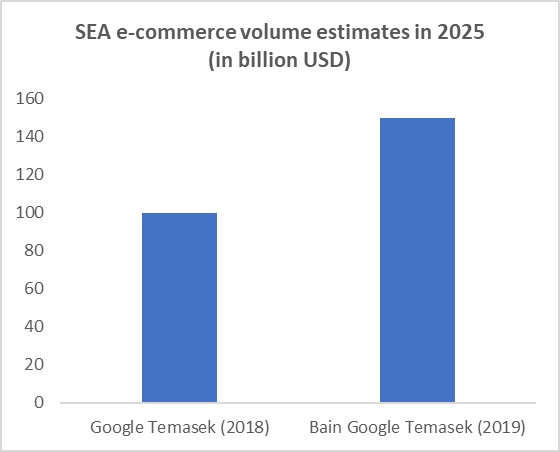
In 2018, Google and Temasek predicted Southeast Asian ecommerce volumes to reach US$100 billion by 2025. In 2019, the two firms, together with Bain & Company, predicted that the 2025 volumes would reach US$150 billion, representing a 50% increase in just one year.
Today, there are many ecommerce platforms in the region with strong backing and robust marketing efforts.
In 2019 alone, four platforms raised – or were in talks to raise – a total of roughly US$1.7 billion. Tokopedia may secure US$1.5 billion before its initial public offering, while Tiki.vn is set to raise US$100 million. Bukalapak snapped up US$50 million in January, and Sendo banked US$61 million in November.
On top of this, Sea’s Shopee has continued to invest US$1 billion in the last four quarters (based on the parent firm’s adjusted EBITDA), with Lazada likely investing in similar magnitude. Besides strengthening their technology and logistics infrastructure, a good portion of these investments go into raising public awareness of ecommerce.
Shopee, for instance, has spent an estimated US$500 million in marketing in the last four quarters – assuming it consumes a majority of Sea’s US$760 million sales and marketing budget. In Indonesia, it’s also not unusual to have six different ecommerce platforms running TV ads simultaneously (Lazada, Shopee, Tokopedia, Bukalapak, JD.com, and Blibli).
The development of the digital ecosystem across other consumer touch points, including ride-hailing, food delivery, travel, and gaming, is also bolstering the adaptation of ecommerce as customers become more accustomed to transacting on apps.
Why you should care as a brand: For many brands, their share of online sales on total sales have started to reach massive thresholds (some have a 5% share, some are at 10%, and some have even surpassed 20%).
This is set to continue at a rapid pace in 2020. However, a brand’s internal governance – particularly in the alignment of sales and marketing teams – can become a barrier to fully tapping into the market potential. We expect companies to rethink their internal structure to empower ecommerce teams, especially as online becomes an increasingly strategic channel.
2. Acceleration of brand adoption
Looking back at the region’s recent ecommerce history, there has been a clear progression: Brands mostly refused to list their products on ecommerce platforms until 2016. Then, early adopters led the way (Philips, Unilever, P&G, L’Oreal, etc.). In 2017 to 2019, most mass brands in electronics, fast-moving consumer goods, and home appliances moved to online platforms.
In 2020, companies of all categories and all segments – from mainstream fashion labels, which are still not on online platforms for the most part, to luxury beauty brands, and even specialty and influencer brands – will embrace ecommerce platforms.
3. Brand.com vs. platform
4. Platforms: the age of maturity
5. Cross-border commerce
6. Social and influencer commerce
7. Fast-changing fulfillment landscape
8. Marketing: Year One of a revolution to come
Southeast Asia will follow





Stay updated on the go with our mobile app.
Get latest insights with smoother, more personalized experience through TIA mobile app.