- Premium Content It takes our newsroom weeks - if not months - to investigate and produce stories for our premium content. You can’t find them anywhere else.
 Emmanuel Samarathisa · · 7 min read
Malaysia’s coffee scene heats up as foreign players take on local firms
A war is brewing in Malaysia. It’s one that involves coffee and the craze is pitting foreign brands against homegrown firms.
First came American coffee chains Starbucks and The Coffee Bean and Tea Leaf (CBTL). But tech-enabled homegrown players started cropping up to tackle Malaysia’s growing middle class by offering premium coffee at a cheaper price.
As these upstarts mushroomed, they caught the attention of foreign players such as Kopi Kenangan, which decided to make Malaysia their port of call for overseas expansion. And looming over all these is the specter of Chinese players like Luckin’ Coffee, which has already set up shop in Singapore.
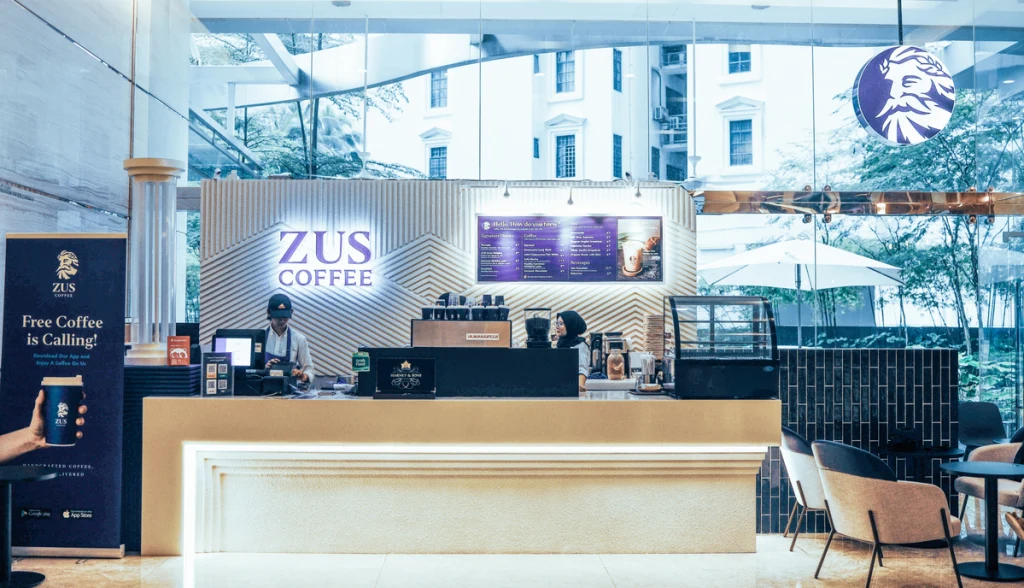
ZUS Coffee’s first outlet in Binjai / Photo credit: ZUS Coffee
Malaysians love their coffee. Total consumption of the caffeinated beverage grew from 625,000 bags – each weighing 60kg – to 800,000 in 2022, according to market insights provider Statista.
While this figure pales in comparison to that of neighbors like Thailand and Indonesia, Malaysia remains hot on the map of coffee companies.
But is there room enough for everyone? “No,” equity analysts covering the food and beverage sector as well as investors backing some of these entities tell Tech in Asia.
They cite two reasons. Firstly, Malaysia may have a growing middle class, but the country’s population is relatively small compared to neighbors Indonesia, Thailand, and the Philippines.
Secondly, Malaysia isn’t insulated from externalities such as higher import costs brought about by a weaker ringgit and inflation back home, leading to coffee companies targeting the same group of coffee drinkers.
Luckin’ charm
To understand Malaysia’s premium coffee scene, one needs to dial back to circa 1997, when coffee chains CBTL as well as Starbucks opened their maiden stores in Kuala Lumpur.
The “sell” then was to target the country’s upper-middle class, says a coffee industry insider based in the capital.
To be sure, the country has always had a coffee culture (think Chinese coffee shops). Malaysia also grows its own plants, mainly the liberica variety, but remains a net importer of coffee beans to meet demand.
But the craze for premium coffee truly took off when CBTL and Starbucks landed on Malaysian shores, the insider says.
Between the two, Starbucks stole the limelight because it’s backed by the Berjaya Group, a well-connected family-run conglomerate with a number of listed entities on Bursa Malaysia, the country’s stock exchange.
Enter: competition
Hunting for value
Stay ahead in Asia’s tech landscape
This is premium content. Subscribe to read the full story.
The specter of Chinese brands looms large as coffee chains duke it out in offering cheap caffeinated beverages.
We know this is not ideal. ⌛ Sign up in 20 seconds. Cancel anytime.
Our subscriber community includes professionals from these companies:





Stay updated on the go with our mobile app.
Get latest insights with smoother, more personalized experience through TIA mobile app.