- Premium Content It takes our newsroom weeks - if not months - to investigate and produce stories for our premium content. You can’t find them anywhere else.
 Emmanuel Samarathisa · · 4 min read
Malaysia grants Musk’s Starlink rare ownership exemption to operate in country
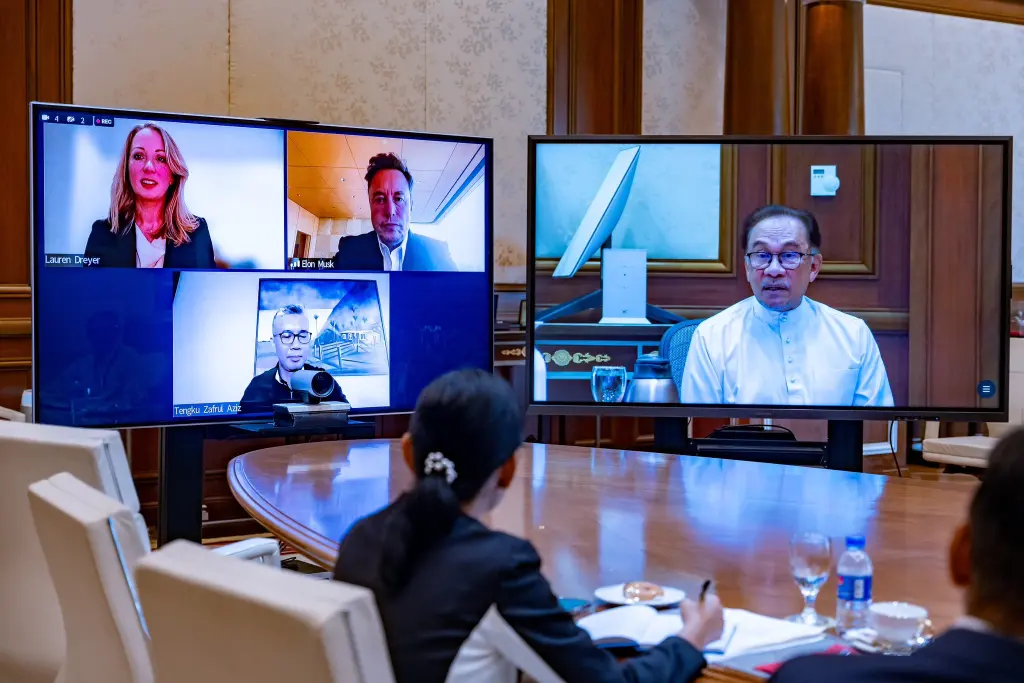
Tesla and SpaceX founder Elon Musk and Malaysian Prime Minister Anwar Ibrahim (right) in talks during a July 14 virtual meeting / Photo credit: Anwar Ibrahim’s Twitter
Starlink, the satellite-internet unit of Elon Musk’s SpaceX, has received a rare ownership exemption to operate in Malaysia.
Tech in Asia understands that only four firms, including Starlink, have been accorded that privilege since 2005.
The satellite-internet company was awarded two licenses: the network facilities provider (NFP) individual license and the network service provider (NSP) individual license. Both run from July 17 this year to July 16, 2033.
NFPs refer to owners or providers of network infrastructure such as towers and satellite stations. NSPs, on the other hand, are firms that enable connectivity across different networks.
Malaysian law dictates that foreign ownership in a licensee can only be up to 49% unless exempted by the minister in charge, in this case Communications and Digital Minister Fahmi Fadzil.
The Malaysian Communications and Multimedia Commission (MCMC), however, told Tech in Asia that SpaceX retains full ownership of the company that was granted these licenses.
Starlink Internet Services Malaysia is wholly owned by Starlink Holdings Netherland, according to the Malaysian companies’ database.
MCMC said that only three companies, aside from Starlink, had been given such an exemption since 2005. The remaining firms are: NTT MSC (2005 and 2010), AT&T Worldwide Network Services (2012), and BT Systems (2014).
The industry regulator told Tech in Asia that the decision to grant Starlink the exemption was made after assessing the “value and benefits” provided by the satellite-internet firm.
MCMC added that this case is similar to the other licensees that were granted exemptions, which are “companies with a global footprint” that had full foreign ownership.
Some of the policy considerations for the exemption include a review of Starlink’s Malaysia Digital status, Malaysia’s commitments to any free-trade deal with the applicant’s country of origin, and the direct and indirect benefits that the licensee can bring to Malaysia. The entire process also involves other relevant agencies and ministries, MCMC said.
Malaysia Digital is a series of perks for multinational or local tech companies, ranging from tax incentives to grants.
Stay ahead in Asia’s tech landscape
This is premium content. Subscribe to read the full story.
The satellite-internet firm’s foray comes after a highly publicized virtual meeting between Elon Musk and the country’s prime minister.
We know this is not ideal. ⌛ Sign up in 20 seconds. Cancel anytime.
Our subscriber community includes professionals from these companies:





Stay updated on the go with our mobile app.
Get latest insights with smoother, more personalized experience through TIA mobile app.










📅 Upcoming Events
22 October 2026
Payoneer x CSPN Summit 2026