 Nadine Freischlad · · 4 min read
Four prominent VCs talk fundraising and scaling at Tech in Asia Tour Jakarta
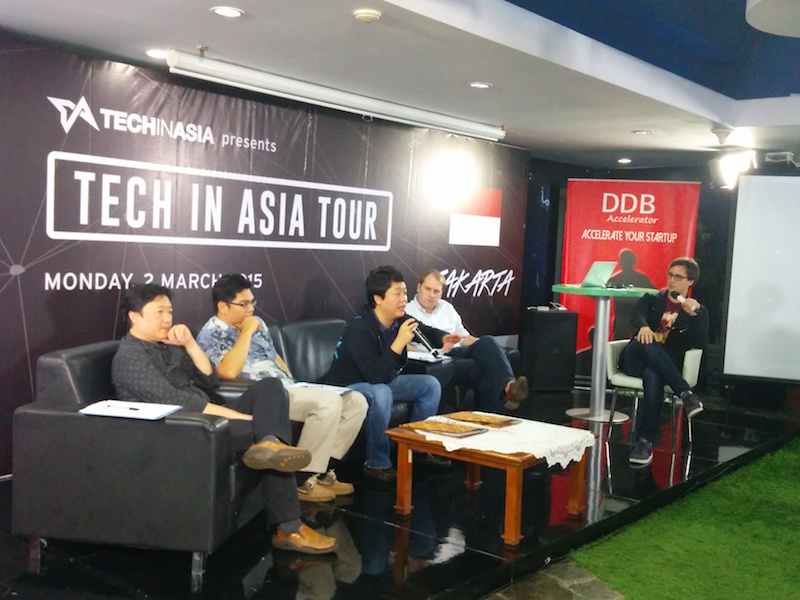 The Tech in Asia Tour made its first stop in Indonesia’s capital at Jakarta Digital Valley on March 2. While five startups waited for their chance to get on stage, TIA’s Leighton Cosseboom led a discussion with the four seasoned VCs who also acted as judges in the pitch competition later that evening.
It was a rare opportunity to hear four high-profile VCs from Indonesia and abroad – Kay-Mok Ku of Gobi Partners, Stefan Jung from Monk’s Hill Ventures, Ideosource’s Andi S. Boediman, and Kuan Hsu of GREE Ventures Asia – talk shop and share some of their experience on stage.
Young entrepreneurs often share the same problem. I have an idea, maybe a prototype, but lack an understanding of how to move on from there. How do I raise funds for my idea? How do I scale?
Know the profiles and preferences of potential VCs
Every VC firm has its own strategic approach, determined by the size of the fund, experience of the VCs, location, and other factors. Knowing as much as possible about the VC that a startup plans to approach will help get a foot in the door.
According to Stefan Jung, Monk’s Hill is mostly interested in Series A or B investments between US$2 to 5 million. Andi S. Boediman’s Ideosource has a different approach: “We do seed capital below US$500,000, but we also go big, above US$ 5 million.” Knowing what stage and how much a VC is likely to support your startup is a good guideline to help decide who to approach.
Relationships and perseverance matter – a lot
The worst thing a founder can do is crash doors with demands before tactfully building a relationship first. Kuan Hsu was once approached cold with an email, but when he agreed to meet, the founder requested he sign a non-disclosure agreement before he had the chance to learn more. “That did not work for me”, said Kuan Hsu, laughing. “We suggest you to establish a relationship with us before you ask for investment. This allows me to collect data points.”
VCs usually agree that ideas are easy to come by, but that it’s the execution of these ideas that matter. Boediman put it bluntly: “I don’t believe in ideas. I can give you a hundred of those. I am not interested if you have not already built something that gives value to people.”
Jung points out that a connection between the person and the idea helps a lot, as this will give them the strength to persevere if things get rough. “If people are doing it for an opportunistic reason, they will give up early,” he observes. Kuan adds, “I also don’t care so much about product. If a team is good, it will realize when a pivot is needed and it will be able to adjust.
VCs can help startups scale, but a good understanding of the market is key
While starting up a business is comparatively easy, the real challenge begins when the time comes to scale up. But this is where a good investor on board can help.
“Bukalapak, one of our investments, is a good example,” says Kuan. “Their product is a B2C (business to consumer) marketplace. They worked in a niche, trading bicycle parts. We helped Bukalapak identify their sales funnel, to analyze their customer’s behaviour in a systematic way. As a consumer facing company you need to be on top of your metrics at all times. We helped them understand how to maximize each step.”
While metrics matter, Jung points out that scaling is also about recruiting the right people. Beyond that, to scale effectively a startup needs experience and tools, which is how great investors can add value to a startup. “We’ve seen many business models, so we can see patterns, and we can give strategic advice. We also help set up KPI sheets and how to solve leadership issues,” says Jung.
Boediman says that founders need to be clear about the potential to scale to begin with. “We look at companies this way: Is there a 100 million dollar potential? If there is not, why even start?”
While there surely are smaller markets to explore and build sustainable businesses around, Boediman’s message is clear: A startup must do its homework to understand its market and potential to scale, all arguments which will help to approach and convince the right VCs.
How to get to this understanding? Come to events, talk to people, and read. Boediman has a tip for young startups: “Read Zero to One. Please read that book.”
See: Zero to One is a great book. But is Peter Thiel oversimplifying Asia?
Stay updated on the go with our mobile app.
Get latest insights with smoother, more personalized experience through TIA mobile app.
Recommended reads
 Recession Run: Alt protein to be $200b industry this decade, says Good Startup
 3 things startups should do to start fundraising on the right foot
 Founders are being hit hard by layoffs, too
 3 tips from Monk’s Hill Ventures’ Susli Lie on finding the right co-founder
 How founders can prepare for 2023 even as markets fall apart
 Willson Cuaca’s coconut framework wants startups to focus on core strengths
 Deep Dive: How Asian VCs are giving the recession a run for its money
 A closer look at how East Ventures is driving ESG impact in Southeast Asia
 Did you get a good deal on 9.9?
 Indonesian founder Aria Rajasa dies at 39





Editing by Paul Bischoff and Malavika Velayanikal
(And yes, we’re serious about ethics and transparency. More information here.)




