 Paloma Ganguly · · 5 min read
The tech exec who got tiny tots talking English, doing math in rural India
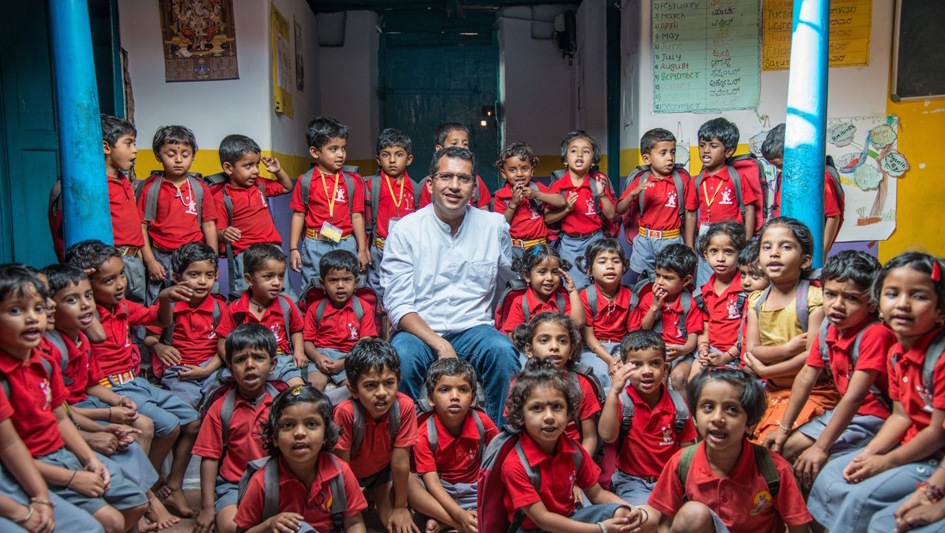
Photo credit: Hippocampus Learning Center.
Tiny tots troop in dressed in red and grey uniforms. They are ready for another day of play and learn. A motley bunch, some are barely two. But if you show them a three-letter word in English, they will use phonics to break it up and read it. They can also count out objects in perfect sequence or string up beads with utter concentration.
It might seem like a familiar sight. Haven’t I seen my kids do the same in their playschool?
But here’s the big difference. The place where my children went is an elite Montessori school in a posh quarter of Delhi, sought after by the who’s who of the capital. It’s tough to get into and costs upwards of US$1,780 annually.
The scene I just narrated to you pertains to rural Karnataka. This school charges a tuition fee of US$30 (1/60th of what I paid), and its students are the children of farmers, shopkeepers, and laborers – people with no strings to pull, little money, and even lesser access to quality education.
Welcome to the Hippocampus Learning Center, an edtech startup that could revolutionize the way much of India looks at preschool.
“Our services target the poorest of the poor, and reach the most rural of areas, where no such interventions are available,” CEO and founder Umesh Malhotra tells Tech in Asia. IIT grad, ex-Infosys executive, Bangalore Labs founder, call him what you will, but the man has found his calling somewhere unexpected.
Hippocampus has built up 285 centers in 11 districts across Karnataka, making it one of the largest private preschool networks in rural India.
Hippo’s journey from a library

Photo credit: Milada.
It started with Umesh and his wife’s love for libraries.
In 1999, when they came back from the Bay Area to India with their son, who was then five years old, a good public library was what they sorely missed.
So they started one called Hippocampus, named after the part of the brain that governs learning and memory formation. “That nicely shortened to hippo, and a purple, grinning cartoon of the animal became the organization’s logo!” says Umesh.
Then came a reading foundation for underprivileged children. But the constraints became overwhelming. “With fewer than half the children able to read at a grade-appropriate level, even in their native tongues, an active library seemed like a dream,” says Umesh.
The daunting landscape
Women with tech tools
A deeper dive





Stay updated on the go with our mobile app.
Get latest insights with smoother, more personalized experience through TIA mobile app.










📅 Upcoming Events
22 October 2026
Payoneer x CSPN Summit 2026