 Jonathan Chew · · 5 min read
How this startup helped SEA lenders reduce processing time by 70%

After years of toiling in the same field, some people take a break – a vacation, perhaps, or a nice long weekend – while some scroll through LinkedIn searching for greener pastures.
And then there are those that start their own companies. Such was the case with Kunal Goel and Shrinivas Deshmukh, who decided to found their own startup after getting to know each other through a mutual friend in 2021.

Shrinivas Deshmukh (left) and Kunal Goel (right), co-founders of PowerCred / Photo credit: PowerCred
“Coming from years of working in similar roles, we both wanted to feel the excitement of starting something new. We had complementary skill sets, and it was a perfect marriage of ideas,” says Goel, who has had several stints as a business development executive. Deshmukh, on the other hand, is a seasoned software developer.
In their previous roles, Goel and Deshmukh noticed that lenders often faced challenges in obtaining and understanding borrowers’ data. This is why in 2022, they began testing a data aggregation and analytics solution with a potential customer.
The co-founders noticed that it clicked well, signaling the potential for product-market fit. That was the green light for them, and Singapore-based PowerCred – which provides comprehensive data solutions through document intelligence, API integrations, and helps firms with process optimization and fraud detection – was born that same year.
Leave it to the algo
To start off, Goel and Deshmukh worked with some early customers to develop the solution in the right direction. They eventually tapped AI to help lenders analyze documents submitted by individuals or companies seeking loans, using the technology to vet borrowers and identify fraudulent applications.
Their solution would also make it easier for lenders to compile borrowers’ data into a single platform, allowing for more efficient analysis, better fraud detection, and improved scaling capabilities.
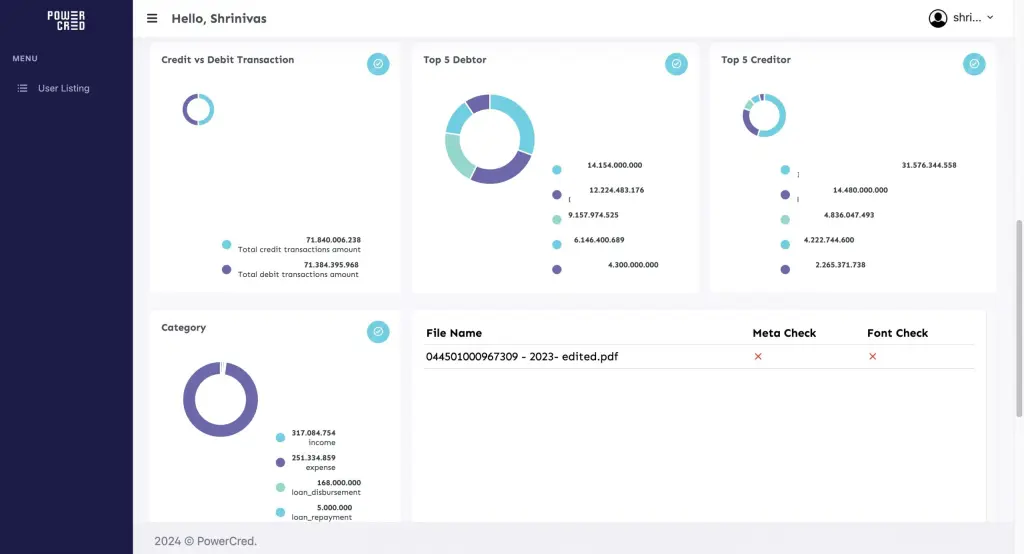
The dashboard for PowerCred’s solution / Photo credit: PowerCred
This, in turn, has helped PowerCred’s customers shave off valuable processing time. According to Deshmukh, manually vetting loan applications from small businesses could often take lenders up to four days, while the process for individual borrowers could take between 18 and 24 hours.
“Once our product came into the picture, the turnaround time for business applications is now less than an hour. For individual borrowers, we can onboard them in less than five minutes and help lenders make a decision to disburse within another four,” he adds.
By May 2023, they had secured their first customer in Indonesia, the company’s main market, and started to gain traction. Come September, the company would see its first dollar of revenue nestled snugly in its bank account.

Photo credit: Shutterstock
Over the next year or so, PowerCred would net a total of 16 customers across three main lending segments: companies that issued loans to borrowers to buy automobiles; those that lent to individual borrowers, which typically involved cash loans and had smaller ticket sizes; and SME financing, which covers working capital or invoice financing products.
In total, these 16 customers would use PowerCred’s platform to process 20,000 to 40,000 loan applications daily, with up to US$400,000 in loan ticket sizes.
“Since the entire analysis is done through an automatic system, there’s little to no manual intervention and almost no human errors. Processing time has been reduced by about 70%, while manual errors have dropped by 23%,” says Deshmukh.
“This allows lenders to cater effectively to a large number of borrowers.”
According to the co-founders, PowerCred’s investors were instrumental in helping them shape the product and build credibility to work with the enterprise level clients. These investors included Taurus Ventures, Forge Ventures, and TNB Aura via its Scout Initiative, among others. They also provided roughly US$2 million in capital injections.
To Southeast Asia and beyond
While the firm seemed to be doing well, the work wasn’t over. It was time to tackle the next step: regional expansion.
The co-founders’ first target destinations? Malaysia and the Philippines, where Goel and Deshmukh have connections to local players. Moreover, these markets weren’t as “structured” yet, so PowerCred would be an early mover.

Photo credit: Shutterstock
Apart from that, Goel and Deshmukh made some adjustments to their solution.
“We broadened our scope and customized the solution so that it was segment-agnostic. This allowed more lenders to explore PowerCred’s solutions,” Goel says. Additionally, this customization was needed to accommodate new user behaviors and languages.
For example, around 80% of Indonesian users typically upload documents in PDF format, but this isn’t the norm in the Philippines, according to Deshmukh. He notes that for loan applications, many Filipino users prefer taking photos of their bank passbooks and uploading the images instead.
As such, when PowerCred launched in the Philippines earlier this year in June , the accuracy rate for the AI was about 89%, some ways off from the 98.9% accuracy rate it achieved in Indonesia. However, after training the AI algorithm to recognize the types of documents uploaded by local users, its accuracy rate increased and is now close to reaching 98.6%, Deshmukh shares.
“Today, whether it’s an invoice, an ID card, or bank statements, our AI can recognize the document and vet it,” Deshmukh adds.
Signals for success
As PowerCred continues its expansion in Malaysia and the Philippines, Goel and Deshmukh will look at three key metrics to gauge success of their solution: how long customers take to go live with the product, what the user engagement levels are, and whether it has attracted a variety of users including developers, risk officers, or even C-suite executives.
For now, the company is primarily targeting the top banks in both countries because that’s where the volume and impact are.
The co-founders also aim to accelerate their scaling efforts. According to Goel, most of the firm’s current customers come from word-of-mouth references.
“Over the next few months, we’d like to get to a stage where the product speaks for itself and leads are generated automatically so our team can focus solely on closing sales,” he says. “We’ll have to create a strong story and the dream is that eventually, we’ll be able to sell customers an entire platform.”
PowerCred offers advanced data solutions to lenders, providing them with tools for identity checks, credit assessments, and fraud defense. To learn more about it, check out its website.
This content was produced by Tech in Asia Studios, which connects brands with Asia’s tech community. Learn more about partnering with Tech in Asia Studios.
Stay updated on the go with our mobile app.
Get latest insights with smoother, more personalized experience through TIA mobile app.
Recommended reads
 Who pays for AI in your language?
 MoneySmart grows revenue by 26% in 2025, but AI threatens margins
 The truth about AI language models: No one wants to pay for them
 Tracking AI hiring in Singapore: OpenAI, Anthropic, and more
 Korea’s physical AI ambitions meet the factory’s bottom line
 SEA financials tracker: Moladin’s revenue rises 6% in 2025
 On‑demand services lift Line Man Wongnai’s 2025 revenue to $544m
 Flipkart’s costly late push into quick commerce and food delivery
 Inside Singapore’s government team that kills its own products
 Once an IPO hopeful, SCI Ecommerce nears collapse





Editing by Winston Zhang, Mina Deocareza, and Eileen C. Ang
(And yes, we’re serious about ethics and transparency. More information here.)




