C. Custer · · 6 min read
How Alibaba created the world’s biggest online shopping day

For most of the world, this Friday will be just another day. But in China, internet users will be throwing money at their screens. At the end of the day, Chinese users will almost certainly have set a new record, spending more money online in a single day than has ever been spent before anywhere.
Why? Because all of the ones in the date – 11/11 – reminded some college kids of loneliness.
How Singles Day got started

Nanjing University, the possible birthplace of the original Singles Day
For a country where many major holidays can be traced back thousands of years, Singles Day is a refreshingly recent invention. No one is quite sure exactly who first thought it up, but it definitely emerged as a student tradition in the mid-1990s. The most widely-accepted story is that it emerged from the dorms of Nanjing University in 1993 when four single male students got together to discuss how to break free of the loneliness and monotony of single life. One suggested that because of the ones in the date, November 11 would be a good day on which to organize activities for singles.
What started as an idea executed by a small group of friends gradually became a university tradition. Singles Day grew into something like the anti-Valentines day, a day China’s single young people – at first just men, but later single women adopted the tradition as well – could use as an excuse to get together and do fun stuff like visit karaoke bars together. Traditions like eating youtiao – fried dough strips that resemble the number one – in the morning evolved as the holiday spread, and by the late 2000s it had become pretty widely known, especially among China’s youth.
The fact that the holiday went from local to national in less than two decades likely has a lot to do with China’s demographics and its culture. The country has a serious gender gap – by 2020 it will have 35 million more men than it does women – so there are plenty of young, single men who can relate to the desire to have fun and celebrate independence without a significant other. And because there’s immense family pressure on many young Chinese men and women to find a suitable partner and marry young, young people of both genders embraced the holiday as a kind of release. Singles Day was about being with friends and having fun.
Monetize this
I say the holiday was about being with friends and having fun because now Singles Day is about shopping – mostly online shopping. How did an underground youth holiday go corporate? It’s a long story, but the short answer is Alibaba.
By the late 2000s, Singles Day was well known enough that most of China’s internet users – who skew young and urban – were familiar with it. There might have been some small shops online and offline offering sales on that day earlier, but no major company bought into the holiday until Alibaba launched its first Singles Day online sale in 2009.
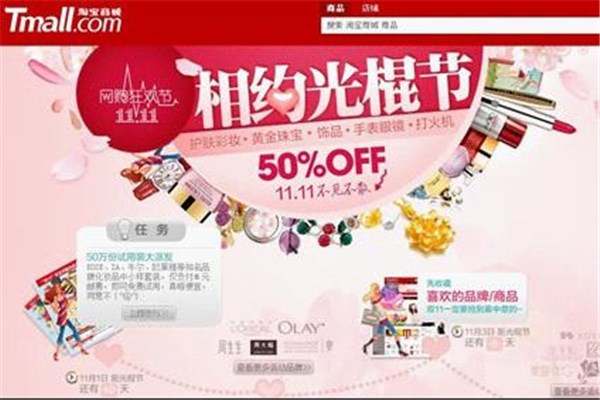
A Tmall ad from 2012 that uses the original Chinese term for “Singles Day”
An Alibaba representative explained to Tech in Asia that the company’s intent wasn’t to tie its day of sales to any particular holiday. November 11 was just a convenient date that fell during a holiday lull: sales were common before China’s National Day in late September and again before Spring Festival in the first two months of the year, but late autumn had no recurring retail sale period. November was thus the perfect time for big online sales; there was no offline sale to compete with and at a time when ecommerce was still growing in China, getting consumers’ undivided attention was important.
That said, although Alibaba plays down the Singles Day connection and has since even trademarked a different term – double-eleven – for its day of sales, it seems unlikely that the date of November 11 was chosen by total coincidence. After all, it was a holiday that already had some cachet with China’s young, urban internet users, who were Alibaba’s primary customers. Moreover, the company used the original term for Singles Day invented by university students – guanggunjie – in its marketing materials until as late as 2012.
This year: more, more, more





Stay updated on the go with our mobile app.
Get latest insights with smoother, more personalized experience through TIA mobile app.