
Summary:
- SMEs often lose capital through small, unmonitored costs – the “leaky bucket” that can erode the bottom line.
- At “Built to scale: How SMEs can reclaim margins and optimize cash flow,” an event co-organized by MariBank and The Business Times, leaders unpacked their struggles with the leaky bucket and how that shows up in other ways, such as time inefficiencies and issues with legacy banking institutions.
- Digital banks have emerged as a solution to these concerns, offering faster loan approvals and eliminating maintenance fees. But the perceived lack of a human touch remains a hurdle for SME owners.
- Explore how MariBank can help your SME unlock new growth opportunities.
The word “growth” often gets thrown around in the tech and business space. Everyone is chasing growth, driving revenue growth, looking for growth opportunities … you get the idea.
But having lots of sales, plenty of customers, and high revenue numbers is just one part of the picture. If you look at how your finances are leaky and your bottom line is getting eroded by small, seemingly insignificant costs that quickly add up, you get a fuller view that isn’t as rosy.
That was the focus of the discussion at “Built to scale: How SMEs can reclaim margins and optimize cash flow,” an event co-organized by digital bank MariBank and The Business Times.
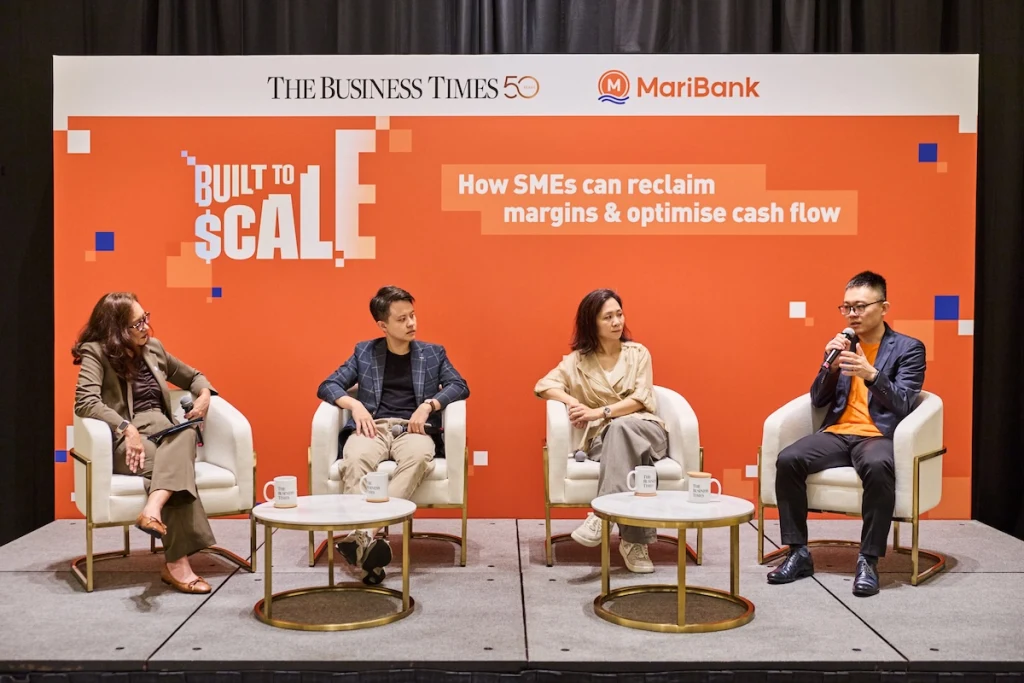
The event took place on October 15 at St Regis Singapore / Photo credit: The Business Times
Held on October 15, the event featured a panel discussion moderated by Claressa Monteiro, head of audio at The Business Times. Sharon Teo, CEO and co-founder of Inspire-Tech; Tan Yee Hern, assistant managing director at Capstone Aluminium; and Tiger Wang, Monee consulting director, SME business solutions at MariBank Singapore, shared perspectives on where they see gaps in financial operations, how SMEs need to evolve their processes, and what solutions are available.
Here’s what went down.
Leaky buckets and hidden costs
A central theme of the discussion was the “leaky bucket” – the subtle, often unmonitored ways that capital gets drained from a business. While rent, payroll, and materials are strictly tracked, some financial leakages frequently go unnoticed. These may seem small – 1% here, a dollar or two there, 20 cents on a transfer – but they pile up.
For SMEs, “it’s really difficult to run a very tight ship,” said Tan. “We’ve got many things to manage [and] look at … I think it’s only inevitable that we have some leaks here and there. Account fees, FX exchange, your transaction costs and all that – all of these add up.”
Teo echoed this sentiment.
“Sometimes as SMEs, when it comes to negotiating rates and stuff like that … because we don’t have the volume, if you want to talk about negotiating with suppliers or even banks, you’re not really in that position,” she shared. “So you are always the price taker. Whatever is given to you, you just take it.”
The requirement of maintaining minimum balances in bank accounts is also a pain point that emerged, given how many SMEs struggle to get access to working capital.
“The minimum balance was quite a [point of] tension for me because cash flow is always a challenge for young businesses,” Teo explained. “It was very frustrating. Sometimes, seeing that we are almost reaching or we are below that balance … actually distracts us from doing business.”
Time is of the essence
Beyond monetary fees, the panel emphasized that time is one of the most expensive hidden costs for SMEs.
For example, lengthy processes at legacy banking institutions could lead to lost opportunities for SMEs.
Tan recalled how construction work still carried on in Singapore during the Covid-19 pandemic. Capstone Aluminium experienced fewer supply chain constraints compared to its competitors, so it was able to accept contracts that others could not.

From left: Claressa Monteiro, head of audio at The Business Times; Tiger Wang, Monee consulting director, SME business solutions at MariBank Singapore; Sharon Teo, CEO and co-founder of Inspire-Tech, and Tan Yee Hern, assistant managing director at Capstone Aluminium / Photo credit: The Business Times
“We started taking double, triple, quadruple the amount of projects that we used to take,” Tan recalled.
However, Capstone Aluminium needed capital to procure the raw material needed to finish these projects. Due to the nature of the construction business, it would take at least 180 days or more for the company to receive payment for its work.
Cash flow was a serious issue, and getting loans proved to be an even bigger problem. In Tan’s experience, it took months – and in some cases, a year – for Capstone Aluminium to get the loans it needed.
“Having things processed fast is very important for us, especially when there’s an opportunity presented to you,” he said. “If you don’t have speed, you don’t have efficiency. You might just miss the boat, right?”
Capstone Aluminium managed to secure the loans it needed by the skin of its teeth. But Tan noted that it was only possible because projects in the construction industry span years, giving the company breathing room. A business that needs to move much faster could have lost out on the opportunities.
Relying on legacy banking processes can also create administrative burdens that draws SME owners away from core business growth.
“If we’re gonna spend a lot of our time doing all the paperwork and answering questions, it eats away at our mental capacity and [adds to] our load. That distracts us from our business, which I feel is even more costly than the monetary cost,” Tan said.
Inspire-Tech’s Teo also pointed out that SMEs need to look into how processes can be run more efficiently, as time savings can often be indirect. For example, if a staff member takes a whole day to complete a task that saves the company US$50, is that the best use of their time?
“When we do banking services or any other work that we are doing, sometimes we can be penny wise but pound foolish,” she said.
Unlocking new solutions
During the conversation, digital banks emerged as a solution to the woes SMEs experience.
“One of the benefits of a digital bank is we have a chance to rebuild all these processes from scratch and … use technology to make a lot of these processes faster,” shared MariBank’s Wang.
MariBank, for one, decided to restructure standard fee models. Wang explained that the bank eliminates account maintenance fees and FX markups for overseas remittances, while also offering daily interest on deposit balances. Not only does this eliminate one “leak” that SMEs grapple with, but it also allows their money to grow.
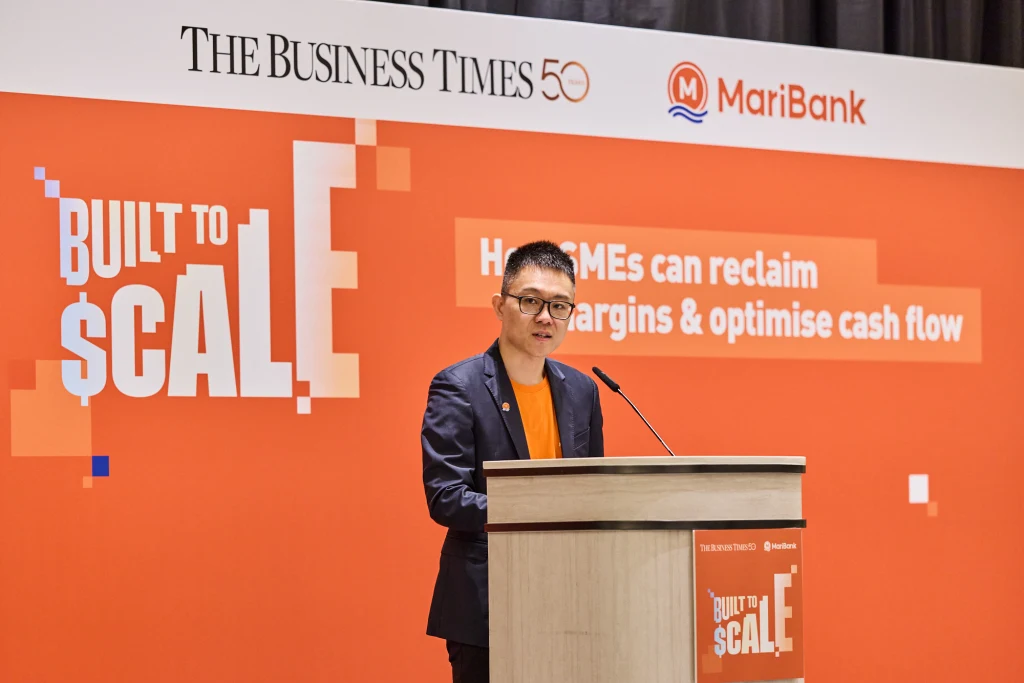
Wang delivering a keynote prior to the panel discussion / Photo credit: The Business Times
“[We try] to make every part of the banking products we build a little bit better than the existing players’ [offerings],” Wang said. “Over time, there will be more SMEs or customers who get to know us, who are willing to try us and enjoy the benefits.”
One area where digital banks may shine is loans. They can speed up the lending process significantly by leveraging new technology and alternative data sources. They can also offer products such as revolving credit facilities where interest is only incurred if borrowers actually draw from the loan.
“We use tools to digitize the reading of the bank statement submissions or document submissions, and auto-generate the data necessary for our credit assessors. That shortens a lot of the credit underwriting and credit assessment processes,” Wang added.
Capstone Aluminium’s Tan noted that when he was seeking a loan, he received much quicker responses from digital banks. Some had disbursed the loan even before a traditional bank finished processing his application.
Tech and trust
Despite the potential efficiency gains, SME owners remain hesitant about digital banking.
During the session, several audience members expressed concerns around the lack of the human touch with digital banking. While most SME owners were excited about digital banking’s speed and efficiency, they still wanted to speak with humans to resolve more complex issues instead of dealing with a chatbot.
Trust was a concern as well. Traditional banks have physical branches that give customers a sense of stability that digital players still struggle to offer.
Wang acknowledged that digital banks need to work on this and that there are no shortcuts to building trust among SMEs.
“Trust will be gained through consistently delivering reliable services to our customers, being there on time, [having] minimal downtime to our systems, and being always responsive to the queries from the customers,” he said.
Digital banks are certainly changing the game for SMEs, but it’s clear that not everyone is ready to go all in just yet. But the road ahead isn’t about choosing between traditional players and digital banks. Instead, it’s more about how SMEs can leverage the best of both worlds to meet their needs.
MariBank is a wholly owned subsidiary of Sea Limited. Based in Singapore under Monee (formerly SeaMoney), a leading digital financial services provider in Southeast Asia, MariBank is supported by its ecosystem partner Shopee, the top ecommerce platform in Southeast Asia and Taiwan.
Explore how Maribank can support your SME journey.
This content was produced by Tech in Asia Studios, which connects brands with Asia’s tech community. Learn more about partnering with Tech in Asia Studios.
Stay updated on the go with our mobile app.
Get latest insights with smoother, more personalized experience through TIA mobile app.
Recommended reads
 High car costs give Singapore a robotaxi edge: Waymo founder
 Automating premium hotel kitchens with sensors
 Who pays for AI in your language?
 MoneySmart grows revenue by 26% in 2025, but AI threatens margins
 The truth about AI language models: No one wants to pay for them
 Tracking AI hiring in Singapore: OpenAI, Anthropic, and more
 Korea’s physical AI ambitions meet the factory’s bottom line
 SEA financials tracker: Moladin’s revenue rises 6% in 2025
 On‑demand services lift Line Man Wongnai’s 2025 revenue to $544m
 Flipkart’s costly late push into quick commerce and food delivery





Editing by Jonathan Chew and Eileen C. Ang
(And yes, we’re serious about ethics and transparency. More information here.)








📅 Upcoming Events
30-31 March 2027
Upskill Fest