 Winston Zhang · · 5 min read
Cultivating the talent and future of Singapore’s biomedtech scene

Summary:
- While Singapore’s biomedtech sector has great transformative potential, it faces a shortage of professionals capable of translating academic expertise into commercial, real-world industry roles.
- Launched by SGInnovate, the Helix Immersion Programme (HIP) builds industry-ready talent pipelines, bridging the gap between STEM graduates and biomedtech firms through on-the-job training fellowships.
- Companies like Vivo Surgical have successfully tapped on the program to find high-quality talent who can contribute immediately to complex projects, helping to build a sustainable talent pipeline for the industry.
- Find out more about HIP and how it can help you find the talent you need to bring your company to the next level.
Deep-tech firms are the unsung heroes of the tech scene.
Although less flashy than their consumer-facing counterparts, these companies pioneer technologies that fundamentally change how we navigate challenges and offer advancements that could radically transform both global markets and individual lives.
Singapore evidently recognizes this potential, with initiatives such as the Research, Innovation and Enterprise (RIE) plan investing considerable resources into the industry. However, there is still a limited supply of skilled professionals in specialist areas such as biomedtech.
“When it comes to talent, there remain gaps in translating academic expertise into commercial roles, shortages in skills such as project management and business leadership, and a lack of direct exposure to real-world industry workflows and frameworks,” says Alicia Ng, deputy director of people at SGInnovate. The company is a deep-tech ecosystem builder and investor backed by the Singapore government.

Alicia Ng, deputy director of people at SGInnovate. / Photo credit: SGInnovate
Enter the Helix Immersion Programme (HIP).
Connection and cultivation
HIP is a 12-month, full-time, on-the-job training fellowship designed by SGInnovate to provide talent that has academic biomedical expertise with industry-ready capabilities. It places research professionals and degree holders into fast-growing biotech and medtech companies to gain hands-on experience in both lab and non-lab roles.
In this way, it plays an active role in nurturing the connection between jobseekers and deep-tech firms, supplying companies with candidates who are ready to contribute meaningfully and opening up opportunities for talent to translate their academic strengths into tangible industry outcomes.
It also isn’t simply a matter of connecting one to the other and calling it a day. SGInnovate provides continuous support throughout the placement, conducting regular check-ins and progress monitoring.

Photo credit: iStock
While industry-ready talent is important regardless of the field, Ng says that it’s particularly key in biomedtech, as it “involves specialized technical and regulatory demands.” With such specific needs, a poor hiring fit could lead to drastic setbacks – ones that burgeoning startups can’t afford to suffer.
SGInnovate ensures the quality of the candidates by putting them through a placement process jointly reviewed by HIP and partner companies, ensuring alignment of skills with startup needs. This takes the gamble out of hiring and provides companies with fresh ideas and a boost in productivity right away, allowing them to continue their long-term growth without the long wait of a traditional hiring cycle.
“The Programme supplements candidates with industry-relevant readiness through mentoring and structured exposure to startup operations,” Ng adds.
The right fit
One company that has reaped the benefits of HIP is Vivo Surgical, a Singapore-headquartered firm that develops medical devices for surgery, including an endoscopic robot for minimally invasive procedures in the gastrointestinal tract.
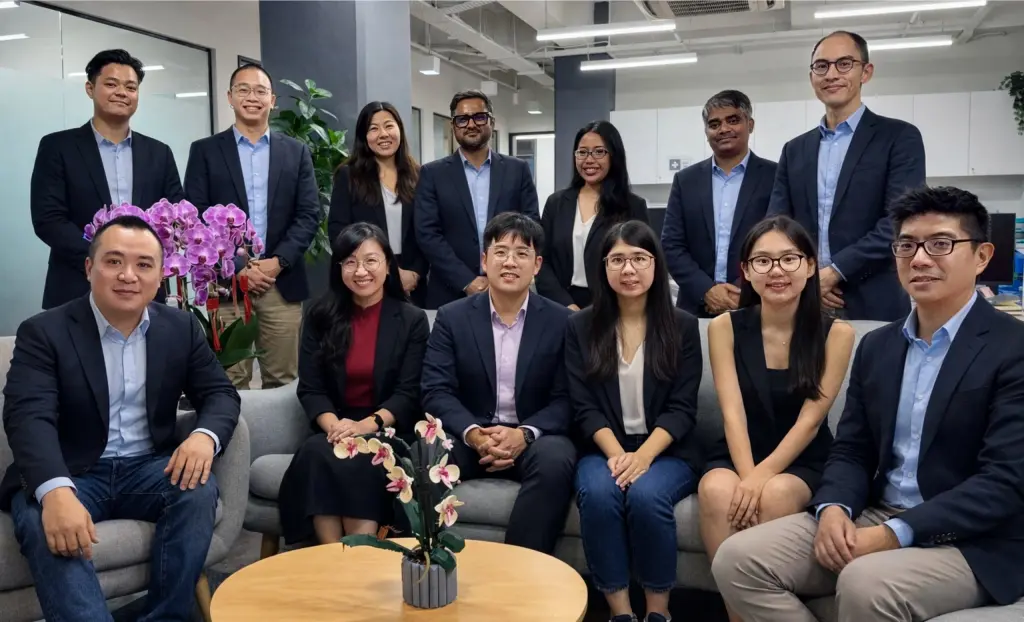
The Vivo Surgical team. CEO and founder Kevin Koh is in the front row, seated on the leftmost chair. / Photo credit: Vivo Surgical
Vivo’s issues with hiring were very much in line with the solutions HIP offers.
“Many candidates had excellent academic backgrounds, but fewer had exposure to systems integration, real-world product development, and collaboration with clinicians,” says CEO and founder Kevin Koh. “These gaps exist partly because such experience is difficult to gain outside of industry or startup settings.”
HIP’s collaborative approach was evident in its partnership with Vivo Surgical. Koh says that SGInnovate took the time to find out exactly what kind of profile Vivo was looking to bring on board. Eventually, the firm was matched with an individual who was equipped to grow with the company, rather than just fill a short-term role.

“Our Helix fellow joined us with a solid technical foundation and strong learning mindset – she was well-prepared to contribute meaningfully from day 1,” Koh recounts. The startup did right by her as well, offering structured onboarding, close mentorship, and “giving her real ownership of tasks, which helped accelerate her development and impact.”
The firm leveraged her robotics background, and as her familiarity with the system’s architecture grew, she led development of a key component that directly and significantly enhanced the robot’s performance and made it more user-friendly.
A foundational partner
The Vivo example is just one success story among many, but SGInnovate’s work is far from done. The ecosystem builder is continuously working on broadening its engagement with biomedtech companies, seeking to always be up to date with industry ecosystem demands, “particularly in functional domains most constrained by talent shortages such as AI, machine learning, quality assurance, and regulatory affairs,” Ng points out.
“SGInnovate will continue to build ecosystems – training platforms, talent-industry matchmaking mechanisms, and community-of-practice engagements – that enable both individuals and companies to keep pace with sector growth and complexity,” she adds.
Vivo itself is looking forward to future participation in talent programs and broader engagement with the medtech innovation ecosystem, illustrating its confidence in SGInnovate’s long-term support.
“Beyond individual placements, programs like Helix play an important role in building a sustainable talent pipeline for Singapore’s medtech industry,” Koh affirms. “SGInnovate helps prepare talent for the realities of the sector. From our experience, this approach works.”
SGInnovate’s Helix Immersion Programme addresses critical talent shortages in Singapore’s biomedtech ecosystem, ultimately contributing to the health of the country’s overall deep-tech industry.
Find out more about how HIP can help your firm take the next step of its growth.
TAP INTO THE TALENT PIPELINE TODAY
This content was produced by Tech in Asia Studios, which connects brands with Asia’s tech community. Learn more about partnering with Tech in Asia Studios.
Stay updated on the go with our mobile app.
Get latest insights with smoother, more personalized experience through TIA mobile app.
Recommended reads
 High car costs give Singapore a robotaxi edge: Waymo founder
 Automating premium hotel kitchens with sensors
 Who pays for AI in your language?
 MoneySmart grows revenue by 26% in 2025, but AI threatens margins
 The truth about AI language models: No one wants to pay for them
 Tracking AI hiring in Singapore: OpenAI, Anthropic, and more
 Korea’s physical AI ambitions meet the factory’s bottom line
 SEA financials tracker: Moladin’s revenue rises 6% in 2025
 On‑demand services lift Line Man Wongnai’s 2025 revenue to $544m
 Flipkart’s costly late push into quick commerce and food delivery





Editing by Stefanie Yeo and Jaclyn Tiu
(And yes, we’re serious about ethics and transparency. More information here.)







📅 Upcoming Events
30-31 March 2027
Upskill Fest