Josh Horwitz · · 3 min read
These Chinese college students built a makeshift business selling fruit on WeChat

Everyone’s familiar with how businesses large and small will leverage social media to generate revenue. In Asia, high profile brands including McDonalds, Maybelline, Xiaomi, and 7-11 have all run promotions on any number of popular social networks.
But China’s WeChat, the behemoth messaging service owned by Tencent (HKG:0700), is reaching even the smallest of small-scale businesses. And there’s perhaps no better ambassador for the app’s potential than Du Hailong, a twenty-one year old computer science student who has built a business selling fruit to his classmates through WeChat.

Du Hailong, left, and a teammate promote Weiguofang at Liaocheng University in Shandong. Passersby can scan the QR code to immediately subscribe to Weiguofang’s official account on WeChat.
Nearly every day for the past four months, Du and his five friends have worked together to deliver fresh fruit around Liaocheng University’s campus in Shandong Province, located about 120 kilometers from the capital Jinan.
Students who follow the WeChat subscription account for Weiguofang, the name of Du’s business, can browse through daily deals on various fruits and snacks. After placing orders on WeChat, the Weiguofang team delivers fruit directly to the customers’ immediate location, where cash is collected for payment.
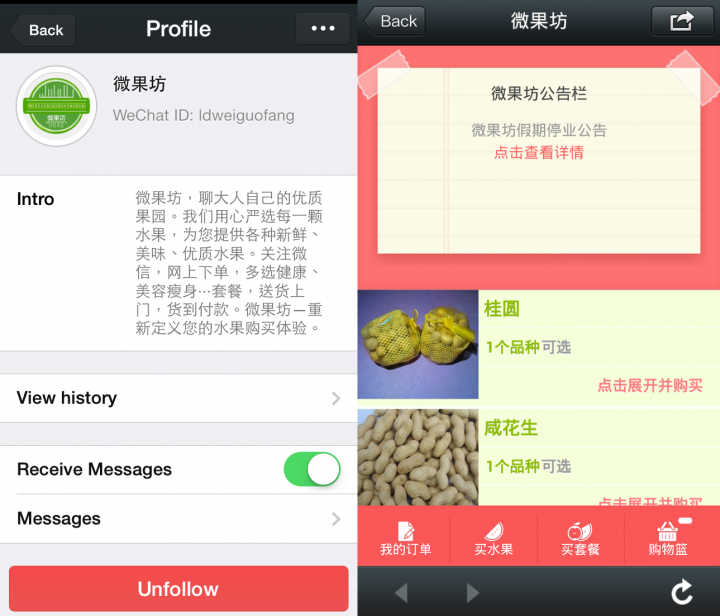
Du has dabbled in internet entrepreneurship in the past, having once owned a few shops on Taobao, China’s leading e-commerce marketplace. But he considers Weiguofang his biggest success thus far, as it’s helped solve a real problem around his college campus.
I decided to sell fruit because the fruit stands at my university are all poor-quality, and expensive too. I knew I wanted to start my own business, but I also wanted to help provide convenience for my classmates
Du tells Tech in Asia that WeChat was an appealing tool for launching the business due to its flexibility and openness.





Stay updated on the go with our mobile app.
Get latest insights with smoother, more personalized experience through TIA mobile app.