Eva Xiao · · 6 min read
From dark warehouses to delivery robots, Chinese ecommerce figures out models of automation
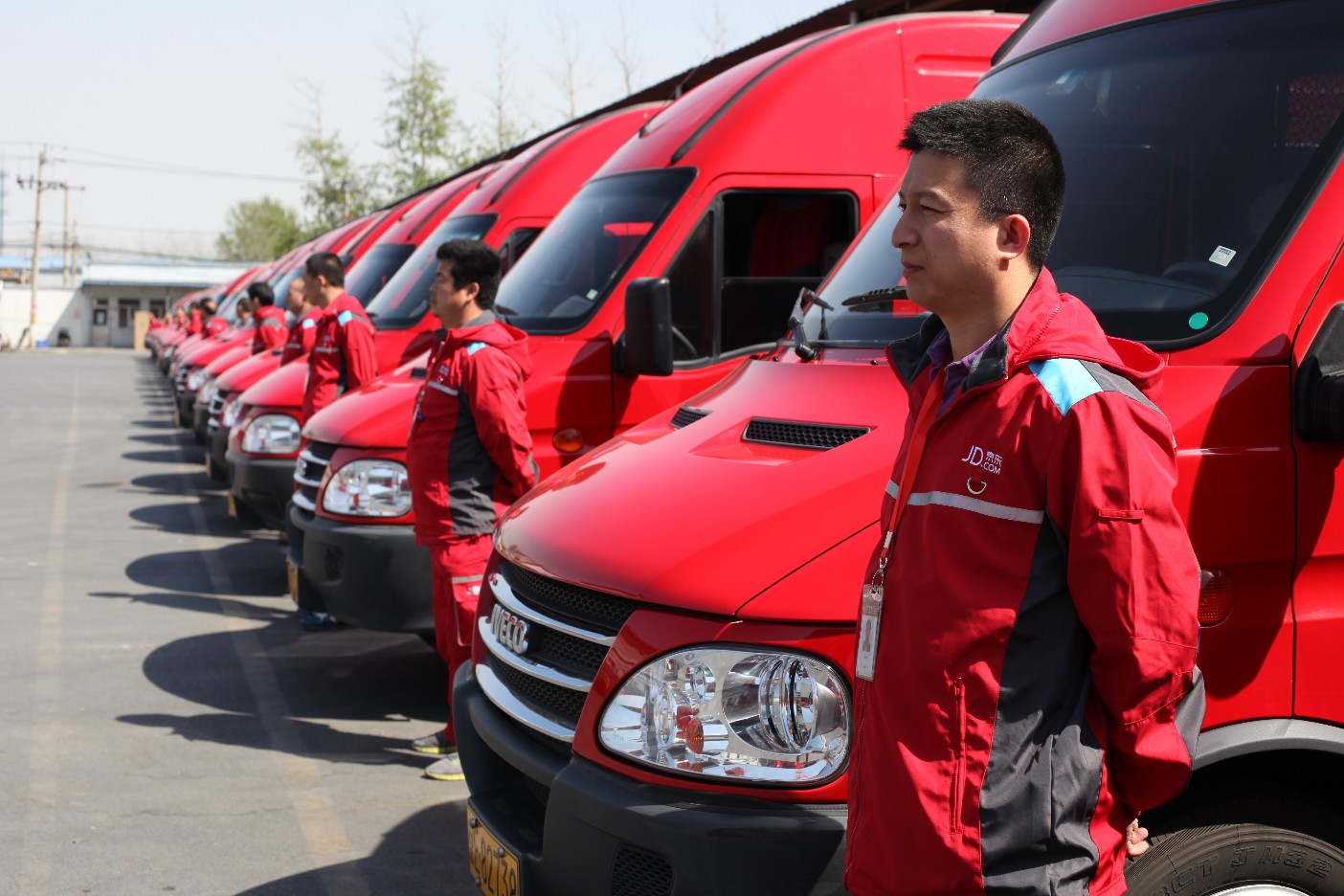
Chinese ecommerce giant JD relies on around 65,000 employees for its last mile delivery service. Photo credit: JD.
Inside a warehouse in the southeast corner of Beijing, a crane-like robot patiently picks up packages from pallet to container. Red banners are strewn across the top of the wall, inscribed with slogans like “Innovation never rests” and “We advance towards smart logistics.”
This is JD-X, the logistics lab of Alibaba’s ecommerce archival JD. Launched last May, the R&D unit has teams in China and Silicon Valley, and develops a wide range of applications and tech: anything related to the movement and processing of packages – autonomous drones, delivery robots, and unmanned warehouses.
Right now, it’s very hard to recruit workers to work in the warehouse and for last-mile delivery.
“Our goal is to develop ‘dark warehouses,’” Huang Fengquan, head of planning for JD Automated Warehousing Solutions, told media during a tour of the lab’s facilities on Monday. Like ‘dark factories,’ dark warehouses refer to completely autonomous facilities where robots work alone in the dark, completing tasks formerly done by humans.
Automating the logistics sector is a global trend, but in China, the stakes are especially high as the country’s population rapidly ages and labor costs rise. In particular, the one-child policy has whittled down the number of available young workers. According to China’s National Bureau of Statistics, the number of workers between 16 and 59 years old plunged by almost 5 million in 2015. As the labor pool shrinks, demands for better benefits and higher wages have also risen.
“Right now, it’s very hard to recruit workers to work in the warehouse and for last-mile delivery,” explained Beth Bao, director of strategy at JD Logistics. That’s actually a more crucial factor than cost at the moment, she said.
“The wages are going up [like] in the United States,” she continued. “I’ve talked to a lot of partners in the US, they also see the labor shortage. It’s very hard for them to get workers to work in those environments.”
Logistics as a service
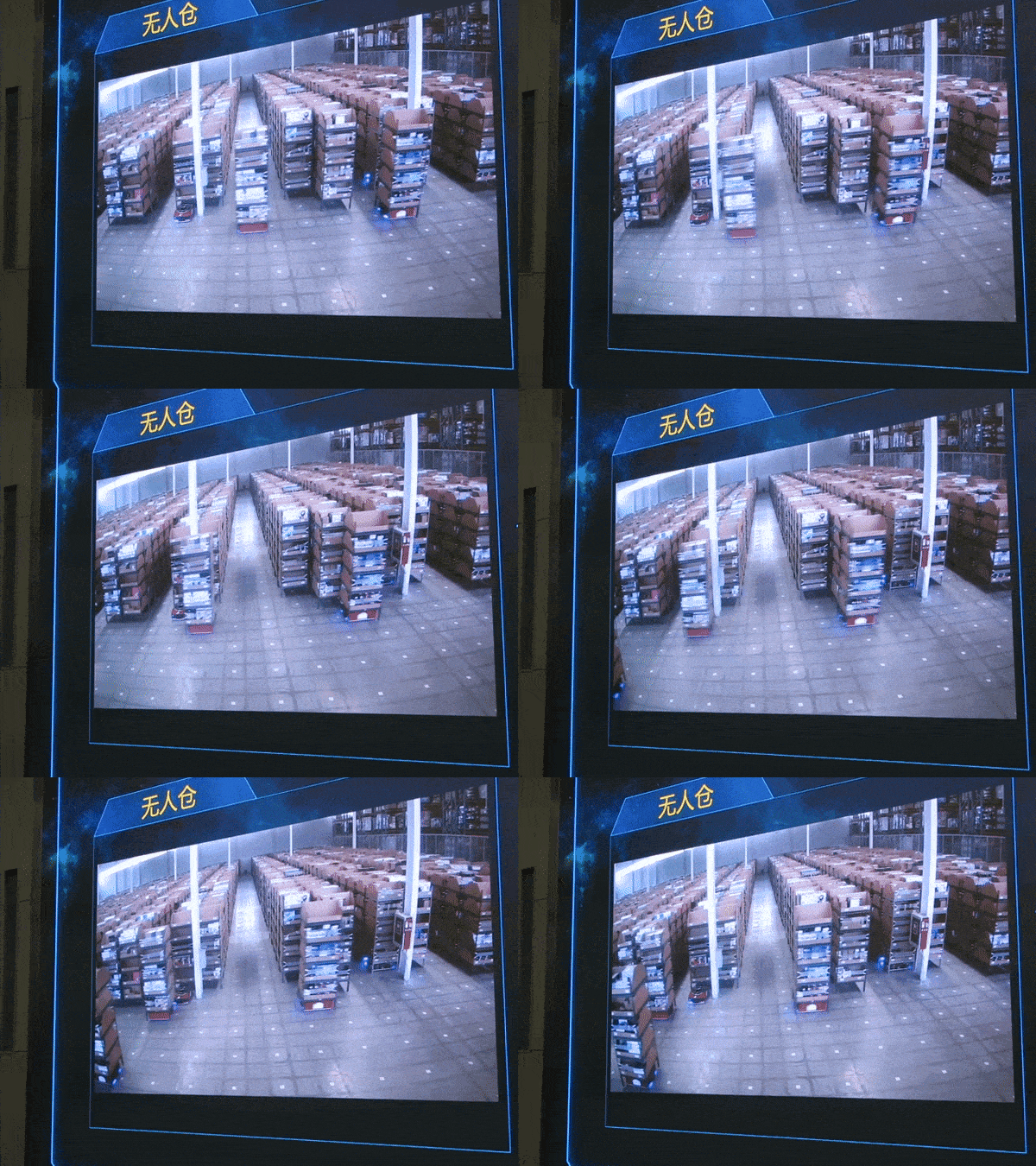
A live stream of Kiva-like robots moving inventory shelves in JD’s unmanned Shanghai warehouse. Image credit: Tech in Asia.
Globally, growth in the ecommerce industry has also galvanized companies to automate fulfillment centers. In 2012, Amazon paid US$775 million to acquire Kiva Systems, whose Roomba-like robots can carry inventory shelves across warehouse floors. In October, JD announced its first dark warehouse in Shanghai – a massive 16,000 square meter facility that has the area size of around three football fields.
Warehouse automation could also optimize workflows and boost efficiency – a top priority for China, whose costs from the logistics sector amounted to 15 percent of its GDP last year. It’s a huge market, said Bao, explaining that JD Logistics – a newly minted business group under JD – aims to be a one-stop shop supply chain provider that serves businesses outside of the ecommerce industry.
“We’re providing the whole supply chain service to brands, which means from warehousing to transportation, to last-mile delivery,” she said. “We can also provide predictive analytics for the brands because we own the customer information. We know where they are and what they like.”
On the data analytics side, JD competes with Alibaba, whose logistics arm Cainiao provides merchants with online and offline inventory management. Cainiao, however, works with third-party delivery companies, whereas most of JD’s couriers are full-time employees. To deal with peak periods, such as the upcoming Singles Day shopping bonanza, JD has also taken on temporary couriers as part of its merger with Dada, a crowdsourced delivery network.
Robot vs Man





Stay updated on the go with our mobile app.
Get latest insights with smoother, more personalized experience through TIA mobile app.