
Fintech has seen some incredible growth around the world. But according to DBS CIO Neal Cross, Asia is the real “waking giant” on the scene. Late to the party but catching up fast.
In 2015, venture capital funding for fintech businesses in Asia reached an all-time high, jumping to US$4.5 billion from US$1.1 billion in 2014, says KPMG. In fact, some of last year’s largest fintech deals were in the region.

Photo credit: Pixabay.
Probably the most interesting thing about fintech in Asia is how it came about. Its exponential growth has been the result of many unique circumstances – what Neal calls its “local flavor.”
“Each market in Asia is developing in response to its own circumstances. The challenges and local nuances are immense and it would be a mistake to try to carbon copy ideas from the West,” the DBS CIO tells Tech in Asia.
So what is this “local flavor” that Neal talks about? We’ve boiled it down to three main points.
1. Chinese Millennials

Hollister launches a new branch in Shanghai. Photo credit: Wikimedia.
China, one of the countries leading the fintech charge, has achieved considerable success thanks to a generational population shift.
Consumer patterns are changing as China’s “post-’80s” generation (those born in the decade starting 1980) come of age, many of them gaining significant spending power as they reach their thirties. This group of young spenders is moving away from their parents’ thrifty mindset and is instead embracing consumerism and more modern societal norms.
The combination of higher spending power and a freer adaptation of technology means that fintech has an entire market of willing and able customers.
When a survey saw a spike (PDF link) in China’s online stock or fund speculation in the first half of 2015, it noted that most of it (41.8 percent) was due to the “post-80s” generation.
Mobile payments in China are also at an all-time high. China has 380 million people shopping online via their phones, as well as nearly 200 million people using their phones as a wallet for in-store payments.
While reports from Citibank and J Capital Research have found that China’s fintech scene is “well past the tipping point of disruption,” it’s still nothing to sneeze at: investments in VC-backed companies in China have quintupled in a year to hit US$2.7 billion in 2015.
That’s over half of Asia’s total venture capital funding in fintech. China will continue to take the lead in Asia in the next few years.
2. Connecting the unbanked
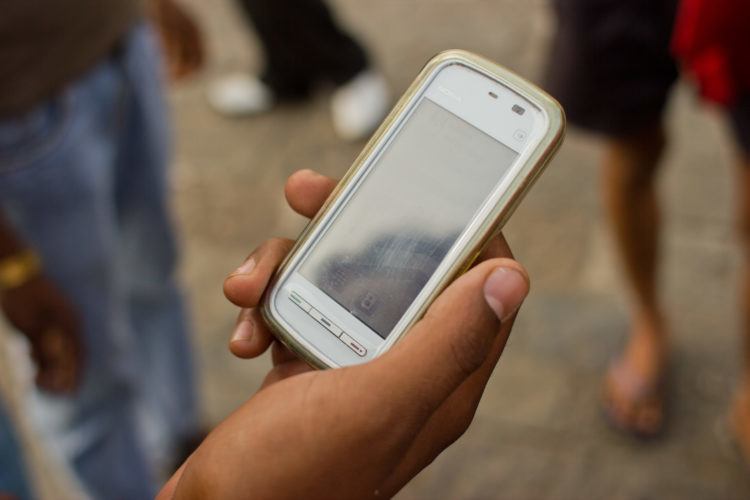
India has the world’s third-largest internet user base. Most access the internet on a phone. Photo credit: Wikimedia.
Neal says there are Asian populations “going from underbanked to banked, who may have never set foot in a branch, but have access to mobile devices through the explosion in mobile phone penetration.”
Businesses are tapping into these populations. According to the World Bank, Asia-Pacific’s unbanked – those without bank accounts – in 2015 stood at about two billion adults.
Financial inclusion has become a main focus in many parts of the continent since it was last year recognized as an important tool in the fight against poverty by world leaders who adopted the 2030 Agenda for Sustainable Development.
Phones are key to converting the unbanked. Having a smartphone is enough to connect the unbanked to financial institutions.
Now consider how companies in Singapore and India are building digital solutions to reach these individuals. In India, the unbanked population has halved in the span of four years, from 577 million in 2011 to 233 million in 2015, states a report by PricewaterhouseCoopers.
“Yes, the lack of ubiquitous use of the smartphone is a barrier in the rural areas, but we can still leverage feature phone technology” – that means those really old flip phones – “and integrate some of our services to actually give people this access,” says Sidd Gandhi, co-founder and CEO of fintech startup Kyepot.
3. Trust in math and systems

Photo credit: Wikimedia.
Due to its diversity and turbulent political climates, Asia is also a region that has the most to gain from the newest player in fintech – the blockchain.
It’s not just a Bitcoin thing. A loose description of blockchain technology is that it is a public, permanent, and online ledger that can only be updated by majority consent of users on that system. It can’t be tampered with or edited in any way.
According to a DBS white paper exploring the technology, Asia has the most to gain from blockchain tech being used in finance because of its unique social structure.
Asian societies tend to have a lower level of trust in both businesses and political regimes, while new business relationships are generally created from family ties and mutually trusted parties. As the credibility of blockchain lies in systems and mathematics, it can create a fair and neutral space to remove questionable third parties and bring legitimacy to potentially risky investments, opening doors for many new business ventures.
One example of how blockchain can benefit businesses is through lending. If a new business struggles to obtain funds to grow its company, blockchain technology may help these companies make loans against existing assets, such as machinery and equipment. As blockchains are tamper-proof, banks and potential investors can be assured of the assets’ existence and the business’s ability to repay the loan.
This new method of establishing trust can also be used with international trade, supply chains, voting registers, and in many more areas.
“Global trade is often overlooked in fintech terms – but with our region featuring nine of the 10 busiest container ports in the world, fintech can help facilitate and modernize centuries-old systems in trade. It can do this in a way that minimizes the potential of money laundering, fraud, and illegal capital flows,” says Neal.
In summary – friends, not food!

Photo credit: Kenny Loule.
As Asia’s growth becomes impossible to ignore, banks are shifting from seeing fintech companies as disruptors to collaborators.
Singapore’s DBS is something of a pioneer, bringing in fintech startups to work with DBS HotSpot , the only pre-accelerator program wholly owned by a bank here in Asia.
Fintech brands under the program include Cinch, an integrated financial management system to help small and medium-sized enterprises manage invoicing and cash flow, and Invoice Interchange, a peer-to-peer invoice trading marketplace.
“As an Asian bank,” Neal explains, “we understand that we have a role, and a strategic imperative, to support the development of local fintech. DBS HotSpot wasn’t just about bragging rights, but a tacit recognition that there is much that we can learn from these startups – just as they can tap into the experience of our team.”
Fellow Singaporean bank OCBC also has a pre-accelerator, The Open Vault, that fosters a range of fintech companies. This includes Coins.ph, a Filipino startup that enables the unbanked with the ability to transfer and receive money without a bank account.
“Earlier this year we went to Money 2020 in Copenhagen, the world’s largest fintech conference to date. I’m more convinced than ever that Asian fintech must chart its own course – or rather courses, given the diversity of markets we serve,” concludes Neal.
DBS is a leading financial services group in Asia, with over 280 branches across 18 markets. Headquartered in Singapore, DBS has a growing presence in the three key Asian axes of growth: Greater China, Southeast Asia and South Asia. The group serves more than six million consumer banking and wealth management clients and over 200,000 institutional banking customers, and employs about 22,000 people, representing over 40 nationalities. Global Finance and Brand Finance have ranked DBS as the Safest Bank in Asia and the most valuable banking brand in ASEAN respectively.
Providing a full range of services in consumer, SME and corporate banking, the bank is at the forefront of leveraging digital technology to shape the future of banking. DBS is also committed to positively impacting communities by nurturing digital startups through DBS HotSpot, a pre-accelerator programme, in addition to supporting social enterprises and corporate social responsibility efforts to build a more inclusive Asia.
Stay updated on the go with our mobile app.
Get latest insights with smoother, more personalized experience through TIA mobile app.
Recommended reads
 SG’s crypto brain drain and India’s new digital rupee
 Binance names new regulatory policy director
 Taiwan fintech firm hires ex-Federal Reserve exec for risk management
 Crypto.com, Independent Reserve in top 5 for strong AML; Binance places 42nd
 FTX owns ID crypto exchange Bitocto, court document shows
 How blockchain seeks to change energy and commodity markets
 SG minister highlights AI adoption pitfalls in SEA
 DBS joins JPMorgan’s blockchain-based trading network
 Binance lays groundwork for Ethereum Merge support
 Will Islamic fintech be Malaysia’s ticket out of ‘no man’s land’?





Editing by Terence Lee, Steven Millward, and Malavika Velayanikal
(And yes, we’re serious about ethics and transparency. More information here.)