
Photo credit: The Kingsway School.
Whether it’s because of lackluster curriculums or limited job opportunities, India has never shone when it comes to innovations in science.
But there’s something afoot at an office in the tiny town of Hubli, Karnataka. There, a group of tinkerers are shrinking the orbit of planets around the sun so the solar system fits right into the rectangular screen of a cell phone. They’re also taking a cell’s nucleus and making it large enough to see, and turning the invisible friction of a balloon rubbing against a table visible.
Those tinkerers are the team at LabInApp, and the co-founder Pavan Shinde explains to me that that they’re working on something that might revolutionize science education.
“This is the new wave,” he says. “First were the textbooks, then came smartboards, and then videos. Students found most of these boring, although they’re getting better. Now is the time for immersive technology.”
LabInApp’s product is a virtual laboratory that works with Android phones and computers.
It uses the science curriculums of students studying from the 9th through the 12th grade in India to build out a visual version of what goes on in school labs – including all of the things that are otherwise impossible or too expensive. If you’re learning about gravity for example, LabInApp lets you move objects around under the earth’s normal gravity, and then change parameters to see how it might look on the moon, or with liquid.
Add to that the fact that labs are expensive to maintain and even tougher to keep safe, and you have lots of reasons why LabInApp is an attractive alternative.
Pavan didn’t have to travel very far to come across the idea. He attended BVB Engineering College in Hubli, where he met his three co-founders, Vinayak Hulabutti, Pramod Ramdurg, and Girish Shirigannavar. Once they graduated, the four incubated the idea at the college’s Center for Technology Innovation and Entrepreneurship.
“Do and learn, do and learn,” says Pavan. “That’s how we think science should be learned.”
Edtech problems
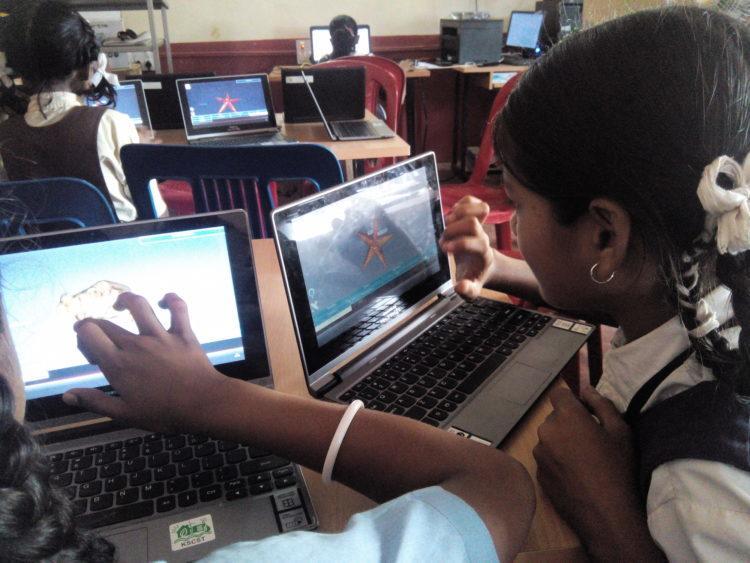
Students using LabInApp.
When LabInApp first launched, it was selling individually to schools, which made it tough to scale. “We were going from school to school, to nearly 200 different ones across Karnataka,” reminisces Pavan.
Even worse, each school had multiple players that needed convincing before the team could sell a product – including parents, teachers, principals, and sometimes even students.
Many hats





Stay updated on the go with our mobile app.
Get latest insights with smoother, more personalized experience through TIA mobile app.









📅 Upcoming Events
22 October 2026
Payoneer x CSPN Summit 2026