Stefanie Yeo · · 6 min read
How you like that: Behind Tokopedia’s K-wave marketing campaigns

Even if you’ve been living under a rock, you’d be well aware of how hallyu, or the Korean wave, has taken the world by storm. Often referred to as the “K-wave,” the phenomenon is evident in how people all over the world are appreciating Korean culture, whether it’s through listening to K-pop music or enjoying Korean food.
Indonesia is no exception to this phenomenon. The country is home to a young, internet-savvy population that has the world at its fingertips, and these people have had the K-wave wash over them via social media, YouTube, and Netflix.
Because of this, it’s no surprise that Indonesian tech giant Tokopedia has used the K-wave in its marketing strategies, seeking to meet customers where they are and connecting with them in more meaningful ways.
The power of shoppertainment
According to Hilda Kitti, vice president of marketing at Tokopedia, the firm leveraged the power of the K-wave for its campaigns as the phenomenon felt like a natural extension of how it could reach out to more customers.
“As marketers, it’s very important to stay relevant to your target audience,” she explains. “At Tokopedia, we saw that several segments of our customers – like the younger age group, or female consumers – were very into K-entertainment, especially K-pop, and we decided we ought to bring these elements into our marketing so that we can better engage with our consumers.”

Hilda Kitti, vice president of marketing at Tokopedia / Photo credit: Tokopedia
The firm brought on K-pop groups BTS and Blackpink as brand ambassadors in 2021, and it often features Korean artists on its monthly television show Waktu Indonesia Belanja (WIB). A “shoppertainment” program, WIB airs on the 25th of every month and marks the start of a sales campaign that runs till the month ends.
WIB serves as a way for Tokopedia to get customers to learn more about its products and services. The program intersperses entertainment content with promotional segments detailing the latest deals happening on the Tokopedia app, such as flash sales, discounts, and cashback promotions.
The show features different elements, ranging from comedy skits by local stars to performances from Indonesian musicians. But Tokopedia also brings K-pop stars into the program – BTS appeared on WIB in July 2020, becoming the first of many Korean groups to become a guest on the show.
By featuring K-pop artists and other celebrities on WIB, Tokopedia gets more eyeballs on its latest campaigns and promotions. People may tune in to catch their favorite stars, but they also learn about what Tokopedia has to offer.
“We use TV, Tokopedia Play – our own streaming platform – and YouTube as a mass medium,” says Kitti. “It reaches many parts of Indonesia, and provides us with a way of educating people around the country about the benefits of ecommerce.”
Branding and brand loyalty
After over a year of having K-pop stars as guests on WIB, Tokopedia decided to run its WIB Indonesia K-pop Awards in November 2021. According to Kitti, it was a much grander version of WIB, featuring performances from 10 K-pop groups alongside numerous deals and promotions on the Tokopedia app.
“We’ve been engaging with multiple K-pop fandoms over the last year or so, and we wanted to do something special to thank them for their support,” she shares.
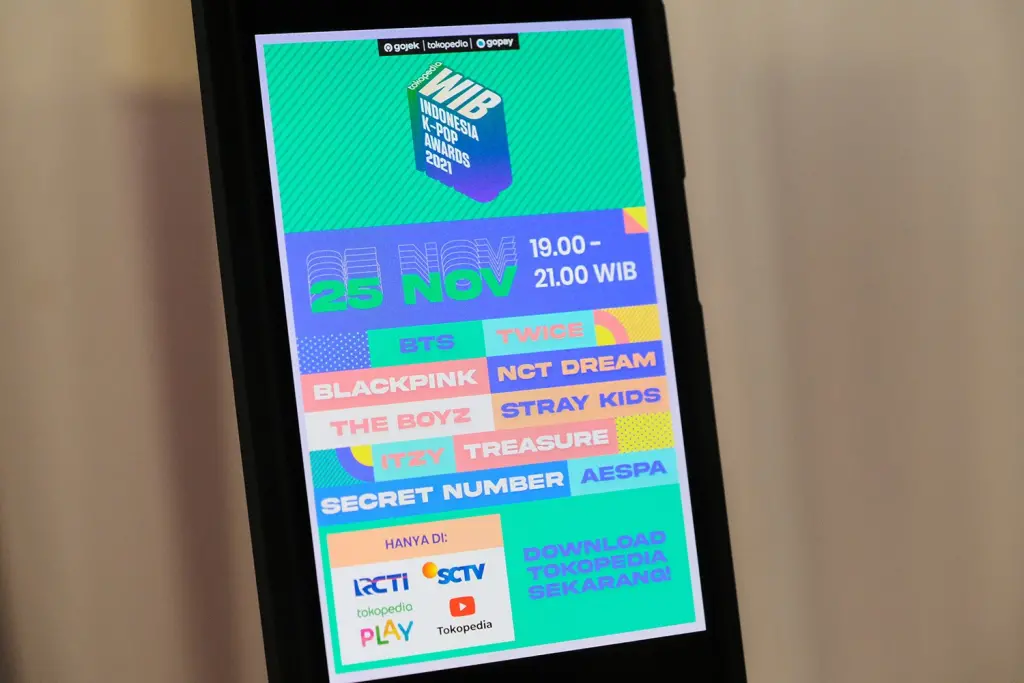
Photo credit: Tokopedia
By bringing K-pop idols onto Tokopedia’s platform, the firm achieves several things. Aside from attracting customers through the deals available during the program, it also propels Tokopedia onto the international stage, allowing fans from outside Indonesia to learn more about the company when they tune in to watch their favorite stars perform.
“While Tokopedia operates only in Indonesia, it shows people that Indonesia is home to businesses that can attract global stars to work with and collaborate with them,” explains Kitti. “Indonesian fans also feel proud that a local company is able to do something of this scale, which helps create brand loyalty.”
While coordinating and monitoring performances between South Korea and Indonesia has been challenging, especially in the face of the ongoing Covid-19 pandemic, Tokopedia’s efforts in using K-pop as part of its marketing strategy have paid off.
Though unable to disclose any specific numbers, Kitti reveals that WIB often marks the biggest sales period for Tokopedia every month.
“In terms of business performance – traffic, number of orders, number of new customers coming on board, et cetera – that period is when all these numbers peak,” she shares.
An incentive to try
Aside from being a means of getting Tokopedia’s name out there and creating brand loyalty, the firm also leverages the power of the K-wave in getting users to try out new offerings on the platform.
For example, when Tokopedia wanted to get more customers to order products available through TokoCabang, its fulfillment and warehousing service, it created a photocard campaign to incentivize K-pop fans to use the service.
K-pop photocards function similarly to trading cards, featuring exclusive images of the celebrities in question. Some cards are harder to acquire than others, being limited to particular events or brands.
Tokopedia created exclusive photocards of BTS for its campaign on TokoCabang, offering limited-time opportunities to acquire these cards as a gift when customers bought an item available through the fulfillment service.
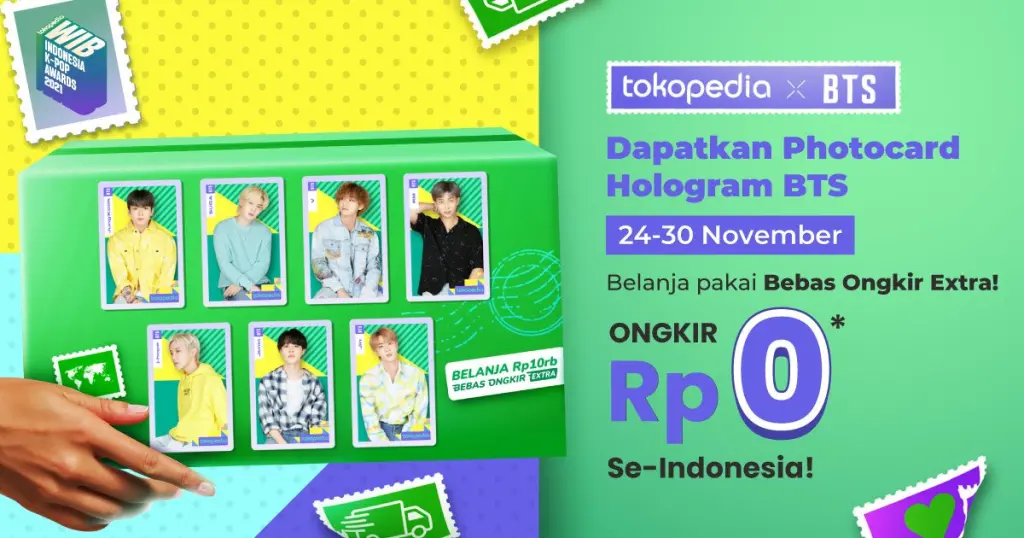
Photo credit: Tokopedia
“It creates a good experience for users,” explains Kitti. “If a user is signing up and trying out TokoCabang for the first time, they’re able to get a product they need, they experience the benefits of being serviced by TokoCabang’s free, speedy, and quality delivery – and, of course, they get a photocard of their favorite K-pop idol.”
From her perspective, a new user may try out TokoCabang because of the photocard, but after using the service and enjoying its benefits, they’re more likely to return and purchase other items.
Tokopedia has seen success with the strategy – certain BTS photocards sold out within minutes from launch. However, the promotion created some unforeseen challenges for the firm.
“You do have fans who are unhappy about things selling out so quickly,” says Kitti. “But we use it as an opportunity to learn, to improve the mechanics of how these campaigns work, so that we can come back with better mechanics.”
Riding the K-wave
On top of working with K-pop celebrities, Tokopedia is also exploring other facets of K-entertainment.
The firm recently launched Mantul House, a talk show available on Tokopedia Play. The show brings in actors from popular K-dramas to chat with a host, play games, and experience Indonesian culture, such as through sampling the country’s cuisine.
“The K-wave is here to stay, and we hope to keep finding new and unexpected ways to connect with fans and customers,” says Kitti. “We plan on experimenting with different formats and seeing what new trends come up.”
Kitti’s hopes that through these efforts, Tokopedia will serve as a bridge between Indonesia and the rest of the world.
“We want to bring more Indonesian culture into the mix along with these K-entertainment stars. It’s not just about getting more customers on board, it’s also about bringing Indonesia to a larger audience,” she concludes.
Tokopedia is an Indonesian tech company with the country’s biggest marketplace. Its mission is to democratize commerce through technology.
Find out more about Tokopedia on its website.
This content was produced by Tech in Asia Studios, which connects brands with Asia’s tech community. Learn more about partnering with Tech in Asia Studios.
Stay updated on the go with our mobile app.
Get latest insights with smoother, more personalized experience through TIA mobile app.
Recommended reads
 Fave names ex-Touch ‘n Go exec as chief product officer
 How ecommerce firms can get the most bang for their buck with digital advertising
 How great marketing builds bridges between brands and audiences
 Carousell names Ox Street founder as head of luxury
 Temu’s US Super Bowl ad intensifies battle with Shein
 Can Sociolla become the AWS for smart retail?
 400m Indians use WhatsApp, but will they shop on it?
 Shopee emerges as no. 1 liveselling platform in SEA survey
 Vertex Ventures backs Indian WhatsApp-based ecommerce startup
 Tracking Southeast Asia’s thriving ecommerce logistics




Editing by Winston Zhang and Lorenzo Kyle Subido
(And yes, we’re serious about ethics and transparency. More information here.)