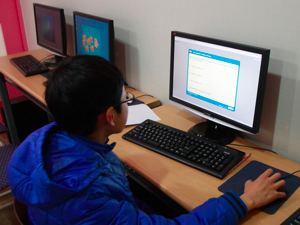
 15-year old students from sixteen countries have had their digital literacy put to the test, and Korean kids came out on top – displaying that they possess the most adeptness at using the internet productively for school work and research.
The Organisation for Economic Co-operation and Development (OECD) tasked the students with “evaluating information on the Internet, assessing its credibility and navigating webpages to test their digital reading performance.” Those are all key skills in the digital era, where the internet is a source of information that needs to be used as carefully and judiciously as any library. Print reading skills were also gauged, as part of the test’s focus on using learning resources.
All too often, the internet and other digital devices get a bad rap for assisting in cheating – although that does admittedly happen sometimes – so it’s nice to see that kids can be allowed to use Wikipedia, and other major sources of information, without getting a teacherly talking-to.
Aside from being good news for Korea, there’s also a merit point for female students around the world. The OECD website today notes:
Girls performed better than boys in every economy, but the difference was less marked than in print reading: girls scored an average of 24 points more, compared to a difference of 39 points in print, the equivalent to one year of schooling. Harnessing boys’ relatively strong digital reading performance may be a way to improve their overall reading ability and engagement, says the [OECD’s Programme for International Assessment] report.
Closely trailing their Korean counterparts came kids from New Zealand, Australia, Japan, Hong Kong (China), and Iceland. So, good news for Asian kids, nabbing 1st, 4th and 5th places in the top 6 rankings.
Remarkably, the OECD found that computer usage at home – where productive – was massively helpful to the students, whilst schools’ deployment of computers and the web was somewhat lacking. The OECD report’s introduction suggests:
To help students at school, computer use should be integrated into curricula, and more invested in training teachers to use them for teaching and to help students learn.
Thirteen OECD member countries took part in this test – Australia, Austria, Belgium, Chile, Denmark, France, Hungary, Iceland, Ireland, Japan, Korea, New Zealand, Norway, Poland, Spain and Sweden – as well as three non-member economies – Colombia, Hong Kong SAR (China), and Macao SAR (China).





Stay updated on the go with our mobile app.
Get latest insights with smoother, more personalized experience through TIA mobile app.












📅 Upcoming Events
22 October 2026
Payoneer x CSPN Summit 2026